Affiliate disclosure: As an Amazon Associate, we may earn from qualifying purchases. This does not affect the price you pay or which products are retained in this comparison.
If you want a standalone full-house dehumidifier without adding a ducted HVAC system, focus on moisture-removal capacity, room layout, drainage, operating temperature, and where the unit will sit. The seven models below are large-area portable or crawl-space dehumidifiers suited to basements, garages, workshops, crawl spaces, and open home layouts.
These are not conventional ducted whole-home dehumidifiers. A single standalone unit may influence a large open area, but it cannot reliably distribute dry air through several closed rooms or floors without sufficient airflow.
Quick verdict: The Waykar 120-Pint Energy Star Dehumidifier is the most balanced portable pick because it combines high listed output, broad coverage, a collection tank, continuous drainage, and easier placement than a commercial crawl-space machine.
Choose the HBN 125-Pint when condensate must be pumped upward. Choose the Waykar 125-Pint Crawl Space Dehumidifier for a fixed gravity-drain installation below the living area. The AEOCKY 50-Pint is a more manageable choice for a smaller home or medium basement.
Important: Coverage and pint figures are manufacturer-listed maximums. Actual performance depends on temperature, relative humidity, airflow, layout, and the test conditions used for the rating.
Key Takeaways
- Use a portable model for a large open basement, garage, or central living area.
- Use a crawl-space model for continuous fixed operation and direct drainage.
- Choose a built-in pump only when gravity cannot carry water to the drain.
- Compare capacity test conditions rather than relying only on the largest pint number.
- Fix leaks, seepage, and drainage problems instead of expecting a dehumidifier to overcome an active water source.
Quick Comparison of the Best Standalone Full-House Dehumidifiers
| Product | Best For | Listed Coverage | Listed Maximum Capacity | Drainage |
|---|---|---|---|---|
| Waykar 120-Pint | Best Overall Portable Pick | Up to 6,000 sq. ft. | Up to 120 pints/day | Tank or gravity hose |
| AEOCKY RHEA-002 | Best Efficiency-Focused Pick | Up to 5,500 sq. ft. | Up to 105 pints/day | Tank or gravity hose |
| HBN 125-Pint | Best With Built-In Pump | Up to 5,900 sq. ft. | Up to 125 pints/day | Gravity hose or pump |
| Waykar 125-Pint Crawl Space | Best Fixed Crawl-Space Pick | Up to 6,500 sq. ft. | Up to 125 pints/day | Gravity drain hose |
| Kesnos 80-Pint | Best Front Humidity Display | Up to 5,500 sq. ft. | Up to 80 pints/day | Tank or gravity hose |
| Vellgoo 64-Pint | Best Moderate-Capacity Pick | Up to 4,000 sq. ft. | Up to 64 pints/day | Tank, included hose, or compatible garden hose |
| AEOCKY BOREAS-001 | Best for Smaller Open Layouts | Up to 3,500 sq. ft. | Up to 50 pints/day | Tank or gravity hose |
Capacity note: The maximum figures above may be measured under warm, highly humid conditions and should not automatically be treated as standardized basement-condition ratings. Confirm the linked model’s current specification sheet before comparing two products directly.
How These Products Were Compared
The ranking emphasizes relevance to large residential areas, maximum moisture-removal capacity, drainage flexibility, placement, automatic controls, cold-area features, and honest limitations. Square-foot coverage was treated as a screening estimate rather than guaranteed whole-home performance.
Waykar 120-Pint Energy Star Dehumidifier for Homes
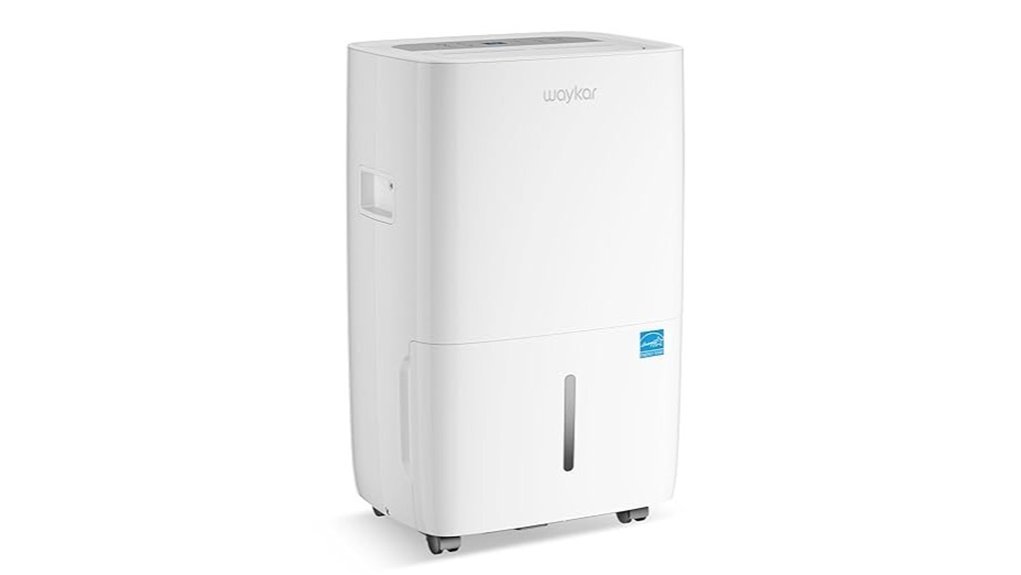
Best Overall Portable Pick
Waykar’s 120-pint model is the strongest all-around option for a large basement, open-plan home, garage, laundry area, or workshop. The manufacturer lists coverage up to 6,000 sq. ft. and moisture removal up to 120 pints per day at 95°F and 90% relative humidity.
The listed equipment includes a 1.14-gallon tank, an included gravity-drain hose, auto-defrost, adjustable humidity control, and a 90-degree auto-swing outlet. These features provide a useful balance of high maximum output, portable placement, air movement, and hands-off drainage.
Why You’ll Like It: It offers more placement flexibility than a fixed commercial crawl-space unit while still providing the high listed output needed for a broad, persistently damp area.
Best For: Large basements, open living areas, garages, workshops, laundry areas, or homeowners who want a movable high-capacity compressor model.
Who Should Avoid It: Buyers seeking a duct-connected HVAC dehumidifier, installations requiring pumped drainage, or anyone treating only one small room.
Pros:
- High listed maximum capacity and broad 6,000-square-foot coverage claim.
- Supports tank collection or continuous gravity drainage.
- Auto-defrost and adjustable airflow improve large-area convenience.
- Easier to reposition than a metal crawl-space dehumidifier.
Cons:
- The 120-pint figure is based on hot, highly humid conditions.
- One unit may not control closed bedrooms or several floors evenly.
- The tank requires frequent emptying when continuous drainage is not used.
- No built-in condensate pump is specified for this linked model.
AEOCKY RHEA-002 5,500 Sq. Ft. Dehumidifier With Drain Hose
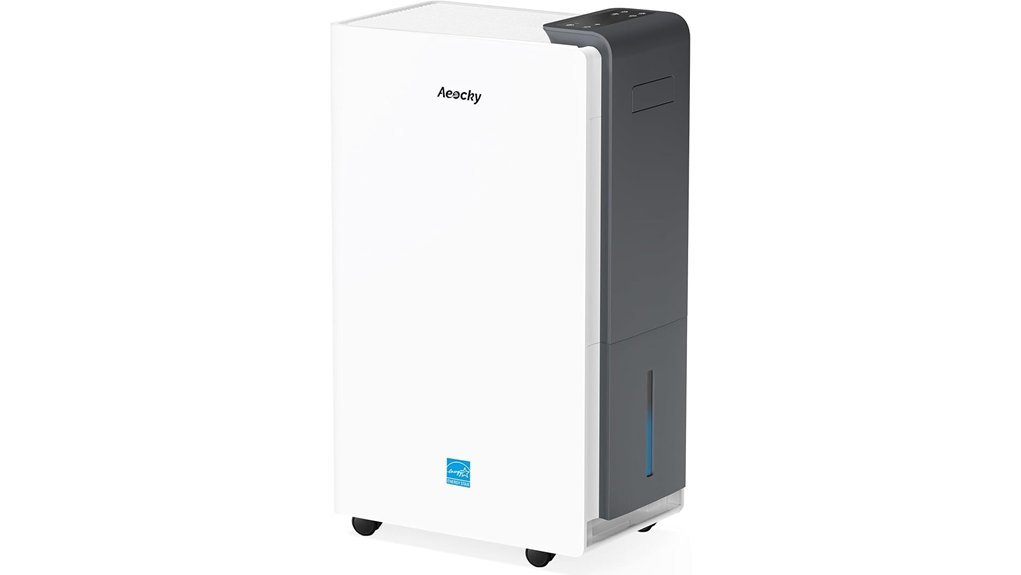
Best Efficiency-Focused Pick
The AEOCKY RHEA-002 is a practical choice when operating efficiency matters alongside moisture-removal capacity. The manufacturer lists coverage up to 5,500 sq. ft., maximum extraction up to 105 pints per day at 95°F and 95% relative humidity, and approximately 72 pints per day at 86°F and 80% relative humidity.
It also includes automatic humidity control, continuous-drain support, a portable cabinet, and advertised three-year machine coverage. Its ENERGY STAR Most Efficient 2024 designation is useful supporting information, but buyers should still confirm the current certification attached to the exact linked model.
Why You’ll Like It: The listing provides more context than most by showing performance under two conditions, making it easier to understand how the maximum figure differs from more moderate operation.
Best For: Energy-conscious homeowners with a large basement, garage, open living area, or persistent seasonal humidity.
Who Should Avoid It: Buyers who need pumped drainage above the machine or a compact appliance for one small bedroom.
Pros:
- Large listed coverage area and high maximum extraction.
- Provides a second capacity figure under less extreme conditions.
- Automatic humidity management supports set-and-maintain operation.
- Continuous drainage reduces the need to empty the tank manually.
Cons:
- The 105-pint claim is not the expected output in a cool basement.
- No built-in pump is highlighted for this linked model.
- The certification year and warranty conditions should be checked before ordering.
- It remains a standalone appliance rather than a ducted whole-home system.
HBN Crawl Space Dehumidifier 125 Pints With Pump
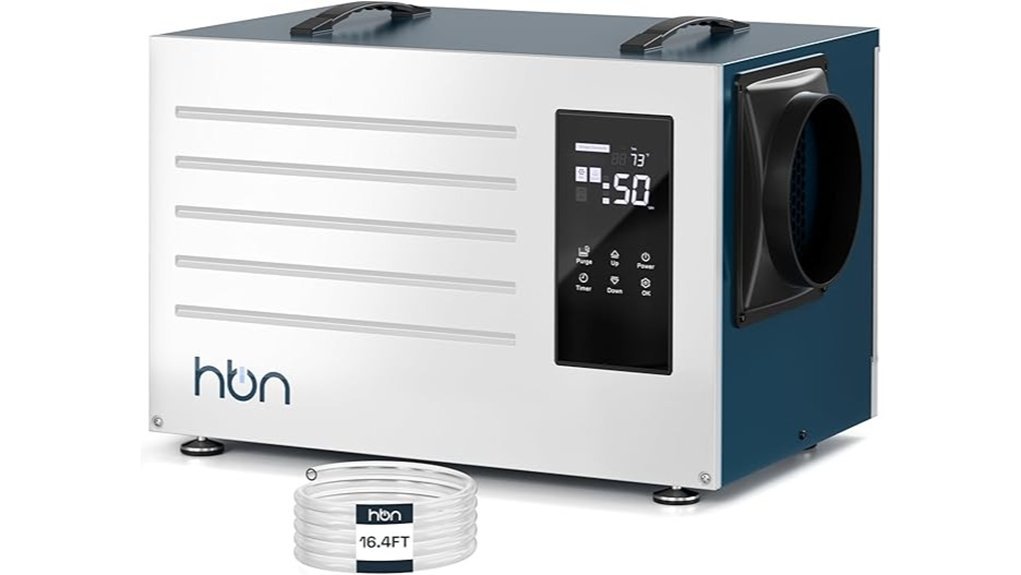
Best With Built-In Pump
The HBN is the most flexible drainage choice in this lineup. Its listing specifies maximum moisture removal up to 125 pints per day in hot, humid test conditions and coverage up to 5,900 sq. ft.. It includes both a gravity drain and a built-in condensate pump.
The pump is the main buying reason. It can move collected water upward when the available sink, standpipe, or remote drain is above the machine. The unit also lists touchscreen controls, a 24-hour timer, a washable filter, adjustable feet, and a connection for an optional wired controller.
Why You’ll Like It: The built-in pump removes one of the biggest installation barriers in basements, crawl spaces, workshops, and utility areas without a nearby floor drain.
Best For: Crawl spaces, basements, warehouses, workshops, garages, and installations that need water pumped to a higher drain point.
Who Should Avoid It: Buyers who want a lightweight room appliance, do not need pumped drainage, or have only mild seasonal humidity.
Pros:
- Built-in pump and gravity drainage support more installation layouts.
- High listed maximum capacity for persistently damp utility spaces.
- Commercial-style metal construction suits fixed operation.
- Includes timer and automatic humidity controls.
Cons:
- Requires more installation planning than a portable tank-based appliance.
- Less convenient for room-to-room movement.
- The 125-pint figure is based on very warm, humid conditions.
- Its commercial form factor may be excessive for a normal bedroom or apartment.
Waykar 125-Pint Crawl Space Dehumidifier With Drain Hose
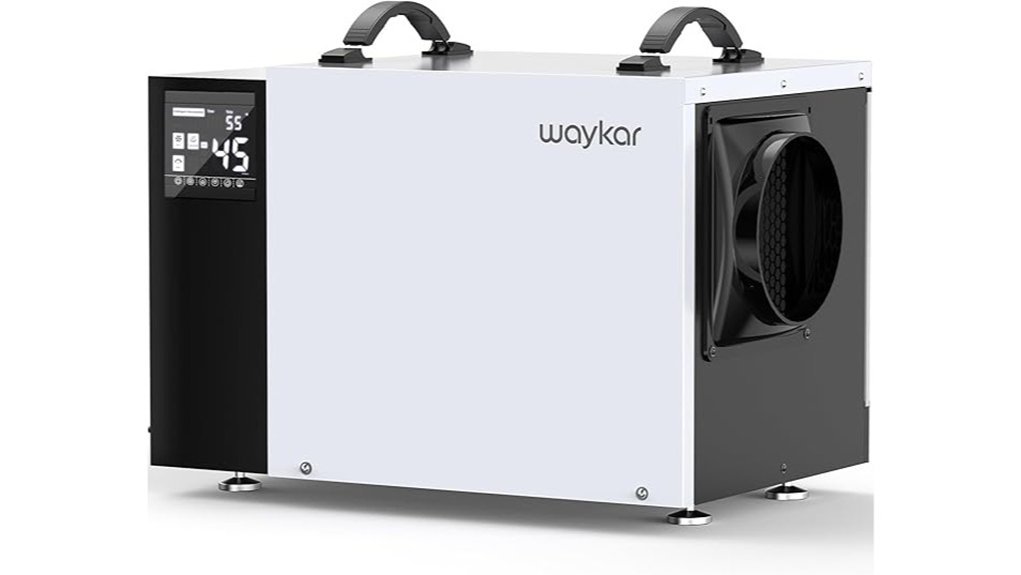
Best Fixed Crawl-Space Pick
The Waykar 125-Pint Crawl Space Dehumidifier is intended for fixed moisture control in crawl spaces, basements, storage areas, garages, commercial rooms, and water-damage applications. The listing specifies coverage up to 6,500 sq. ft., maximum removal up to 125 pints per day, an included drain hose, and a compact metal cabinet.
This linked product is positioned as a gravity-drain model. Waykar also sells similarly named pump versions, so compare the model number, included hoses, and drainage description carefully before ordering.
Why You’ll Like It: It prioritizes continuous fixed operation and a compact utility-space footprint instead of a large collection tank or decorative living-space cabinet.
Best For: Encapsulated crawl spaces, large basements, garages, storage areas, workshops, and property-maintenance use with a suitable gravity drain.
Who Should Avoid It: Buyers who need condensate pumped upward or want a portable appliance with a removable collection bucket.
Pros:
- High listed maximum output and broad coverage claim.
- Low-profile crawl-space form factor supports fixed placement.
- Continuous gravity drainage suits unattended operation.
- Designed for utility and commercial-style environments.
Cons:
- Requires a reliable downward drain route unless an external pump is installed.
- Not designed for casual room-to-room portability.
- The advertised coverage terms should be checked on the exact linked ASIN.
- Any advertised multi-year quality coverage may require registration and may not equal a full parts-and-labor warranty.
Model check: Confirm whether the linked listing is the non-pump AFW2.0D version or another Waykar 125-pint variant. Similar product titles may describe different drainage hardware.
Kesnos 80-Pint Energy Star Dehumidifier for Home and Basement
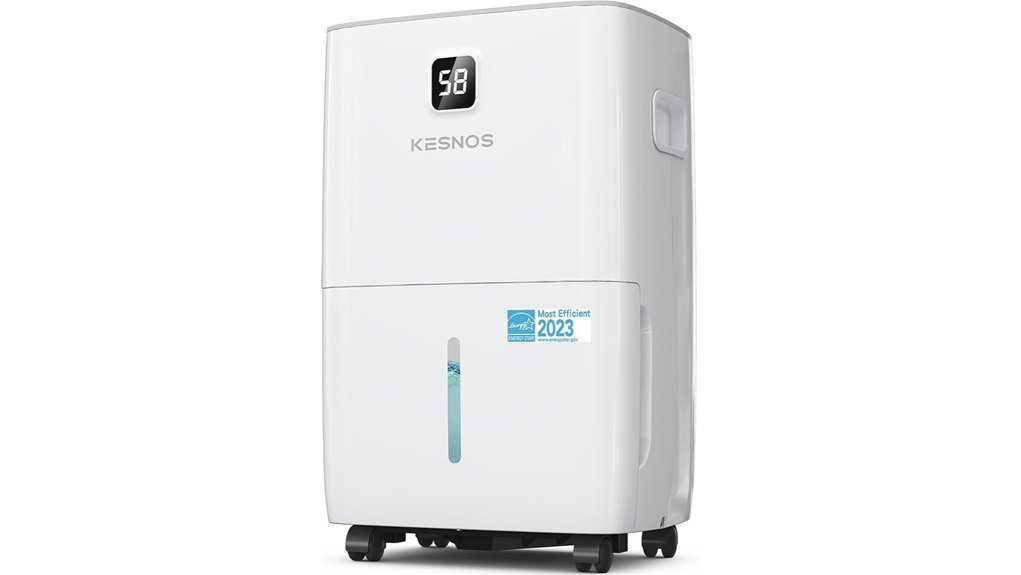
Best Front Humidity Display
The Kesnos 80-Pint model is a user-friendly choice for large home areas where you want to see the approximate humidity reading from across the room. Its listing specifies coverage up to 5,500 sq. ft., maximum moisture removal up to 80 pints per day at 95°F and 90% relative humidity, a front display, a 1.06-gallon tank, auto-defrost, and an included drain hose.
Why You’ll Like It: The front display simplifies monitoring, while the casters, bucket, and hose provide more placement flexibility than a fixed crawl-space machine.
Best For: Large basements, open home areas, garages, laundry areas, and buyers who value visible controls and portable placement.
Who Should Avoid It: Low-clearance crawl-space installations, applications requiring pumped drainage, or very wet spaces needing greater standardized capacity.
Pros:
- Large 5,500-square-foot manufacturer coverage claim.
- Front humidity display supports quick visual checks.
- Tank and drain hose allow manual or continuous collection.
- Auto-defrost is useful for cooler basement operation within the approved temperature range.
Cons:
- The bucket may fill quickly in heavy humidity if the hose is not connected.
- No built-in condensate pump is listed.
- The maximum capacity is based on hot, humid conditions.
- Room separation can reduce its influence beyond the installation area.
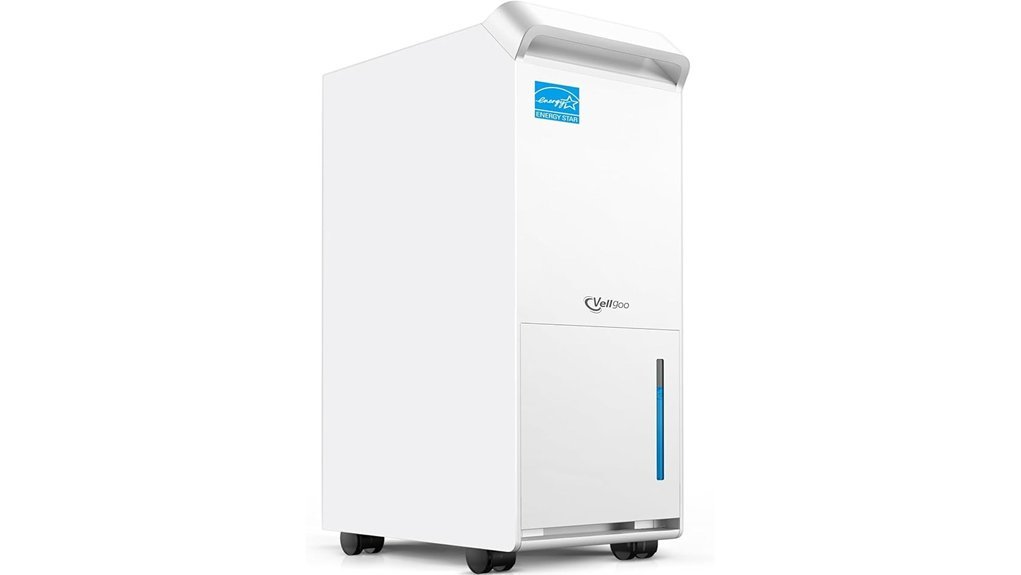
Vellgoo 4,000 Sq. Ft. 64-Pint Dehumidifier With Drain Hose
Best Moderate-Capacity Pick
Vellgoo’s linked model is listed as a 64-pint maximum dehumidifier for spaces up to 4,000 sq. ft.. It provides a more moderate alternative to the 100-plus-pint machines while retaining automatic humidity control, auto-defrost, automatic restart, and continuous drainage.
The listing describes three collection methods: the removable tank, the included drain hose, or a compatible standard garden hose using the appropriate connection or adapter.
Why You’ll Like It: It offers a practical middle ground for buyers who need more than a basic room unit but do not need the weight, output, or installation demands of a commercial crawl-space model.
Best For: Medium-to-large basements, garages, laundry areas, open-plan homes, and buyers who want flexible gravity drainage.
Who Should Avoid It: Very large wet spaces, active water-damage projects, or installations requiring condensate to be pumped upward.
Pros:
- More manageable capacity and form factor than the commercial-style picks.
- Provides tank, included-hose, and compatible garden-hose drainage choices.
- Automatic restart and humidity controls support routine operation.
- Suitable for buyers who do not need a 100-plus-pint maximum claim.
Cons:
- Lower maximum output than the 80- to 125-pint options.
- No built-in condensate pump.
- Still cannot distribute treated air evenly through closed rooms.
- Certification badges and included adapters should be confirmed on the current listing.
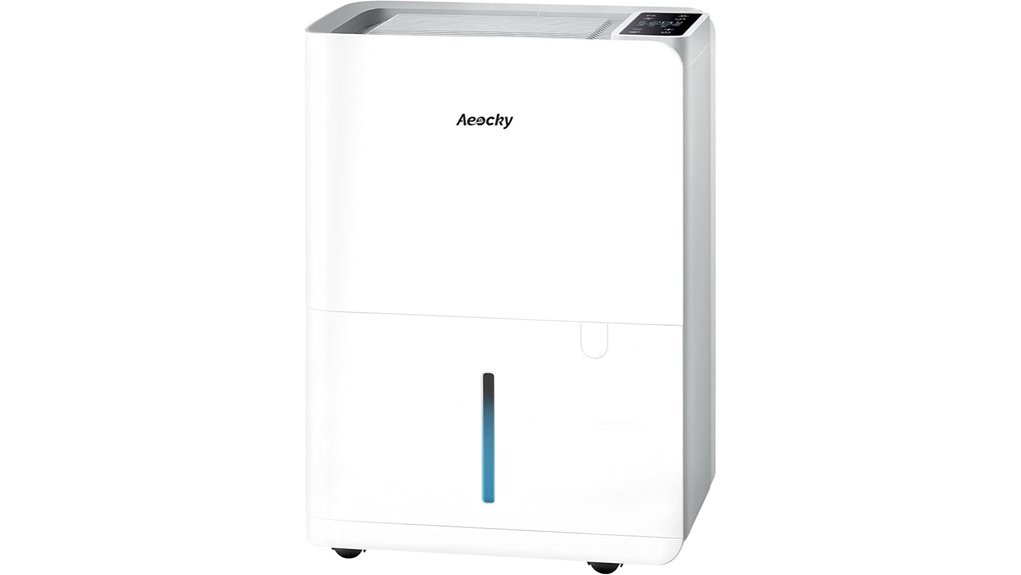
AEOCKY BOREAS-001 50-Pint Dehumidifier for 3,500 Sq. Ft.
Best for Smaller Open Layouts
The AEOCKY BOREAS-001 is the smallest suitable large-area option in this comparison. Its listing specifies coverage up to 3,500 sq. ft., maximum extraction up to 50 pints per day, a 0.8-gallon tank, drain hose, garden-hose adapter, automatic humidity control, and operation around 40 dB under the listed conditions.
It makes the most sense for a smaller single-level home, medium basement, open apartment, or garage where the 80- to 125-pint maximum models would be unnecessarily large.
Why You’ll Like It: It provides continuous drainage and automatic humidity control without the size and industrial appearance of a commercial crawl-space machine.
Best For: Smaller homes, apartments with open layouts, medium basements, garages, and buyers who prioritize manageable size and lower listed noise.
Who Should Avoid It: Large multi-level homes, severe seepage, water-damage drying, or crawl spaces requiring pumped drainage.
Pros:
- More manageable capacity and cabinet size for smaller spaces.
- Includes a bucket, drain hose, and garden-hose adapter.
- Automatic humidistat supports target-humidity control.
- Lower listed noise than many commercial-style units.
Cons:
- Lowest maximum extraction capacity in this comparison.
- May struggle to influence closed rooms away from the installation area.
- No built-in condensate pump.
- The 50-pint figure remains dependent on the stated test conditions.
Factors to Consider When Choosing a Standalone Full-House Dehumidifier
The best unit is not necessarily the one with the largest coverage or pint number. Match the dehumidifier to the home’s layout, moisture severity, temperature, airflow, drainage route, noise tolerance, and maintenance needs.
Portable Versus Ducted Whole-House Systems
The products in this guide are standalone portable or crawl-space dehumidifiers. A conventional whole-home dehumidifier normally connects to an HVAC system or dedicated ducts so treated air can be distributed through several rooms.
Choose a standalone model for a basement, crawl space, garage, workshop, or large open central area. Consider professional HVAC sizing when you need balanced humidity throughout multiple floors or many rooms that usually remain closed.
Coverage Area and Layout
Coverage is a manufacturer estimate, not a guarantee. Compare it with the actual conditioned area, ceiling height, door positions, airflow paths, and source of the moisture.
An open basement allows one machine to influence a broad area. Closed doors, finished rooms, stairways, and separate floors can require fans, transfer grilles, a second unit, or a ducted system.
Moisture Severity Matters More Than Square Footage Alone
A 2,000-square-foot area with seepage, wet floors, or indoor laundry drying can create a heavier moisture load than a larger area that is only mildly humid. Look for the source of the moisture and estimate how much water the existing unit collects each day when replacing a dehumidifier.
Daily Moisture Removal and Test Conditions
Capacity is reported in pints per 24 hours, but not all figures use the same test conditions. Several products in this guide advertise a hot-humid maximum measured around 90°F to 95°F and 90% relative humidity or higher.
Performance in a cooler basement can be substantially lower. Compare standardized capacity figures when available, and never confuse the daily extraction rating with the volume of the removable tank.
Energy Efficiency
For a dehumidifier that may operate for many hours, look for current ENERGY STAR certification, an efficient compressor, automatic humidistat control, and capacity appropriate for the moisture load.
An undersized machine may run continuously without reaching its target. A much larger appliance may cost more, occupy more space, and produce more noise than the application requires. Avoid exact savings promises unless they reflect your electricity rate and operating schedule.
Drainage Options
Continuous drainage is important for large-area operation. Gravity drainage requires the hose to run continuously downward without loops, kinks, or a raised outlet.
A built-in pump is useful when water must travel upward to a sink, standpipe, window, or remote drain. Check the included hose length, lift limit, fitting type, and whether an adapter is required for a standard garden hose.
Noise and Placement
Large compressor dehumidifiers contain a fan and refrigeration system, so even a model marketed as quiet may be noticeable in a bedroom, office, or television area.
Place the unit on a level surface with the manufacturer-required clearance around the intake and outlet. Compare decibel specifications under the same fan setting where possible.
Humidity Controls
A built-in humidistat should allow you to choose a target relative humidity and cycle the compressor automatically. A broad indoor target is approximately 30% to 50% relative humidity.
Beginning near 45% to 50% during a humid season is practical for many homes, but adjust the setting for condensation, climate, comfort, and building conditions. A separate hygrometer placed away from the machine can help verify conditions elsewhere in the room.
Cold Basement and Crawl-Space Performance
Compressor dehumidifiers remove less moisture as temperatures fall and may develop frost on the coil. Auto-defrost helps, but it does not remove the need to follow the specified minimum operating temperature.
Confirm the exact temperature range before using a model in an unheated basement, garage, or crawl space.
Safety and Automatic Features
Useful features include bucket-full shutoff, auto-defrost, power-outage memory, timer control, child lock, automatic restart, washable filters, and overheat protection.
Use a properly grounded outlet and follow all clearance, drainage, filter-cleaning, and extension-cord instructions. A dehumidifier can control airborne moisture, but it cannot repair leaks, flooding, foundation seepage, or hidden water damage.
Portability and Maintenance
Choose casters and sturdy handles when you expect to move the machine. For a fixed crawl-space installation, prioritize a durable cabinet, accessible filter, reliable drainage, and enough service clearance.
Clean the filter on the manufacturer’s schedule, inspect drain hoses for algae or clogs, and wash and dry the tank regularly when manual collection is used.
Warranty and Exact Model Number
Confirm the exact model number shown on the Amazon listing rather than relying only on a broad product title. Similar-looking variants may differ in capacity, pump inclusion, hose length, certification, controls, or warranty.
Check whether advertised coverage requires product registration and whether it includes parts, labor, replacement, shipping, or technical support.
Before You Buy Checklist
- Measure the actual problem area rather than the entire property footprint.
- Note whether interior doors normally remain open or closed.
- Determine whether the space is mildly damp, very damp, or actively wet.
- Identify a safe gravity drain or confirm that a pump is necessary.
- Compare capacity ratings measured under similar conditions.
- Confirm the minimum operating temperature for a cold basement or crawl space.
- Check the dimensions, airflow clearance, noise rating, voltage, and outlet requirements.
- Verify hose length, connection type, filter access, model number, and warranty terms.
- Repair leaks, poor grading, drainage faults, and other moisture sources.
Frequently Asked Questions
Are These True Ducted Whole-House Dehumidifiers?
No. The products reviewed here are large-area portable or crawl-space units. They can control humidity in an open basement, garage, crawl space, workshop, or central area, but they do not automatically distribute dry air through HVAC ducts.
Can One Portable Dehumidifier Control an Entire House?
It may influence a smaller, open single-level layout when air can move freely. It is much less likely to maintain the same humidity through several closed bedrooms, stairways, or floors. Those layouts may require additional airflow, more than one unit, or a ducted system.
How Often Should I Clean the Filter?
Inspect the filter every two to four weeks during regular use and clean it according to the manufacturer’s instructions. Pets, construction dust, workshops, and continuous operation may require more frequent maintenance.
Can a Dehumidifier Help With Musty Odors?
Reducing humidity can make the environment less favorable for persistent mustiness, but a dehumidifier does not remove existing contamination or repair the moisture source. Clean affected materials safely and correct leaks, seepage, condensation, or drainage faults.
Should I Choose a Standalone or Ducted Whole-House Dehumidifier?
Choose a standalone unit for one large problem area, lower installation complexity, or a basement or crawl space that produces most of the home’s humidity. Consider a professionally sized ducted system when several floors or many closed rooms require consistent control.
What Humidity Level Is Best for a Home?
A general target is between 30% and 50% relative humidity. Starting near 45% to 50% during humid weather works for many homes, but adjust the setting to prevent condensation and maintain comfort.
Do Dehumidifiers Work in Cold Basements?
They can, but compressor models generally collect less water and are more likely to frost as the temperature falls. Select a machine with auto-defrost and verify its minimum operating temperature before using it in a cold basement, garage, or crawl space.
Is a Built-In Pump Worth It?
A pump is useful when the drain is above the dehumidifier or when the hose cannot maintain a continuous downward slope. For a nearby floor drain or sump, gravity drainage is usually simpler and introduces fewer components that can require service.
Why Is the Water Tank Smaller Than the Daily Pint Rating?
The daily rating describes how much moisture the machine may remove over 24 hours under specified test conditions. The tank only stores part of that water, so a high-capacity model may fill its bucket several times per day unless continuous drainage is connected.
Conclusion
The Waykar 120-Pint Energy Star Dehumidifier is the best overall portable choice for a large open home area because it balances listed capacity, coverage, automatic controls, mobility, and gravity drainage.
The HBN 125-Pint is the better choice when collected water must be pumped upward. The Waykar 125-Pint Crawl Space Dehumidifier is better suited to a fixed utility-space installation with a dependable gravity drain. For a smaller home or medium basement, the AEOCKY BOREAS-001 50-Pint offers a more manageable alternative.
Final Recommendation
- Best portable balance: Waykar 120-Pint.
- Best efficiency-focused choice: AEOCKY RHEA-002.
- Best when a pump is required: HBN 125-Pint.
- Best fixed crawl-space choice: Waykar 125-Pint Crawl Space model.
- Best smaller-home alternative: AEOCKY BOREAS-001.
Match the machine to the moisture load, room layout, operating temperature, and drain route. Verify the linked model’s current specifications before ordering, and remember that a standalone dehumidifier is not a substitute for a professionally sized ducted system when every room requires balanced humidity control.