The best reusable dehumidifiers for cars, closets, storage bins, camera gear, safes, and other enclosed spaces use regenerable desiccant that can be dried and used again. The Wisesorb 500g two-pack offers the best balance of capacity and placement flexibility, while the six-pack of 120g color-indicating pouches is better for dividing moisture protection among several small containers. USB-C models provide convenient built-in heat reactivation, and the Wisedry four-pack supplies the most total desiccant for vehicles and multiple storage areas.
Quick Verdict
- Best Overall: Wisesorb Rechargeable Desiccant Packs (500g, 2pcs)
- Best for Several Small Containers: Color-Indicating Desiccant Packs (120g, 6 Pack)
- Best USB-C Two-Pack: 2 Pack Rechargeable Desiccant Dehumidifier
- Best Single USB-C Unit: Kiorafoto USB-C Rechargeable Desiccant Dehumidifier
- Best for Cars and Multiple Spaces: Wisedry 4 x 500g Rechargeable Silica Gel Packs
Important: These are passive desiccant moisture absorbers for enclosed or limited spaces. They are not substitutes for a powered room dehumidifier when you have persistent high humidity, flooding, an active leak, standing water, or widespread mold.
Key Takeaways
- Choose larger 500g bags when capacity matters more than compact size.
- Choose several smaller pouches when you need to protect separate bins, cases, or toolboxes.
- Choose a USB-C unit when you prefer a built-in heater instead of microwave or oven reactivation.
- Plan for downtime because a unit cannot protect its enclosure while it is being reactivated elsewhere.
- Fix leaks, wet materials, blocked drains, and ventilation problems before relying on a passive moisture absorber.
Quick Comparison of Reusable Dehumidifiers
| Product | Format and Amount | Best For | Reactivation | Status Check | Main Limitation | Amazon |
|---|---|---|---|---|---|---|
| Wisesorb 500g, 2pcs | Two flexible 500g fabric packs | Cars, closets, cabinets, and medium-size storage areas | Microwave or oven, following the included instructions | Orange-to-light-green viewing window | Bulky for narrow cases and very small containers | Check Price |
| 120g Color-Indicating, 6 Pack | Six separate 120g flexible pouches | Storage bins, toolboxes, filament boxes, and electronics cases | Use only a method and settings approved in the included instructions | Blue-to-pink indicator | Lower capacity per pouch than a 500g bag | Check Price |
| USB-C Rechargeable, 2 Pack | Two compact rigid desiccant units | Camera cabinets, safes, 3D-filament storage, and small closets | Built-in heater powered through USB-C | Color-changing silica gel | Cannot absorb moisture while being reactivated | Check Price |
| Kiorafoto USB-C Unit | One compact rigid desiccant unit | One small safe, cabinet, camera case, or storage compartment | USB-C built-in heater | Orange-to-green beads | One unit offers less placement flexibility than a multi-pack | Check Price |
| Wisedry 4 x 500g | Four flexible 500g silica-gel packs | Cars, RV storage, closets, garages, and multiple enclosed areas | Microwave or oven, following the included instructions | Weight threshold and included reactivation guidance | Large kit requires more storage and total reactivation time | Check Price |
How We Evaluated These Moisture Absorbers
We compared the product format, stated desiccant quantity, reactivation method, saturation indicator, portability, intended enclosure, placement flexibility, and main limitations. This is an editorial comparison based on available product information, not a claim of hands-on or laboratory testing. Preference was given to products that regenerate their moisture-adsorbing material instead of requiring disposable tablets or replacement granules.
Because Amazon listings and included instructions may change, verify the current bundle, regeneration method, dimensions, safety directions, and included accessories before ordering or heating any product.
What “rechargeable” means here: These products regenerate or dry their desiccant for another use. They do not continuously remove water with a compressor, and the USB-C models generally use electricity only during the reactivation cycle.
Wisesorb Rechargeable Desiccant Packs (500g, 2pcs) Best Overall

The Wisesorb two-pack is a practical all-around choice when you need more capacity than a small packet but still want a portable, non-electric solution. Each flexible fabric pack contains 500g of desiccant. A transparent viewing window changes from orange toward light green as the material adsorbs moisture, giving you a visible reminder that reactivation may be due.
Why You’ll Like It: The two medium-to-large packs can be divided between a car and closet, rotated during reactivation, or used together in a larger enclosed storage area. Their reusable format can reduce the need to keep purchasing disposable moisture absorbers.
Best For: Cars, closets, cabinets, storage areas, and other enclosed spaces where a flexible desiccant bag is easier to place than a rigid device.
Who Should Avoid It: Buyers who need whole-room humidity control or a tiny packet for a narrow electronics or camera case.
Pros:
- Two 500g packs provide useful capacity for medium-size enclosed spaces.
- Transparent color-indicating window helps show when drying may be needed.
- Flexible bags can fit under a car seat or on a closet shelf.
- Reusable through the manufacturer-approved microwave or oven process.
Cons:
- Larger than compact packets and rigid mini units.
- Heat reactivation requires careful timing, supervision, and compliance with the included directions.
- Performance varies with enclosure size, air exchange, temperature, and humidity load.
Color-Indicating Desiccant Packs (120g, 6 Pack) Best for Several Small Containers
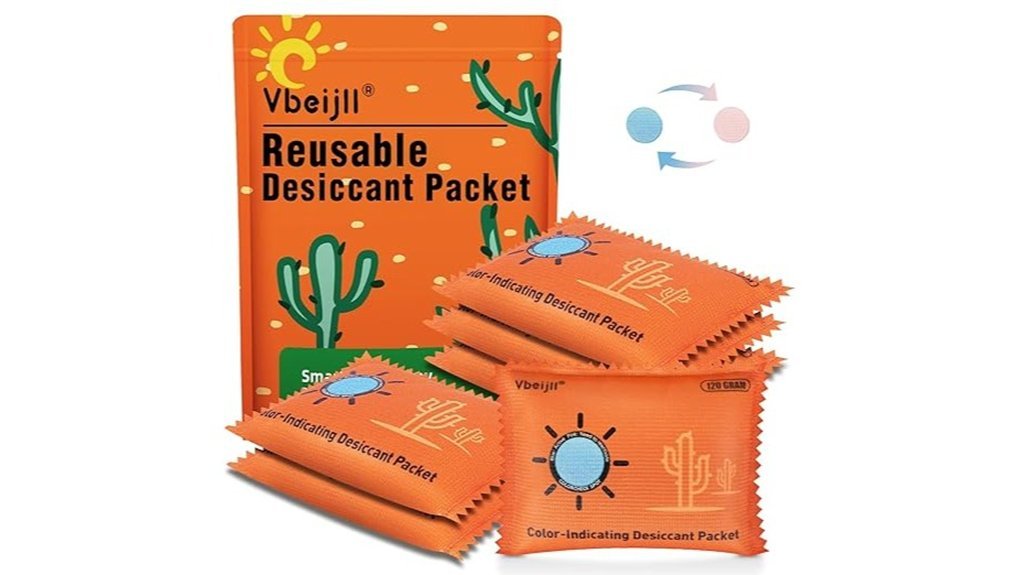
This six-pack gives you several 120g pouches that can be distributed across separate storage containers instead of concentrating all the desiccant in one location. The indicator changes from blue when dry toward pink when saturated, providing a simple visual reminder to check the reactivation instructions.
Why You’ll Like It: The six individually sized pouches are useful when you need moisture protection in several toolboxes, filament bins, camera cases, document boxes, or electronics containers. You can also reactivate one or two packs without removing every pouch from service.
Best For: Buyers who want flexible placement across several small enclosed storage areas.
Who Should Avoid It: Anyone trying to control humidity in a large room, open basement, or continuously damp area.
Pros:
- Six separate pouches make it easy to cover multiple containers.
- Blue-to-pink indicator makes saturation easier to identify.
- Smaller pouches fit places where a 500g bag may be too bulky.
- Regenerable design reduces reliance on single-use packets.
Cons:
- Each 120g pouch has less working capacity than a 500g bag.
- Heat may damage the pouch if the approved settings are not followed.
- Several packs may be needed in a larger or less tightly sealed enclosure.
2 Pack Rechargeable Desiccant Dehumidifier with USB-C Cable Best USB-C Two-Pack
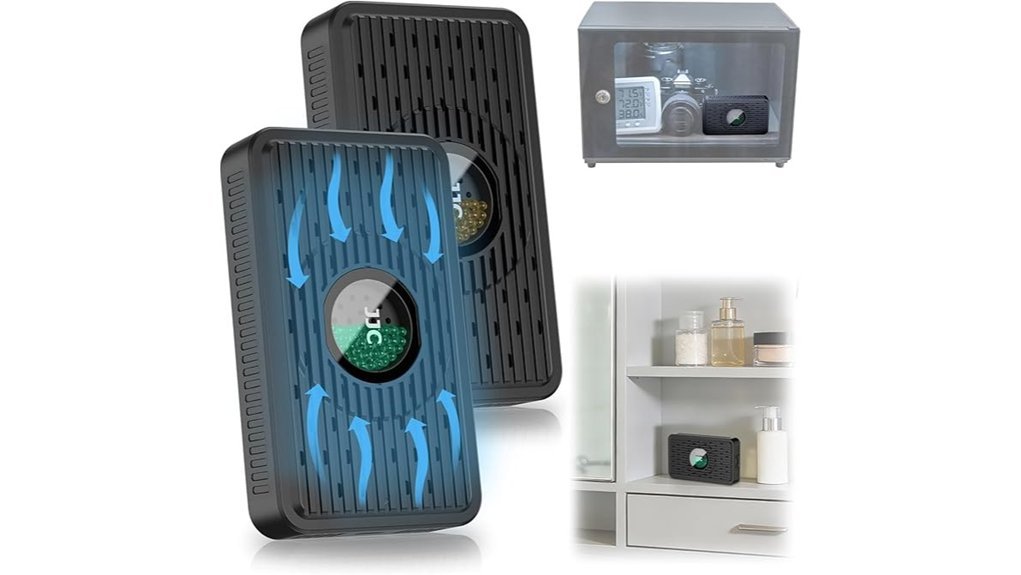
This two-pack uses color-indicating silica gel inside compact rigid housings. During normal use, the units adsorb moisture without a power cord. When the indicator shows saturation, the built-in heater can be powered through USB-C to dry the desiccant for reuse. The listing describes a typical reactivation window of approximately 2 to 6 hours, but actual drying time can vary.
Why You’ll Like It: USB-C reactivation avoids placing a fabric pouch in a microwave or oven. Two units also let you protect separate storage spaces or rotate one into service while the other is being dried.
Best For: Camera cabinets, small safes, 3D-filament boxes, electronics storage, and compact closets.
Who Should Avoid It: Buyers who need immediate, continuous dehumidification or moisture removal from an entire room.
Pros:
- Two compact units support separate spaces or alternating use.
- USB-C built-in heaters simplify the reactivation process.
- Color-changing beads provide a visible saturation cue.
- Rigid housings are easy to position on a shelf or inside a cabinet.
Cons:
- The units do not adsorb moisture while they are being reactivated.
- Reactivation can take several hours.
- Seller-stated coverage should be treated as an enclosure guideline, not a whole-room performance rating.
Kiorafoto USB-C Rechargeable Desiccant Dehumidifier Best Single USB-C Unit
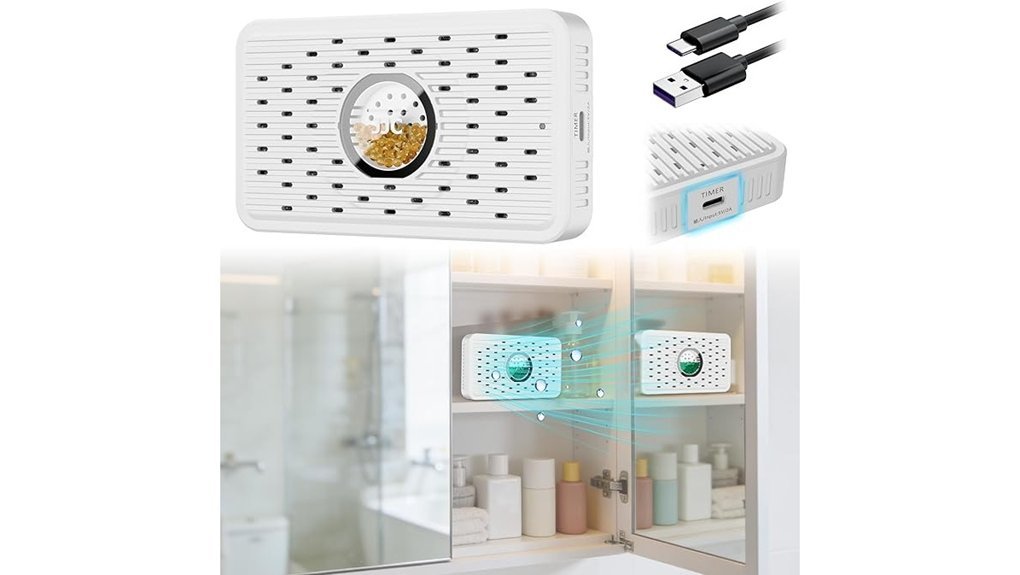
The Kiorafoto rechargeable desiccant unit is a compact option for one small enclosure. It uses color-changing silica gel, a USB-C-powered built-in heater, and listing-stated safety features that include automatic power-off and overheat protection during reactivation. The beads change from orange when dry toward green as they adsorb moisture.
Why You’ll Like It: The slim rigid housing is easy to place in a cabinet, safe, camera case, storage compartment, or small closet. It does not require power while passively managing moisture.
Best For: A single small safe, cabinet, equipment case, RV compartment, or other enclosed storage area.
Who Should Avoid It: Anyone expecting one compact unit to manage an open room, basement, bathroom, or severe moisture source.
Pros:
- Compact rigid design is easy to move between small enclosures.
- USB-C reactivation with a built-in heater.
- Visible orange-to-green moisture indicator.
- Auto-off and overheat-protection features are listed for the drying cycle.
Cons:
- Only one unit is included.
- Capacity is limited compared with multi-pack 500g fabric bags.
- It must be removed from the protected enclosure and placed appropriately for reactivation.
- Listed safety features do not replace following the supplied operating instructions.
Wisedry 4 x 500g Rechargeable Silica Gel Car Dehumidifier Packs Best for Cars and Multiple Spaces
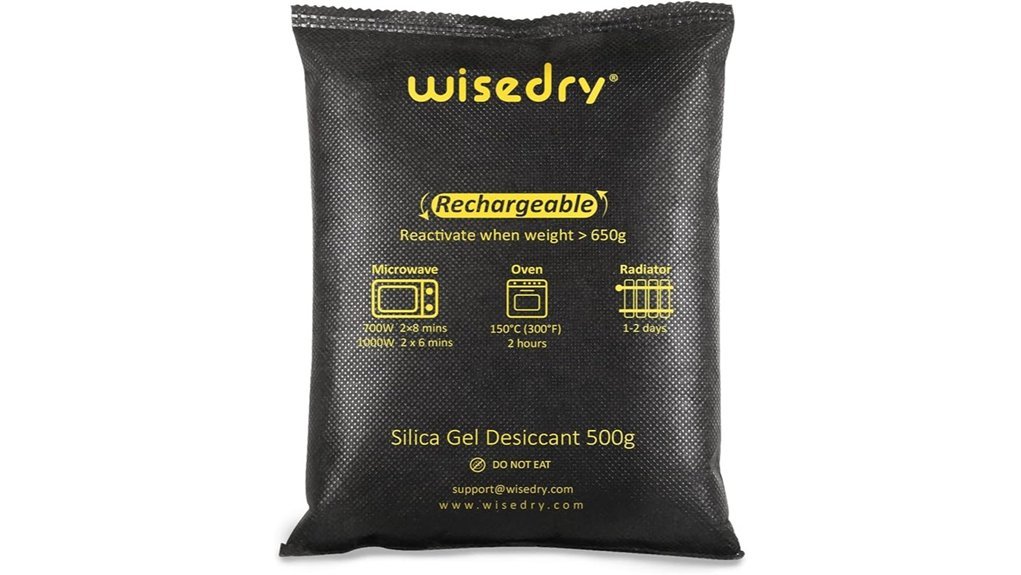
The Wisedry kit includes four 500g silica-gel packs, providing a total desiccant weight of about 4.4 pounds. The listing states that each pack can adsorb around 150g of moisture, with an advertised maximum of up to 180g under suitable conditions. These are seller-stated figures rather than independent laboratory results, and real performance will depend on the enclosure and humidity load.
Why You’ll Like It: Four separately packed bags give you more placement flexibility than one large unit. They can help manage moisture that contributes to interior window condensation, although leaks, wet floor mats, blocked drains, and poor ventilation still need to be corrected.
Best For: Multi-vehicle households, larger closets, RV compartments, garage storage, or buyers who want several high-capacity reusable packs.
Who Should Avoid It: Buyers who only need one small packet or who cannot safely follow the approved microwave or oven reactivation instructions.
Pros:
- Four 500g packs provide the most total desiccant in this comparison.
- Useful for splitting across several vehicles or storage spaces.
- Flexible bags fit under seats, on shelves, or inside larger storage compartments.
- Designed for repeated manufacturer-approved heat reactivation.
Cons:
- The full kit is bulkier than compact USB-C units.
- Each bag should be checked and reactivated only as directed by the manufacturer.
- Reactivating four large bags requires more total time and attention.
- Passive desiccant cannot correct an active water leak or heavy whole-room humidity.
Factors to Consider When Choosing a Reusable Dehumidifier
The right reusable moisture absorber depends less on a broad square-foot claim and more on the enclosure, humidity load, amount of desiccant, air leakage, available placement space, and how often you are willing to reactivate it. Use the points below to compare products safely.
Regenerable vs. Refillable
A regenerable desiccant unit dries and reuses the same moisture-adsorbing material through a microwave, oven, USB-C heater, or another manufacturer-approved method. A refillable calcium-chloride container reuses the plastic holder but still requires replacement tablets or granules. Both can reduce moisture, but they have different ongoing costs, maintenance requirements, and buyer intent.
Flexible Bag vs. Rigid Unit
Flexible bags can fit under vehicle seats, on closet shelves, or inside irregular storage compartments. Rigid units are easier to stand upright and may offer built-in USB-C heaters, but their shape can make them harder to fit in narrow spaces. Choose the format that allows open airflow around the product without blocking vents or indicator windows.
Moisture-Adsorption Capacity
Compare the amount of desiccant rather than relying only on vague room-size claims. A 500g bag generally provides more working material than a 120g pouch, but enclosure size, air leakage, temperature, and starting humidity can change how quickly either product becomes saturated. Multiple smaller packs may be better when you need to protect several separate boxes.
Space Type and Humidity Load
Passive reusable dehumidifiers work best in enclosed spaces such as cars, closets, cabinets, safes, toolboxes, camera cases, and storage bins. A tightly sealed container is normally easier to protect than a frequently opened closet or vehicle with wet materials inside it.
For a damp basement, bathroom with repeated steam, active leak, standing water, or high whole-room humidity, improve ventilation, repair the moisture source, remove wet materials, and consider a powered dehumidifier sized for the room.
Reactivation Method Options
Choose a method you can follow consistently and safely. Microwave and oven models may dry more quickly, but incorrect heat settings or excessive drying can damage a pouch. USB-C models are convenient but often need several hours and must remain outside the protected enclosure during reactivation.
Always follow the directions supplied with the exact model. Never assume that the temperature, microwave power, drying time, cable, or power adapter guidance for one product also applies to another.
Color and Weight Indicators
Color-changing beads or viewing windows make it easier to see when desiccant is approaching saturation. Some large fabric packs also use weight-based instructions. Treat the included manual as the primary guide because indicator colors, weight thresholds, and drying times differ between products.
Size and Portability
Measure the intended placement area before buying. A 500g bag may fit well under a car seat or on a closet shelf but may be too large for a camera case. Compact rigid units are easier to place upright, while flexible pouches can fit irregular storage spaces.
Reactivation Downtime
A saturated unit usually needs to be removed from its enclosure before it can be dried. During that period, the space has no protection from that unit. A two-pack or multi-pack can be useful when you want to keep one absorber in service while another is being reactivated.
Material, Durability, and Safety
Check seams, vents, closures, heat limits, casing quality, cables, and the condition of the indicator window. Keep silica gel and any damaged internal material away from children and pets. Do not open the housing or pouch, and stop using a unit if its fabric, casing, cable, connector, or heater is damaged.
Reactivate the product on an appropriate surface with adequate ventilation, and do not leave a heat cycle unattended unless the manufacturer’s instructions specifically permit it.
Before You Buy
- Confirm that the product regenerates its desiccant instead of requiring disposable refills.
- Check the number of units and desiccant amount included in the current bundle.
- Match the pack size to the actual enclosure rather than an open-room claim.
- Choose microwave, oven, or USB-C reactivation based on what you can use safely.
- Check whether the indicator colors are easy for you to distinguish.
- Measure the available placement area and leave vents or fabric surfaces exposed to air.
- Plan for downtime while the unit is being reactivated.
- Check the current listing for warranty, return, cable, and included-accessory details.
- Fix leaks, standing water, wet upholstery, and ventilation problems first.
Frequently Asked Questions
How Often Should I Recharge My Reusable Dehumidifier?
Reactivate it when the color indicator, weight threshold, or included instructions show that the desiccant is saturated. A fixed two- or four-week schedule is unreliable because humidity, temperature, enclosure size, air leakage, and how frequently the space is opened can vary.
Can I Use Reusable Dehumidifiers in Small Spaces Like Closets?
Yes. Closets, cabinets, cars, storage bins, safes, and equipment cases are among the best uses for passive desiccant products. Place the unit where air can reach it, check it regularly, and do not block the vents on a rigid model.
How Many Reusable Dehumidifiers Do I Need?
The answer depends on the enclosure size, amount of desiccant, air leakage, starting humidity, and moisture source. One small rigid unit may be suitable for a compact cabinet, while a vehicle, large closet, or several separate bins may benefit from multiple packs. Start with the manufacturer’s enclosed-space guidance and monitor how quickly each unit becomes saturated.
Can a Reusable Desiccant Replace an Electric Dehumidifier?
Usually not for a full room or serious moisture problem. Reusable desiccants are best for enclosed spaces and localized protection. Persistent room humidity, leaks, flooding, standing water, or mold requires source control, ventilation, appropriate cleanup, and often a powered dehumidifier.
Are Reusable Dehumidifiers Safe Around Pets and Children?
Use them only as directed and keep them out of reach. Do not allow children or pets to chew, open, or ingest the pouch, beads, casing, cable, or internal material. Discontinue use if a unit leaks, tears, overheats, or becomes damaged.
How Do I Clean a Reusable Dehumidifier?
Wipe the outside with a dry or lightly damp cloth only if the product instructions allow it. Do not rinse a fabric desiccant bag, submerge a USB-C unit, or introduce water through vents or charging ports. Follow the manufacturer’s directions for any deeper cleaning.
Is Microwave, Oven, or USB-C Reactivation Better?
No method is best for every buyer. Microwave reactivation may be faster for compatible bags, oven drying may suit some larger packs, and USB-C is convenient for rigid units with built-in heaters. The safest choice is the method specifically approved for your model. Never apply another product’s temperature, power, or drying-time instructions.
Can a USB-C Desiccant Unit Absorb Moisture While Connected?
USB-C power is generally used to heat and dry the saturated desiccant. The unit should be removed from the protected enclosure and used exactly as directed during this cycle. It should not be treated as a continuously powered room dehumidifier.
Will a Reusable Car Dehumidifier Stop Window Condensation?
It may reduce moisture that contributes to fogging, but it will not repair a leak or remove wet materials. Check door and window seals, drains, floor mats, upholstery, ventilation, and the air-conditioning system if condensation keeps returning.
Can Reusable Desiccant Stop Mold?
A desiccant pack may help manage localized moisture in an enclosed space, but it cannot guarantee mold prevention or remove existing mold. Correct the moisture source, clean affected materials appropriately, improve ventilation, and seek professional help when contamination is extensive or keeps returning.
Conclusion
For most buyers, the Wisesorb Rechargeable Desiccant Packs offer the best balance of desiccant quantity, visible saturation monitoring, placement flexibility, and reusable heat reactivation. Choose the 120g six-pack when you need to divide protection among several small containers, or select one of the USB-C rechargeable units when you prefer a built-in drying heater. For cars and multiple storage areas, the Wisedry four-pack provides the most total desiccant in this group.
Final Recommendation
Choose the Wisesorb two-pack when you want a versatile starting point for a car, closet, or medium-size enclosed storage area.
Choose the 120g six-pack when you have several separate bins, cases, or toolboxes.
Choose a USB-C model when built-in heat reactivation is more convenient than using kitchen appliances.
Choose the Wisedry four-pack when total capacity and multi-space coverage matter most.
Whichever format you choose, match it to an enclosed space, leave enough airflow around the unit, follow the exact reactivation instructions, and treat persistent humidity as a building, ventilation, wet-material, or leak problem rather than expecting a passive moisture absorber to solve it alone.