Affiliate Disclosure: As an Amazon Associate I earn from qualifying purchases. This article contains Amazon affiliate links, meaning if you buy through these links, we may earn a small commission at no extra cost to you.
The 5 best Energy Star dehumidifiers for basements in 2026 are the DEVERSE Max 80 Pint (best for large basements), Midea 22 Pint (best for smaller spaces), Shinco 6000 Sq.Ft WiFi (best smart high-capacity pick), Kesnos 30 Pint (best quiet medium-space pick), and DECIUU 100 Pint (best for continuous gravity drainage). Because basements are cooler and damper than upstairs rooms, choosing the right unit depends on your square footage, dampness severity, floor-drain access, and noise tolerance. Below, you’ll see how each model compares on real-world moisture removal, energy efficiency, bucket capacity, and smart humidity controls so you can keep basement humidity safely between 45% and 50%.
Quick Verdict
If your basement is large and consistently damp, start with the DEVERSE Max 80 Pint, Shinco 6000 Sq.Ft WiFi, or DECIUU 100 Pint and connect a continuous drain hose. If you have a smaller basement or finished lower-level room under 1,500 sq. ft., the Midea 22 Pint (rated under strict DOE test standards) is easier to size accurately. If low noise near a downstairs bedroom or office matters most, the Kesnos 30 Pint is the quietest comfort-focused option in this roundup.
- Best for Large Basements: DEVERSE Max 80 Pints Energy Star Dehumidifier
- Best for Smaller Basements: Midea 22 Pint Energy Star Dehumidifier (White)
- Best Smart High-Capacity Pick: Shinco 6000 Sq.Ft WiFi Energy Star Dehumidifier
- Best Quiet Medium-Space Pick: Kesnos Energy Star Dehumidifier for Home & Basement
- Best for Continuous Drainage: DECIUU 100 Pint Energy Star Dehumidifier with Drain Hose
| Product | Best For | Rated Moisture Removal* | Key Benefit | Amazon |
|---|---|---|---|---|
| DEVERSE Max 80 Pint | Large basements (up to 5,000 sq. ft.) | Up to 80 pints/day (Max rating) | Low-temp operation down to 45°F & drain hose | Check Price on Amazon |
| Midea 22 Pint | Small to mid-sized basements (up to 1,500 sq. ft.) | 22 pints/day (DOE standard) | Quiet 47 dBA operation with Wi-Fi & voice control | Check Price on Amazon |
| Shinco 6000 Sq.Ft WiFi | Very large damp areas (up to 6,000 sq. ft.) | Up to 120 pints/day (Max rating) | App control, wide coverage & included hose | Check Price on Amazon |
| Kesnos Energy Star | Quiet medium spaces & finished rooms | Up to 30 pints/day (at 95°F/90% RH) | Ultra-low 36 dB noise rating & 4 preset modes | Check Price on Amazon |
| DECIUU 100 Pint | Large basements with floor drain access | 70–100 pints/day (Typical to Max) | 1.45-gal (5.5L) tank & 6.5-ft drain hose | Check Price on Amazon |
*Note on Pint Ratings: Midea’s 22-pint rating reflects strict US Department of Energy (DOE) testing at 65°F and 60% RH, whereas 30-, 80-, 100-, and 120-pint figures represent manufacturer maximum saturation ratings tested at higher temperatures and humidity (typically 86°F–95°F and 80%–90% RH).
DEVERSE Max 80 Pints Energy Star Dehumidifier
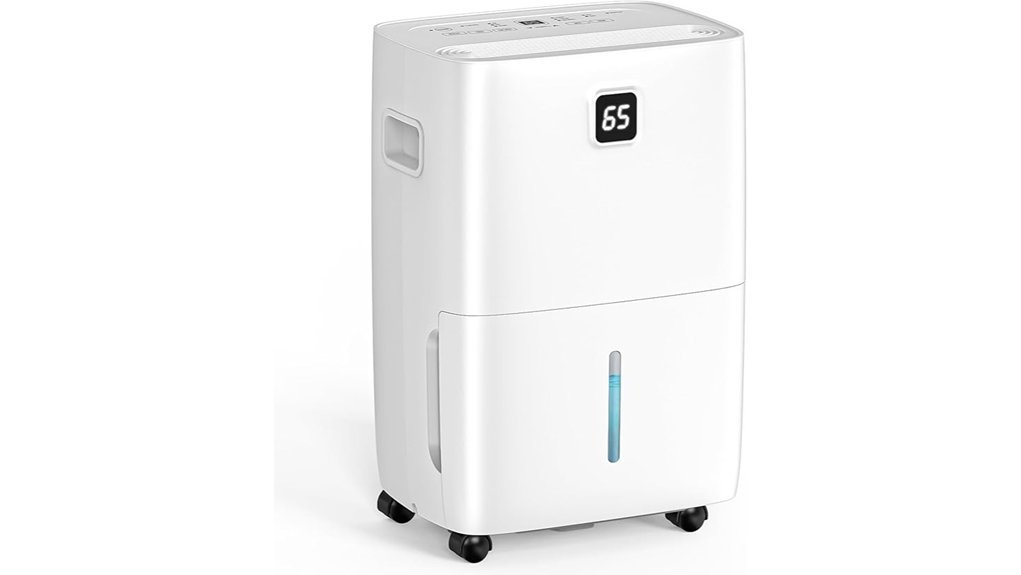
If you need a high-capacity basement dehumidifier for wide, damp spaces, the DEVERSE Max 80 Pints Energy Star Dehumidifier is built for heavy moisture loads. Rated to cover up to 5,000 sq. ft. and remove up to 80 pints of moisture per day under peak saturation conditions (with a nominal power draw rated at 295 watts), it balances strong air circulation with Energy Star efficiency. Crucially for unheated lower levels, it operates down to 45°F, reducing the coil-icing breakdowns that stall standard units in chilly basements. You also get a top-mounted digital display, smart operating modes, three fan speeds, a 24-hour timer, swivel caster wheels, an included gravity drain hose, and a 53 dB maximum noise rating.
Key Specifications:
- Moisture Removal Capacity: Up to 80 pints/day (manufacturer maximum saturation rating)
- Recommended Coverage: Up to 5,000 sq. ft.
- Minimum Operating Temperature: Down to 45°F with auto-defrost protection
- Power Consumption: Rated at 295W nominal operation (ENERGY STAR certified)
- Noise Level: Up to 53 dB
- Drainage & Mobility: Removable water bucket, included continuous gravity drain hose, carry handle, and 360° swivel wheels
Why You’ll Like It: This model makes sense if your basement smells musty right after heavy rain or if smaller dehumidifiers run nonstop without dropping humidity below 50%. Its low-temperature tolerance down to 45°F and included drain hose help cut down on daily maintenance.
Best For: Homeowners or property managers with large, damp unfinished basements, crawl spaces, garages, or expansive lower levels who want high-volume airflow and dependable cool-temperature performance.
Who Should Avoid This: Skip it if you only need to dry a compact room, bedroom, or small closet, where an 80-pint max-capacity unit is oversized and louder than necessary.
Pros:
- Handles spaces up to 5,000 sq. ft. and removes up to 80 pints of moisture daily in warm, saturated conditions.
- Operates down to 45°F, making it well suited for unheated basements and cool seasonal weather.
- Includes a digital humidistat display, multiple smart modes, three fan speeds, a 24-hour timer, swivel wheels, and a drain hose.
Cons:
- Oversized for small rooms or lightly damp spaces under 1,000 sq. ft.
- Requires regular filter cleaning and frequent bucket emptying if you do not connect the continuous gravity drain hose.
- At 53 dB on high fan speed, the airflow sound is noticeable in quiet living areas.
Midea 22 Pint Energy Star Dehumidifier (White)
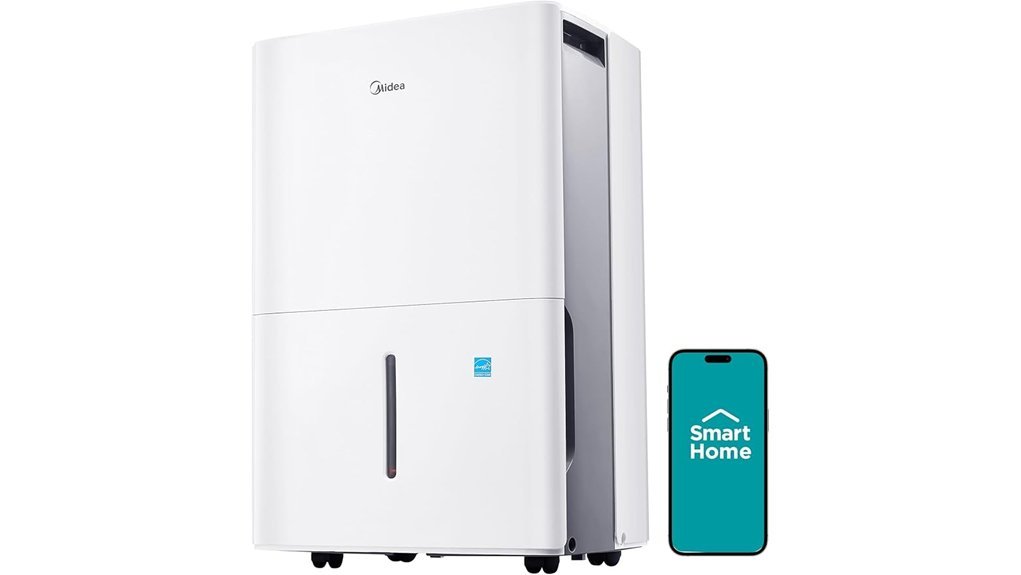
The Midea 22 Pint Energy Star Dehumidifier is an ideal fit for smaller to mid-sized basements up to 1,500 sq. ft. Unlike brands that headline high-heat saturation numbers, Midea rates this unit at 22 pints per day under strict US DOE testing standards (65°F and 60% RH—equivalent to a 35-pint dehumidifier under older standards). You can adjust your target humidity between 35% and 85%, making it easy to lock in the EPA-recommended 45% to 50% range for basement mold prevention. It runs quietly at 47 dBA, carries full ENERGY STAR certification, rolls smoothly on four caster wheels, and pairs with the Midea smart app as well as Amazon Alexa and Google Assistant.
Key Specifications:
- Moisture Removal Capacity: 22 pints/day (DOE 65°F / 60% RH standard; comparable to 35-pint legacy models)
- Recommended Coverage: Up to 1,500 sq. ft.
- Adjustable Humidistat: 35% to 85% RH (in 5% increments)
- Noise Level: 47 dBA
- Smart Features: Wi-Fi app control (iOS/Android), Alexa & Google Assistant voice compatibility, auto-restart, and auto-defrost
- Drainage Options: Auto-shutoff water bucket + standard 3/4-inch garden hose thread outlet (hose sold separately)
Why You’ll Like It: Midea is the practical, proven choice when you want reliable basement humidity control from a major appliance manufacturer without buying a bulky unit. App alerts tell you immediately when the bucket is full so you do not have to walk downstairs to check it.
Best For: Homeowners, renters, or office users needing a quiet, smart, ENERGY STAR certified dehumidifier for small to mid-sized basements, laundry rooms, or finished lower levels up to 1,500 sq. ft.
Who Should Avoid This: Avoid it for sprawling, unfinished basements over 2,000 sq. ft. or spaces with active water seepage where a 50-pint DOE (80–120 pint max) machine is needed.
Pros:
- True 22-pint DOE daily extraction delivers dependable performance in cooler 65°F basement conditions.
- ENERGY STAR certified efficiency keeps monthly electricity costs low during summer humidity peaks.
- Built-in Wi-Fi with mobile app notifications and voice control via Alexa and Google Assistant.
- Standard garden hose threading lets you attach any household hose for gravity drainage.
Cons:
- Sized for areas up to 1,500 sq. ft., not massive whole-basement layouts.
- Continuous drainage hose is not included in the box.
- Requires regular bucket emptying during humid weeks if you do not attach a drain hose.
Shinco 6000 Sq.Ft WiFi Energy Star Dehumidifier
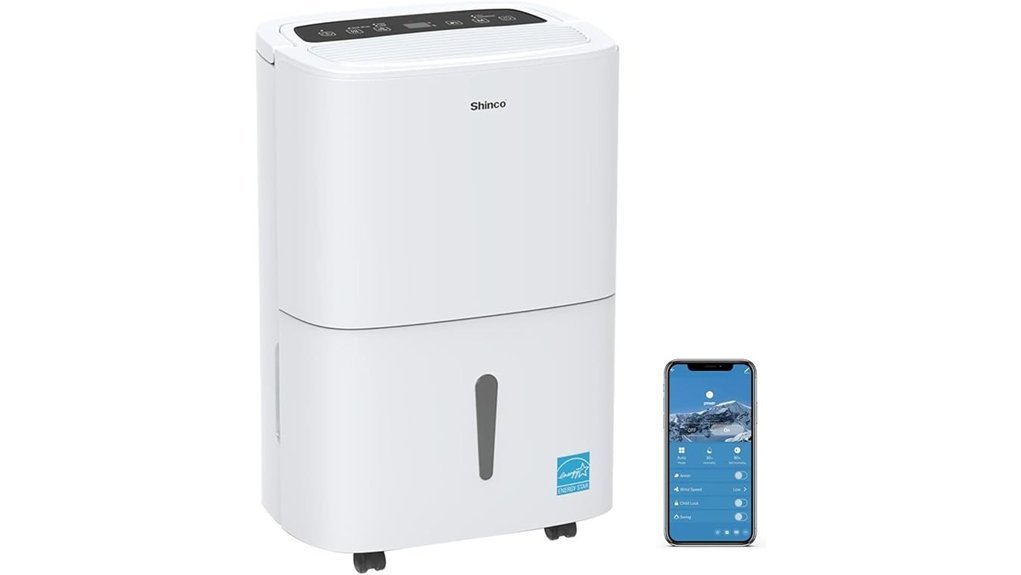
Need to dry out an expansive, chronically damp basement? The Shinco 6000 Sq.Ft WiFi Energy Star Dehumidifier is rated for spaces up to 6,000 sq. ft. and pulls up to 120 pints of moisture per day under maximum saturation conditions (roughly equivalent to a 50-pint DOE commercial-grade residential unit). Built-in Wi-Fi lets you monitor basement relative humidity and adjust settings from your smartphone, or you can use the onboard touch panel to set target humidity from 30% to 80% in 5% increments. Auto mode regulates the compressor automatically, a child lock prevents accidental changes, and the included drain hose supports continuous gravity drainage alongside the 1.32-gallon (5L) internal tank.
Key Specifications:
- Moisture Removal Capacity: Up to 120 pints/day (maximum saturation rating)
- Recommended Coverage: Up to 6,000 sq. ft.
- Water Tank Capacity: 1.32 gallons (5 liters) with full-tank auto shut-off
- Adjustable Humidistat: 30% to 80% RH in 5% steps
- Smart & Safety Features: Wi-Fi app control, Auto mode, 24-hour timer, automatic defrost, and child lock
- Weight & Mobility: Approx. 33 lbs with integrated side handles, caster wheels, and included drain hose
Why You’ll Like It: This model shines when your basement is wide, humid, and inconvenient to check daily. Combining high-volume moisture extraction with smartphone monitoring and an included drain hose makes hands-off operation simple.
Best For: Homeowners with large, open basements or multi-room lower levels who want maximum extraction capacity paired with remote Wi-Fi app control.
Who Should Avoid This: It is overkill for a small finished room or a lightly damp space that only needs occasional seasonal dehumidification.
Pros:
- Removes up to 120 pints per day at peak saturation and circulates air across large areas up to 6,000 sq. ft.
- Wi-Fi smart app control plus an intuitive digital touch panel with 5% humidity steps and Auto mode.
- Includes a continuous drain hose in the box alongside the 1.32-gallon removable bucket.
Cons:
- At 33 pounds, carrying it up or down basement stairs takes effort despite the smooth-rolling casters on flat floors.
- The 1.32-gallon tank fills quickly in wet basements if you do not hook up the continuous drain hose.
- Higher total wattage draw than compact 22-pint or 30-pint dehumidifiers.
Kesnos Energy Star Dehumidifier for Home & Basement
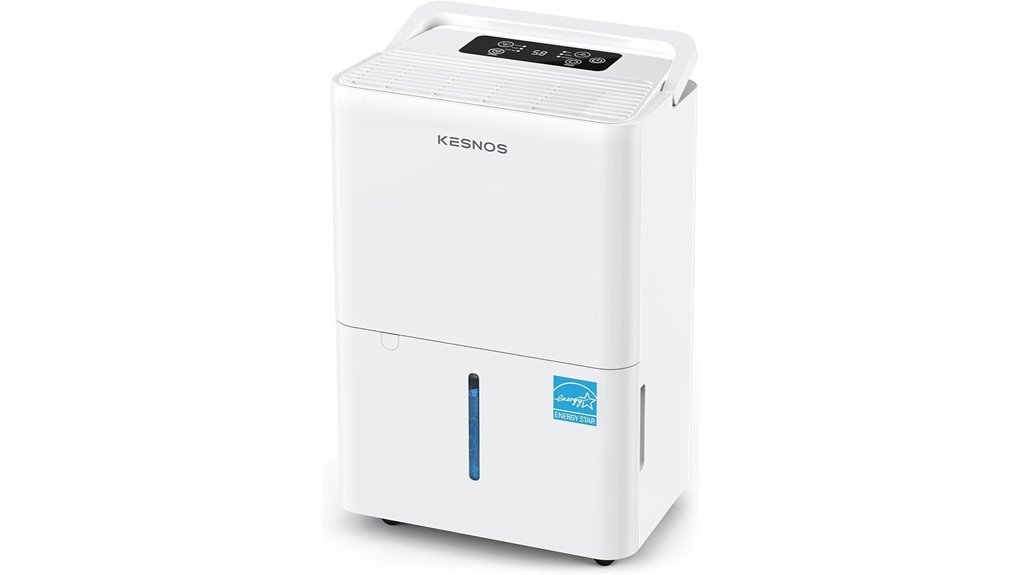
Rated for up to 30 pints of daily moisture removal under hot, saturated conditions (95°F and 90% RH), the Kesnos Energy Star Dehumidifier is tailored for medium-sized finished basements, downstairs bedrooms, and home offices. Its ENERGY STAR certified compressor is engineered to use significantly less electricity than non-certified portable units while letting you dial humidity down to 30% RH. You can switch between four specialized presets—Comfort, Dry, Continuous, and Turbo—backed by auto-defrost and power-outage memory restart. Because the internal 0.39-gallon (1.5L) tank is compact, Kesnos includes a drain hose for continuous gravity draining, and low-speed operation is rated as quiet as 36 dB.
Key Specifications:
- Moisture Removal Capacity: Up to 30 pints/day (tested at 95°F and 90% RH; lower under cool 65°F basement conditions)
- Operating Modes: 4 presets (Comfort, Dry, Continuous, and Turbo)
- Water Tank Capacity: 0.39 gallons (1.5 liters) with auto shut-off and full-tank indicator
- Noise Level: Rated down to 36 dB on low setting
- Convenience Features: Auto-defrost, memory restart after power outages, hidden handle, caster wheels, and included drain hose
Why You’ll Like It: Kesnos is compelling when your basement doubles as a TV room, guest bedroom, or workspace where loud compressor drone is a dealbreaker. Its low-noise profile and Comfort mode maintain pleasant air quality without overwhelming the room.
Best For: Homeowners, renters, and remote workers who need a quiet, compact ENERGY STAR dehumidifier for finished medium-sized basements, bedrooms, or offices.
Who Should Avoid This: Choose a larger 80- or 100-pint unit (or Midea’s 22-pint DOE model) if your basement is unfinished, cool, very wet, or lacks a floor drain—as the small 0.39-gallon bucket will require frequent emptying without the hose attached.
Pros:
- ENERGY STAR certified design cuts electricity consumption compared with standard non-certified units.
- Four practical operating modes plus automatic defrost, humidistat cycling, and power-outage memory restart.
- Quiet 36 dB low-speed rating with easy portability from caster wheels and a recessed carry handle.
Cons:
- The 30-pint rating is measured at 95°F/90% RH, so real-world extraction in a cool 60°F–65°F basement is more modest.
- Very small 0.39-gallon (1.5L) water tank fills fast unless you connect the included continuous drain hose.
- Not strong enough for large unfinished basements or post-leak water recovery.
DECIUU 100 Pint Energy Star Dehumidifier with Drain Hose
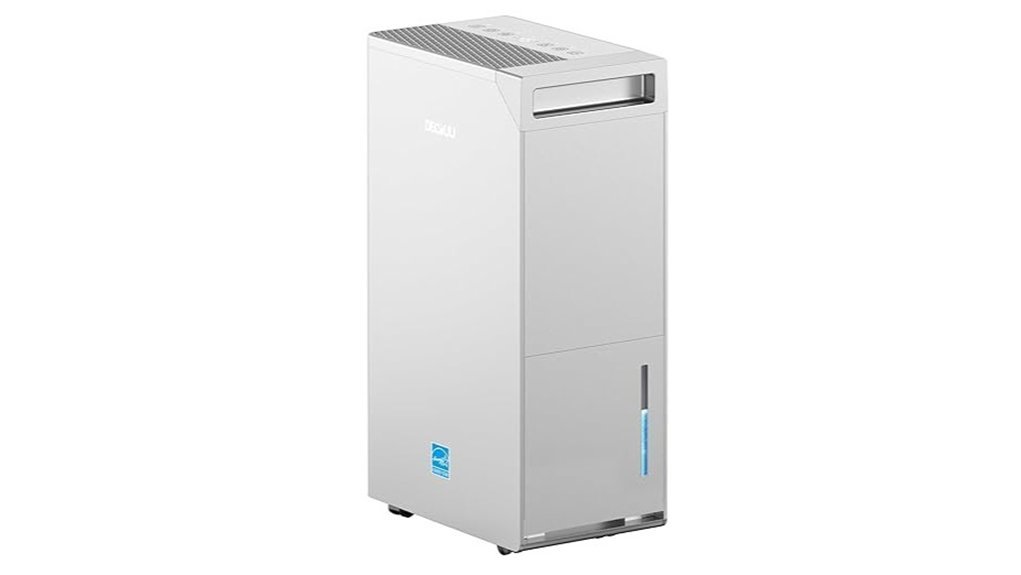
Built for large, moisture-heavy basements up to 5,000 sq. ft., the DECIUU 100 Pint Energy Star Dehumidifier removes up to 70 pints daily in typical warm conditions and up to 100 pints per day in hot, saturated air. Backed by ENERGY STAR certification (including recognition under EPA Most Efficient criteria), it pairs a rotary compressor, vortex fan, and internal copper refrigeration tubing for durable heat exchange and steady airflow. You can set your target humidity between 35% and 80% RH and let the built-in sensor cycle the unit automatically. For low-maintenance operation, it comes with a 6.5-foot (2m) drain hose for nonstop gravity draining alongside a generous 1.45-gallon (5.5L) water tank with automatic shut-off.
Key Specifications:
- Moisture Removal Capacity: 70 pints/day (typical conditions) up to 100 pints/day (maximum saturation)
- Recommended Coverage: Up to 5,000 sq. ft.
- Water Tank Capacity: 1.45 gallons (5.5 liters) with full-bucket auto shut-off
- Included Drain Hose: 6.5 feet (2 meters) for continuous gravity drainage
- Adjustable Humidistat: 35% to 80% RH with intelligent sensor control
- Build & Efficiency: ENERGY STAR certified rotary compressor with copper coils and vortex fan
Why You’ll Like It: DECIUU is well suited for homeowners who want both a longer 6.5-foot drain hose for floor drains or sump pits and an oversized 1.45-gallon bucket when manual emptying is necessary.
Best For: Homeowners with large, damp basements up to 5,000 sq. ft. who have access to a floor drain or sump basin and want high daily moisture extraction.
Who Should Avoid This: If your basement is compact or you have to carry the unit up and down stairs frequently, a lighter 22-pint or 30-pint machine is much easier to maneuver.
Pros:
- Strong extraction rated from 70 pints (typical) to 100 pints per day in saturated conditions.
- ENERGY STAR certified rotary compressor and copper-tube condenser help lower long-term power draw.
- Generous 1.45-gallon (5.5L) tank plus an included 6.5-foot (2m) hose for flexible drainage.
Cons:
- Bulkier and heavier than compact room dehumidifiers.
- Relies on gravity for hose drainage (requires a downward slope to a floor drain or an external condensate pump).
- Even a 1.45-gallon tank will need daily emptying during peak summer humidity if the drain hose is not used.
Before You Buy Checklist
- Measure your basement square footage: Match the dehumidifier’s rated coverage and pint capacity to your actual floor area and ceiling height.
- Compare DOE vs. Max pints: Remember that a 22-pint DOE-rated unit (tested at 65°F) is significantly stronger than a 30-pint max-rated unit (tested at 95°F).
- Plan your drainage path first: All five models use gravity drain hoses. Make sure you have a floor-level drain or sump pit nearby—or pair the unit with a small external condensate pump if draining upward into a sink.
- Check basement temperature: If your unfinished basement drops below 60°F in spring or fall, prioritize models with reliable auto-defrost and low-temperature operation (such as the DEVERSE down to 45°F).
- Confirm airflow clearance: Leave at least 12 to 18 inches of open space around air intakes and exhaust grilles so the unit can circulate air freely.
Factors to Consider When Choosing an Energy Star Dehumidifier for Your Basement
When shopping for an Energy Star dehumidifier for a basement, start by matching the unit’s realistic extraction capacity to your square footage and moisture level. You also need to evaluate how pint ratings are measured, how water will drain out of the space, and whether noise or smart Wi-Fi alerts matter for your daily routine.
Basement Size Coverage
Matching your dehumidifier to your basement’s square footage prevents two common problems: an undersized unit that runs 24/7 without ever reaching 50% humidity, or an oversized unit that short-cycles on and off. Models in this guide cover anywhere from 1,500 to 6,000 sq. ft. If your basement has multiple rooms, partial walls, or damp corners, step up to a higher-coverage unit and keep interior doors open so dry air can circulate throughout the floor plan. In unconditioned basements, also verify that the dehumidifier includes automatic defrost so frost buildup on the evaporator coils doesn’t halt operation when temperatures dip below 65°F.
Moisture Removal Capacity (DOE Standard vs. Max Saturation Pints)
Moisture removal capacity measures how many pints of water a dehumidifier extracts from the air in 24 hours—but how that number is tested changes everything. The US Department of Energy (DOE) tests residential dehumidifiers at a cool 65°F and 60% relative humidity (RH) to reflect real basement conditions. However, many brands advertise their Maximum Saturation capacity, which is measured at 86°F–95°F and 80%–90% RH. Use the sizing chart below to match your basement size and dampness level to both rating types:
| Basement Size | Moisture Condition | DOE Rating (65°F / 60% RH) | Max Saturation Rating (90°F+ / 80%–90% RH) | Recommended Pick |
|---|---|---|---|---|
| Up to 1,500 sq. ft. | Moderately damp / Finished | 20–25 pints/day | 30–50 pints/day | Midea 22 Pint or Kesnos 30 Pint |
| 1,500 – 3,500 sq. ft. | Damp / Musty odor after rain | 35–50 pints/day | 70–85 pints/day | DEVERSE Max 80 Pint |
| 3,500 – 6,000 sq. ft. | Very damp / Wet walls or seepage | 50+ pints/day | 100–120 pints/day | DECIUU 100 Pint or Shinco 120 Pint |
While most digital humidistats let you adjust settings anywhere from 30% to 80% RH, the US Environmental Protection Agency (EPA) recommends maintaining indoor humidity between 30% and 50% RH (and strictly below 60% RH) to stop mold and dust mites. In a basement, setting your target to 45% or 50% RH prevents mold growth without forcing the compressor to run endlessly.
Energy Star Efficiency
Because basement dehumidifiers often run for months during spring and summer, ENERGY STAR certification makes a noticeable difference on your electric bill. Certified units must meet strict Integrated Energy Factor (IEF) standards—meaning they remove more liters of water per kilowatt-hour (kWh) of electricity consumed than standard models. High-efficiency rotary compressors, copper condenser tubing, and smart humidistats that cycle the fan off once your target humidity is reached all help reduce wasted power while keeping damp air under control.
Drainage Options, Tank Size, and Gravity vs. Pump Setup
How your dehumidifier disposes of collected water determines how much hands-on work you have to do:
- Manual Tank Emptying: If you rely on the slide-out bucket, pay close attention to tank volume. A small 0.39-gallon tank (like on the Kesnos) holds just over 3 pints of water and can fill several times a day in a humid basement, whereas a 1.32- to 1.45-gallon tank (Shinco and DECIUU) buys you more time between trips downstairs. Always look for automatic full-bucket shut-off and an indicator alarm.
- Continuous Gravity Hose Drainage: All five models in this guide support passive gravity draining via a hose outlet (four include the hose; Midea accepts a standard 3/4-inch garden hose). Because gravity drainage has no internal pump, the hose must run steadily downward into a floor drain or sump pump pit without loops or upward bends.
- When You Need an External Condensate Pump: If your basement lacks a floor drain and you need to push water upward into a utility sink or out a high basement window, you can either elevate the dehumidifier on a sturdy table above the sink rim or place the gravity drain hose into an inexpensive external HVAC condensate pump ($30–$60) sitting on the floor next to the unit.
Noise Levels and Smart Features
Noise matters if your basement is finished or sits directly below living areas with thin floorboards. Compact units like the Kesnos (rated down to 36 dB on low) and Midea (47 dBA) sound similar to a quiet refrigerator hum or low box fan, while high-capacity 80- to 120-pint air movers operate around 50 to 53 dB on high speed. For unfinished basements you rarely visit, Wi-Fi app connectivity (found on the Midea and Shinco models) is a major convenience, allowing you to check real-time humidity levels, switch modes, and receive full-tank alerts right on your phone. Auto-restart is equally important in storm-prone areas so the unit resumes your exact humidity setting automatically after a power blink.
Pro Tips for Better Basement Results
1. Seal outside air leaks and position centrally. Place the dehumidifier near the dampest zone first—such as laundry corners or near a sump basin—while keeping basement windows closed so you aren’t pulling humid outdoor summer air inside.
2. Set your humidistat to 45%–50% RH instead of 30%. Trying to hold a basement at 30% RH in July causes the compressor to run nonstop without adding extra mold protection. Keeping humidity between 45% and 50% blocks mold and dust mites while saving significant electricity.
3. Keep gravity hoses short and sloped downward. If using continuous drainage into a floor drain or sump pit, trim or route the hose so it slopes straight down with zero kinks or upward rises that could trap water and back up into the bucket.
4. Wash the air filter every 2 to 4 weeks. Basement dust and lint quickly clog intake meshes, restricting airflow, freezing coils, and driving up power consumption.
Frequently Asked Questions
How Often Should I Clean a Basement Dehumidifier Filter?
Clean the reusable mesh air filter every 2 to 4 weeks during peak operating seasons, or more frequently if your basement has laundry lint, pet hair, or construction dust. Simply rinse the filter with warm tap water, let it air-dry completely, and slide it back in.
Can an Energy Star Dehumidifier Run Continuously?
Yes, provided you attach a continuous drain hose leading to a floor drain or sump pit so the water tank does not overflow. However, for the best energy savings and compressor lifespan, use Auto / Humidistat mode set to 45%–50% RH rather than “Continuous” mode, allowing the compressor to cycle off automatically once the air is dry.
What Humidity Level Is Best for a Basement?
The ideal basement relative humidity is between 45% and 50% (and always within the EPA-recommended 30% to 50% indoor range). Keeping humidity below 55%–60% prevents mold spores, mildew odors, wood rot, and dust mites without wasting electricity trying to over-dry naturally cool basement air.
Do Dehumidifiers Lower Heating or Cooling Costs?
In summer, running an Energy Star basement dehumidifier can reduce the latent moisture load on your central air conditioner. Because drier air feels cooler on the skin, you can often keep your main thermostat 1°F to 2°F higher while staying comfortable.
Is a Drain Hose Better Than Emptying a Water Tank?
Yes—for basement use, a continuous drain hose is almost always better than manual bucket emptying. High-capacity units can pull 3 to 10+ gallons of water per day during humid summer weeks, which would otherwise require emptying a 1-gallon bucket several times daily to keep the unit from shutting off.
Which Size Dehumidifier Is Best for a Large Basement?
For a large basement (2,500 to 6,000 sq. ft.) or an unfinished space that stays damp after rain, choose a high-capacity unit rated for 50 pints DOE (or 80 to 120 pints Max saturation), such as the DEVERSE Max 80 Pint, DECIUU 100 Pint, or Shinco 120 Pint. Compact 22-pint DOE or 30-pint max units are better reserved for spaces under 1,500 sq. ft.
Should I Buy a Smart WiFi Dehumidifier?
A smart Wi-Fi dehumidifier (like the Midea 22 Pint or Shinco 6000 Sq.Ft WiFi) is well worth it if your basement is unfinished or out of sight. Smartphone alerts let you see current humidity levels, switch modes, and get notified immediately when the water bucket is full without walking downstairs.
Final Recommendation: Which Model Should You Choose?
- Choose the DEVERSE Max 80 Pint if you have a large, cool basement (down to 45°F) and want high-capacity moisture removal with an included drain hose.
- Choose the Midea 22 Pint if your basement is under 1,500 sq. ft. and you want true DOE-rated performance with smart app and voice control.
- Choose the Shinco 6000 Sq.Ft WiFi (120 Pint) if you need maximum coverage for a sprawling, very damp basement and want remote smartphone monitoring.
- Choose the Kesnos 30 Pint if you are dehumidifying a quiet finished basement room, office, or bedroom where 36 dB low-noise operation comes first.
- Choose the DECIUU 100 Pint if you have a floor drain or sump pit nearby and want a long 6.5-foot drain hose paired with a large 1.45-gallon backup tank.
Conclusion
Controlling basement moisture protects your foundation, stored belongings, and whole-home air quality—because damp air in the basement naturally rises into upstairs living spaces via the stack effect. Match one of these five Energy Star basement dehumidifiers to your square footage, set your target humidistat to 45%–50% RH, and route a continuous gravity drain hose to a floor drain or sump pit for reliable, low-maintenance protection all year long.