10 Best Dehumidifiers for Basements in 2026
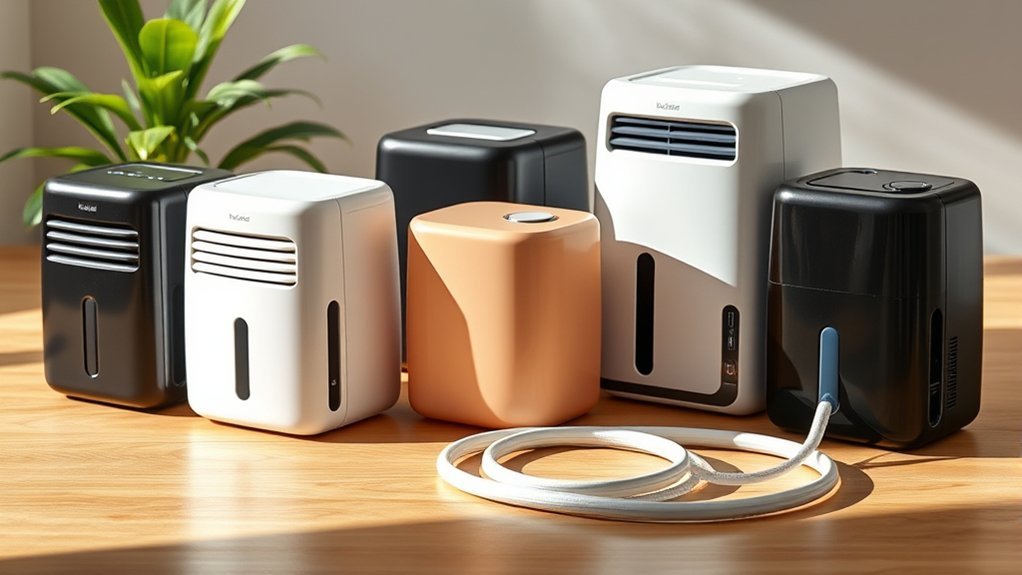
If your basement feels damp, smells musty, or needs steady moisture control, the right dehumidifier can make the space cleaner, drier, and easier to use. For the 10 best dehumidifiers for basements in 2026, focus on square footage, moisture removal capacity, drainage setup, tank size, noise level, and energy use. A small or finished basement may only need a 22- to 34-pint model, while a large or very damp basement often needs an 80- to 120-pint unit with continuous drainage. Top choices include the Waykar 120 Pint for very large spaces, Waykar 80 Pint for most large basements, Midea 22 Pint for quieter rooms, hOmeLabs Wi-Fi for smart control, AEOCKY compressor models, Yaufey 5000 Sq. Ft., and VEAGASO 34 Pint. The best pick is the one that matches your basement’s size, humidity problem, and daily routine.
Quick Verdict: Choose a larger 80- to 120-pint model if your basement is open, humid, or frequently musty. Choose a 22- to 34-pint model if your basement is finished, smaller, or only mildly damp. If you do not want to empty a bucket every day, prioritize a model with a drain hose or built-in pump.
Best overall direction: For most basement buyers, drainage convenience matters almost as much as moisture capacity. A powerful unit is easier to live with when it can run continuously into a floor drain, sump area, sink, or pump setup.
Quick Picks for Basement Dehumidifiers
- Best for very large basements: Waykar 120 Pint Energy Star Dehumidifier
- Best for most large basements: Waykar 80 Pints Energy Star Dehumidifier
- Best for quieter medium rooms: Midea 22 Pint Energy Star Dehumidifier
- Best smart-control option: hOmeLabs Wi-Fi Dehumidifier
- Best with built-in pump: AEOCKY 4500 Sq.Ft Energy Star Dehumidifier with Pump
- Best compact high-capacity option: AEOCKY Compressor Dehumidifier with Drain Hose
Before You Buy: Measure your basement, check whether you have a floor drain nearby, and decide whether you can empty a water tank often. If your basement gets wet after storms, smells musty, or stores cardboard, tools, furniture, or seasonal items, a stronger model with continuous drainage is usually the safer long-term choice.
Humidity target: Many homes feel better when basement humidity stays roughly in the 30% to 50% range. Use a separate hygrometer if you want a simple way to verify your dehumidifier’s built-in reading.
Basement Dehumidifier Comparison
| Product | Best For | Coverage | Drainage Option | Quick CTA |
|---|---|---|---|---|
| Waykar 120 Pint Energy Star Dehumidifier | Very large damp basements | Up to 6,000 sq. ft. | Tank or continuous drainage | Check Price |
| Waykar 80 Pints Energy Star Dehumidifier | Large basements | Up to 5,000 sq. ft. | Tank or drain hose | Check Price |
| Midea 22 Pint Energy Star Dehumidifier | Quiet medium spaces | Up to 1,500 sq. ft. | Tank or optional hose setup | Check Price |
| hOmeLabs Wi-Fi Dehumidifier | Smart remote control | Up to 7,000 sq. ft. | Tank or drain hose outlet | Check Price |
| Aiusevo AS280 1500 Sq. Ft. Dehumidifier | Medium basements and laundry rooms | Up to 1,500 sq. ft. | Included drain hose or tank | Check Price |
| AEOCKY 4500 Sq.Ft Energy Star Dehumidifier with Pump | Hands-off draining | Up to 4,500 sq. ft. | Built-in pump | Check Price |
| 4500 Sq Ft Dehumidifier with Drain Hose | Large rooms and garages | Up to 4,500 sq. ft. | Drain hose or tank | Check Price |
| AEOCKY Compressor Dehumidifier | Compact high-capacity use | Up to 3,500 sq. ft. | Drain hose | Check Price |
| Yaufey 5000 Sq. Ft. Energy Star Dehumidifier | Large humid spaces | Up to 5,000 sq. ft. | Manual or continuous drainage | Check Price |
| VEAGASO 34 Pint Dehumidifier | Basements, bathrooms, and laundry areas | Up to 2,500 sq. ft. | Tank or hose | Check Price |
Waykar 120 Pint Energy Star Dehumidifier for Large Spaces
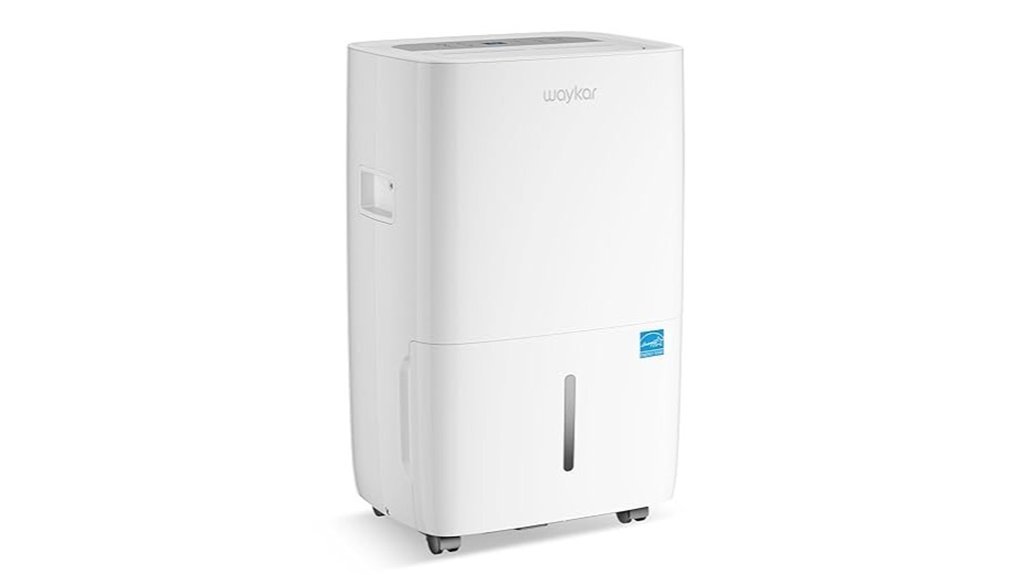
Best Overall for Very Large Basements: If you need a powerful basement dehumidifier for a large, damp space, the Waykar 120 Pint Energy Star Dehumidifier is a strong fit. It removes up to 120 pints of moisture a day and handles areas up to 6,000 square feet, so you can use it in basements, garages, or commercial rooms. You can set humidity from 30% to 80% RH, and the 90° auto swing helps spread dry air evenly. It runs at about 42 dB, supports continuous drainage, and uses Energy Star-certified efficiency.
This is the kind of unit to consider when your basement feels damp most days, smells musty, or needs faster moisture control after heavy rain. It may be more power than a small bedroom or lightly damp storage room needs, but for a large basement, the extra capacity can help the unit work less aggressively over time.
Why You’ll Like It: The main appeal is simple: high capacity with everyday convenience. Instead of buying a smaller unit that runs constantly, this model gives you more drying power for big basement zones where humidity can return quickly.
Who Should Buy This: Choose it if you have a large basement, a persistent musty smell, heavy seasonal humidity, or a space that needs stronger moisture removal after rain.
Who Should Avoid This: Skip it if you only need light humidity control in a small finished room, because a smaller and easier-to-place model may be enough.
Best For: Homeowners, landlords, and small business owners who need a powerful, energy-efficient dehumidifier for large damp spaces like basements, garages, and commercial rooms.
Pros:
- Removes up to 120 pints of moisture per day, making it well-suited for large areas up to 6,000 sq. ft.
- Energy Star certified with quiet operation around 42 dB, which helps keep operating costs and noise levels down.
- Offers adjustable humidity control, 90° auto swing airflow, and continuous drainage for convenient use.
Cons:
- Its large capacity and size may be more than needed for small rooms or light moisture problems.
- The 1.14-gallon tank may still require frequent emptying if continuous drainage is not used.
- Best performance is geared toward demanding spaces, so it may be less practical for users wanting a compact portable unit.
Bottom Line: Choose this one if you want high moisture removal for a large basement and plan to use continuous drainage instead of relying on the tank.
Waykar 80 Pints Energy Star Dehumidifier for Basements
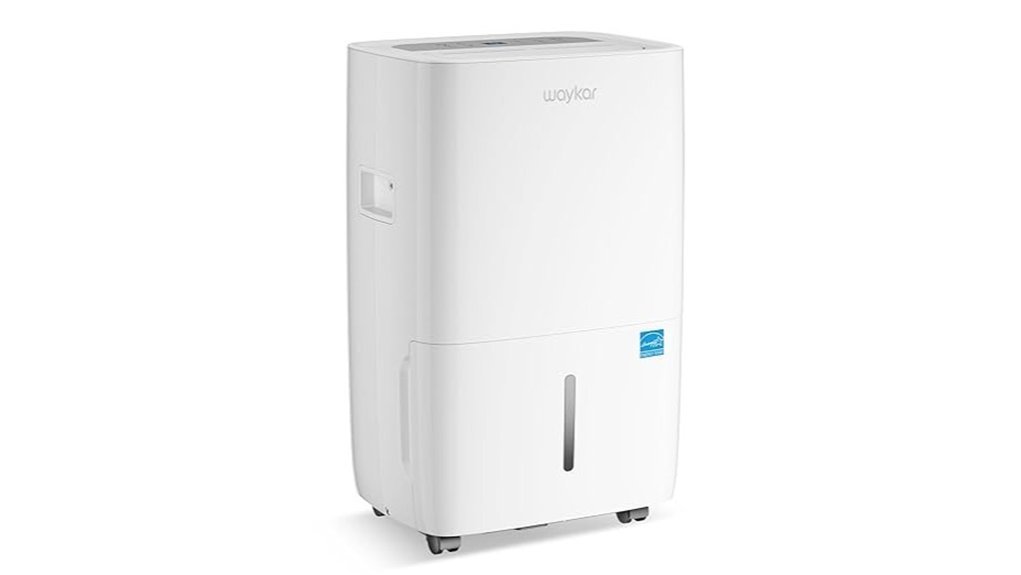
Best for Most Large Basements: Waykar’s 80-pint capacity makes it a strong pick for large, damp basements up to 5,000 square feet. You can set your target humidity from 30% to 80% RH, and the 90° auto swing helps spread dry air evenly. At about 42 dB, it won’t dominate your space, and Energy Star certification keeps running costs in check. Use the 1.14-gallon tank or attach the 3.3-foot drain hose for continuous drainage. Automatic defrost and overload protection add peace of mind, while the U.S.-based brand backs it with a solid warranty, so you can count on reliable performance year-round.
This model is a good middle ground if the 120-pint Waykar feels like too much, but a smaller 22- or 34-pint unit may not keep up. It fits buyers who want a basement-first dehumidifier with quiet operation, automatic features, and simple draining.
Why You’ll Like It: It balances power, noise control, energy efficiency, and drainage flexibility. That makes it easier to recommend for homeowners who need a serious basement unit but do not want to oversize too much.
Who Should Buy This: Pick it if your basement is large, regularly humid, or used for storage, hobbies, laundry, or living space.
Who Should Avoid This: Avoid it if you have a small basement corner or a lightly damp room where a compact model would be easier to move and store.
Best For: Homeowners needing an energy-efficient, quiet dehumidifier for large damp spaces like basements, with flexible drainage and easy humidity control.
Pros:
- Covers up to 5,000 sq. ft. with an 80-pint capacity, making it suitable for large rooms and basements.
- Energy Star certified and relatively quiet at about 42 dB, so it’s efficient without being disruptive.
- Offers both a water tank and drain hose option, plus auto defrost and overload protection for convenience.
Cons:
- The 1.14-gallon tank may require frequent emptying if continuous drainage isn’t used.
- Best performance is based on ideal high-humidity conditions, so real-world capacity may vary.
- The 3.3-foot drain hose is fairly short, which may limit placement options.
Bottom Line: This is a practical pick for large basements where energy use, noise, and drainage flexibility all matter.
Midea 22 Pint Energy Star Dehumidifier With Reusable Filter
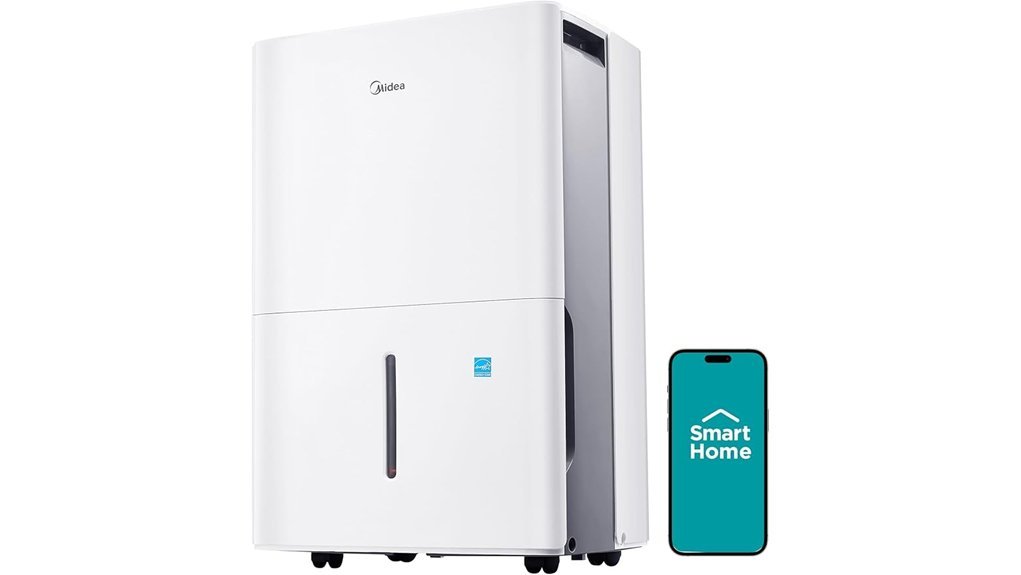
Best Quiet Pick for Medium Spaces: The Midea 22 Pint dehumidifier suits you if you need quiet, smart basement moisture control. You can cover up to 1,500 sq. ft. and pull 22 pints of moisture a day, while setting humidity from 35% to 85% to keep your basement near the healthy 45% to 55% range. It runs at just 47 dBA, so it won’t disrupt your space. ENERGY STAR certification helps you save 31% energy. Use the SmartHome app, Alexa, or Google Assistant to control it remotely. You also get auto restart, auto defrost, turbo mode, a timer, and easy wheel mobility.
This is not the strongest option for a wet, unfinished basement, but it makes sense for smaller basements, finished rooms, offices, storage spaces, and areas where quiet operation matters more than raw capacity.
Why You’ll Like It: It is easier to live with in finished basements because it focuses on quiet performance, app control, and practical daily comfort instead of maximum capacity.
Who Should Buy This: Choose it for a medium finished basement, home office, storage room, or basement bedroom where noise matters.
Who Should Avoid This: Skip it for a very wet or very large unfinished basement where an 80-pint or larger unit would be more suitable.
Best For: Homeowners or renters needing a quiet, energy-efficient, app-controlled dehumidifier for basements or medium-sized spaces up to 1,500 sq. ft.
Pros:
- Removes up to 22 pints of moisture per day, making it effective for damp rooms and basements.
- ENERGY STAR certified and runs quietly at 47 dBA, which is great for everyday home use.
- SmartHome app support plus Alexa and Google Assistant compatibility add convenient remote control.
Cons:
- The 0.8-gallon tank may require frequent emptying if used in very humid conditions.
- Continuous drainage hose is not included, so extra setup may be needed.
- Best suited for spaces up to 1,500 sq. ft., so it may be underpowered for larger areas.
Bottom Line: Pick this if your basement is medium-sized or finished and you want quiet performance with app and voice control.
hOmeLabs Wi-Fi Dehumidifier for Home and Basement
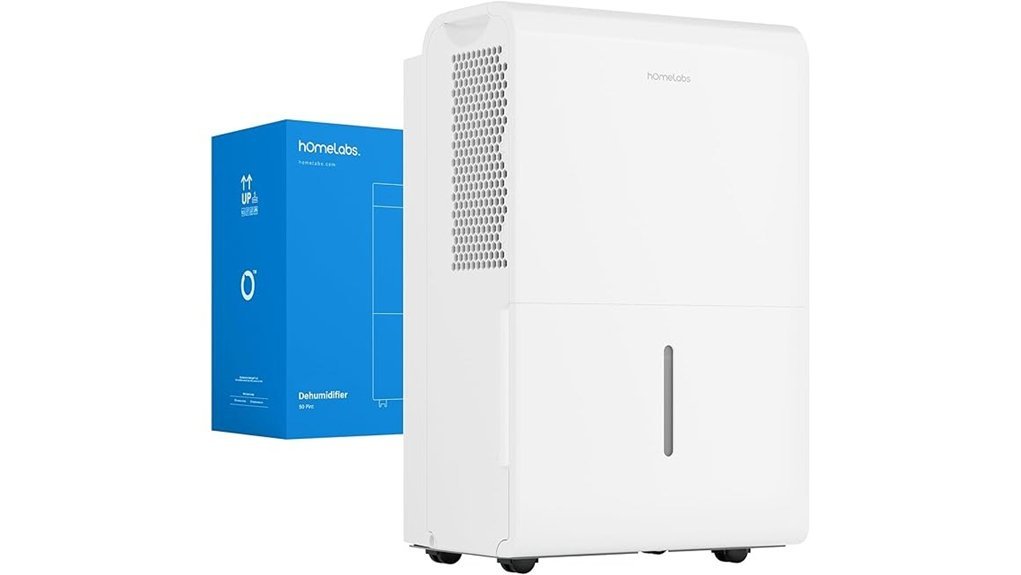
Best Smart-Control Option: Built for large, damp basements, hOmeLabs’ Wi-Fi dehumidifier covers up to 7,000 square feet. You can monitor and change settings through your home network, so you don’t have to head downstairs every time humidity shifts. It pulls up to 50 pints a day in standard conditions and much more in steamy rooms, while turbo mode boosts airflow for faster drying. Set your target humidity, let auto shutoff prevent overflow, and use the drain hose outlet for nonstop operation. Wheels, handles, and quiet performance make it easy to move and live with.
This model is best if convenience matters. Remote control can be useful when the unit sits in a basement, utility area, or rental space where you do not want to check the display every day.
Why You’ll Like It: Smart control helps when your basement is not part of your daily routine. You can check or adjust moisture control without walking downstairs just to look at the panel.
Who Should Buy This: Choose it if you want app-based control for a basement, rental unit, utility room, or large space that needs regular monitoring.
Who Should Avoid This: Skip it if you prefer simple manual controls or do not need Wi-Fi features.
Best For: Homeowners, basement users, and small commercial spaces that need a large-capacity Wi-Fi dehumidifier with remote control and continuous drainage options.
Pros:
- Covers up to 7,000 sq ft, making it suitable for large, damp areas.
- Wi-Fi connectivity lets you monitor and adjust settings remotely.
- Turbo mode, wheels, and handles improve drying speed and portability.
Cons:
- Hose for continuous drainage is not included.
- At 41.2 pounds, it may still be somewhat heavy to move frequently.
- Best performance is limited to environments at or below the 95°F upper temperature rating.
Bottom Line: This is a strong choice if you want smart controls and large-area coverage, especially for a basement you do not visit often.
1500 Sq. Ft. Dehumidifier with Drain Hose
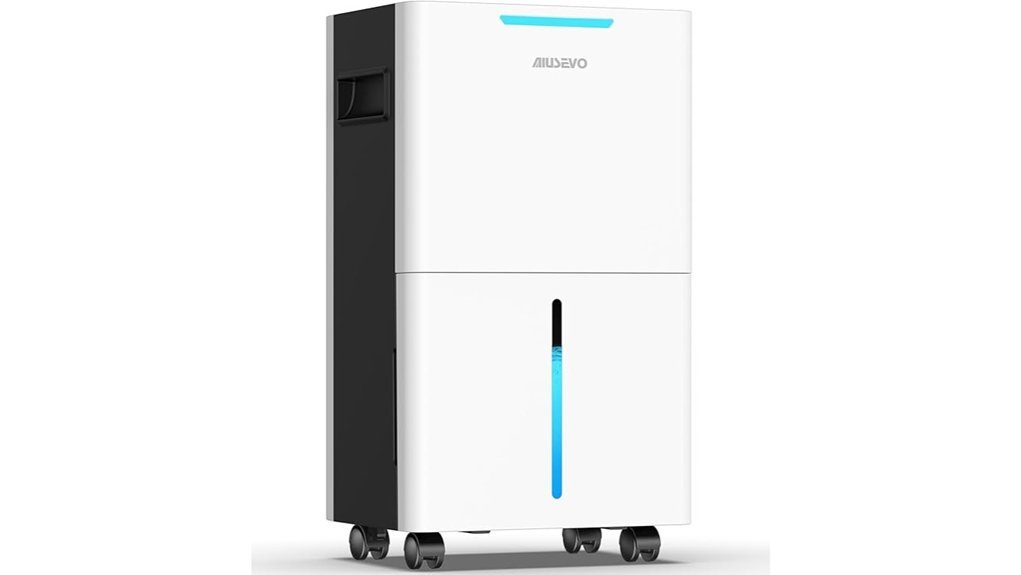
Best for Medium Basement Zones: Aiusevo’s AS280 handles up to 1,500 sq. ft., making it a smart pick for medium-sized basements. You get 21 pints of moisture removal per day, plus DEHU, DRY, and CONTINUOUS modes to match changing conditions. Set your target humidity from 30% to 80%, and let the smart controls adjust fan speed and timing for you. The 3.28-foot drain hose lets you skip bucket emptying, while the 2L tank still gives backup protection. At 15.3 pounds, with wheels and handles, you can move it easily. Quiet sleep mode and smart-home compatibility add convenience too.
This model works best for smaller basement zones, laundry areas, and rooms that need steady moisture control without a large appliance. The included drain hose is helpful if you want a more hands-off setup from the start.
Why You’ll Like It: It gives you a helpful balance of portability, drainage convenience, and simple humidity control for rooms that do not need a heavy-duty basement machine.
Who Should Buy This: Buy it if you need a compact dehumidifier for a medium basement, laundry room, bathroom-adjacent space, or damp storage area.
Who Should Avoid This: Avoid it if your basement has standing dampness, large open square footage, or strong musty odors that may need more capacity.
Best For: Homeowners with medium-sized spaces like basements, laundry rooms, or damp living areas who want a quiet, easy-to-move dehumidifier with flexible drainage and smart controls.
Pros:
- Covers up to 1,500 sq. ft. and removes 21 pints of moisture per day.
- Offers DEHU, DRY, and CONTINUOUS modes with adjustable humidity settings.
- Includes a drain hose, 2L backup tank, wheels, handles, and smart-home compatibility.
Cons:
- 21 pints per day may be limited for very large or extremely wet spaces.
- The 2L tank is fairly small if you’re not using continuous drainage.
- Best suited for medium rooms, not whole-house dehumidification.
Bottom Line: Consider this option if you need an easy-to-place dehumidifier for a medium basement or damp utility room.
AEOCKY 4500 Sq.Ft Energy Star Dehumidifier with Pump
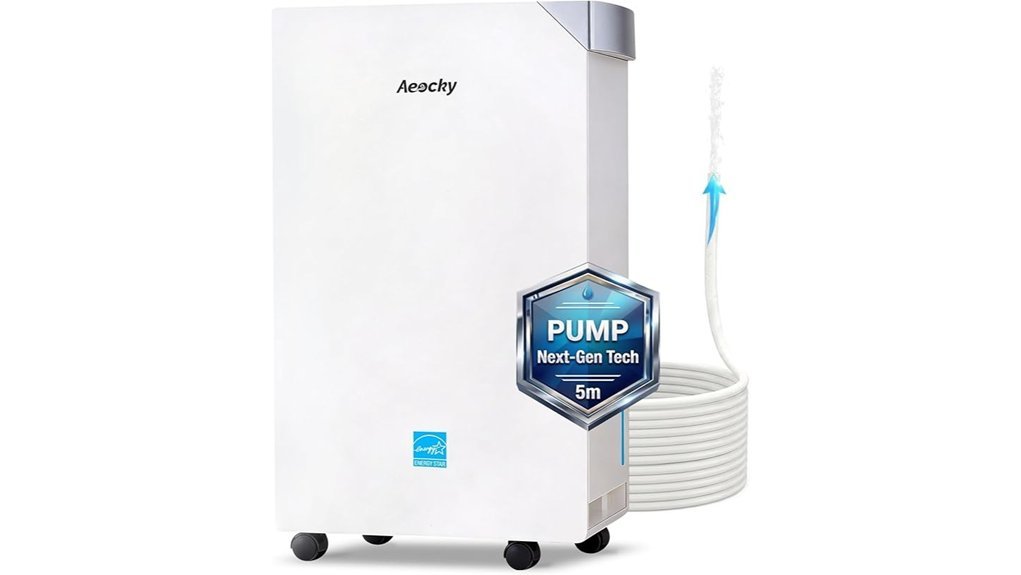
Best Built-In Pump Pick: If you need hands-off basement moisture control, the AEOCKY 4500 Sq.Ft model stands out. You get ENERGY STAR Most Efficient 2025 performance, and that elite rating reflects serious efficiency. It handles up to 4,500 square feet, removes as much as 80 pints a day, and still performs well at 56 pints in damp, warm conditions. Its 360° auto-drain pump lets you skip buckets entirely. You’ll also appreciate quiet operation, smart humidity sensing, easy-clean parts, and durability tested over 10,000 cycles.
A pump matters when your drain is above the unit or when gravity drainage is not practical. If your basement already has a floor drain right beside the unit, a standard hose model may be simpler, but a pump gives you more placement flexibility.
Why You’ll Like It: The built-in pump solves a common basement problem: water does not always have a convenient downhill path. This gives you more freedom to place the unit where it works best.
Who Should Buy This: Choose it if your basement drain, sink, or window outlet is above the dehumidifier or too far away for simple gravity drainage.
Who Should Avoid This: Skip it if your drain is already right beside the unit and lower than the hose outlet, because a simpler gravity-drain model may be enough.
Best For: Homeowners needing a high-capacity, hands-off dehumidifier for large basements or damp spaces who want strong moisture removal, automatic draining, and energy-efficient operation.
Pros:
- ENERGY STAR Most Efficient 2025 rating for top-tier efficiency
- 360° auto-drain pump eliminates manual bucket emptying
- Quiet operation with smart humidity sensing and easy maintenance
Cons:
- May be more than needed for smaller rooms or mild humidity issues
- Pump setup can be less simple than standard gravity-drain models
- Higher-capacity units can take up more space than compact dehumidifiers
Bottom Line: This is one of the better fits if you want large-basement capacity and automatic draining without depending on gravity flow.
4500 Sq Ft Dehumidifier with Drain Hose
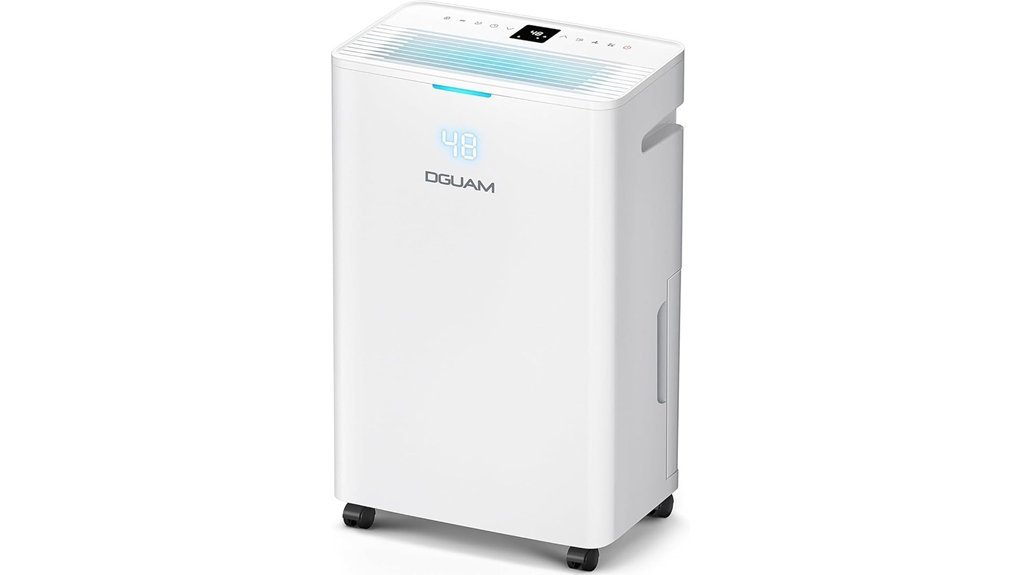
Best Standard Drain-Hose Pick: A 4,500 sq. ft. dehumidifier with a drain hose suits you if your basement stays damp. You can cover basements, garages, large rooms, or even the whole house with up to 80 pints of moisture removed per day. The unit adjusts humidity from 30% to 80% and offers High-Power, Continuous, Dry, and Ventilation modes. Its drain hose lets you run nonstop drainage, while the 1.72-gallon tank adds backup. You’ll also get auto shutoff, auto defrost, child lock, a 24-hour timer, and quiet 40 dB operation.
This is a practical pick if you want high capacity and a larger tank without stepping into a more complex pump setup. It is best for buyers who have a nearby drain or sump area where the hose can run downhill.
Why You’ll Like It: It gives you a straightforward basement setup: strong capacity, a drain hose, a useful backup tank, and common automatic features that reduce daily attention.
Who Should Buy This: Buy it if you have a large basement and a floor drain, sump area, or downhill hose path nearby.
Who Should Avoid This: Avoid it if your only drainage route is uphill, because a pump model may make more sense.
Best For: Homeowners needing a high-capacity dehumidifier for damp basements, large rooms, garages, or whole-house moisture control.
Pros:
- Removes up to 80 pints of moisture per day for strong dehumidifying performance.
- Drain hose supports continuous drainage, reducing the need for frequent tank emptying.
- Quiet 40 dB operation with useful features like auto shutoff, child lock, and a 24-hour timer.
Cons:
- The 1.72-gallon tank may still require manual emptying if continuous drainage isn’t used.
- Larger capacity units can take up more space and may be less convenient to move around.
- May be more powerful than needed for smaller rooms or light humidity issues.
Bottom Line: Choose this if your basement needs 80-pint performance and you prefer a standard drain-hose setup over a pump.
AEOCKY Compressor Dehumidifier with Drain Hose
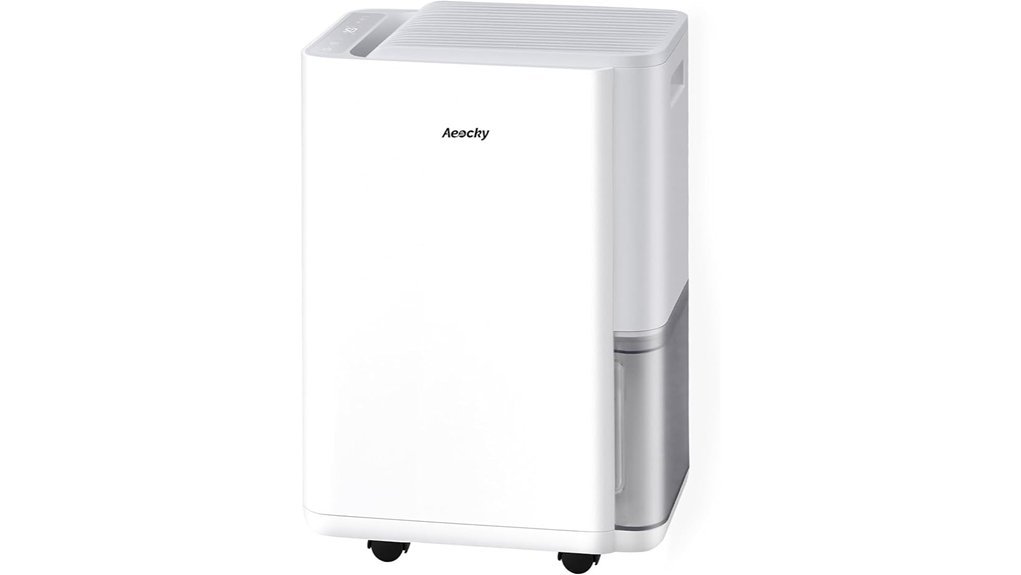
Best Compact High-Capacity Option: The AEOCKY ARION suits you if you need powerful basement moisture control in a compact unit. You get lab-validated performance that removes up to 50 pints a day in hot, humid conditions and covers areas up to 3,500 sq. ft. Its 15.75-inch footprint fits tighter spaces without looking bulky. You can choose Auto, Sleep, Continuous, or custom humidity modes, then let the drain hose handle nonstop water removal. The brushless DC motor and low-friction compressor boost efficiency, while casters and an integrated handle make moving it easy. It’s built for reliable, quiet, long-term use.
This is a strong fit when you need more than a small dehumidifier but do not want a bulky basement unit. The compact footprint may help in utility rooms, finished basements, RV storage areas, or tighter basement corners.
Why You’ll Like It: It is easier to place than many large basement units while still offering stronger performance than a basic small-room dehumidifier.
Who Should Buy This: Pick it if your basement has limited floor space, narrow storage areas, or a utility corner where a full-size unit feels too bulky.
Who Should Avoid This: Skip it for very large open basements where maximum moisture removal is more important than compact size.
Best For: Homeowners or renters who need powerful, compact moisture control for basements, bedrooms, bathrooms, RVs, or other medium-to-large spaces up to 3,500 sq. ft.
Pros:
- Removes up to 50 pints of moisture per day in hot, humid conditions with strong coverage.
- Compact 15.75-inch design fits tighter spaces without looking bulky.
- Efficient, quiet, and easy to move with a brushless DC motor, casters, and integrated handle.
Cons:
- Best performance is in smaller-to-medium spaces rather than very large open areas.
- Continuous drain hose setup may not suit users who prefer emptying a tank manually.
- Premium features and build quality may come at a higher price than basic dehumidifiers.
Bottom Line: Pick this one if you want stronger moisture control than a small unit can provide, but still need a compact design.
Yaufey 5000 Sq. Ft. Energy Star Dehumidifier
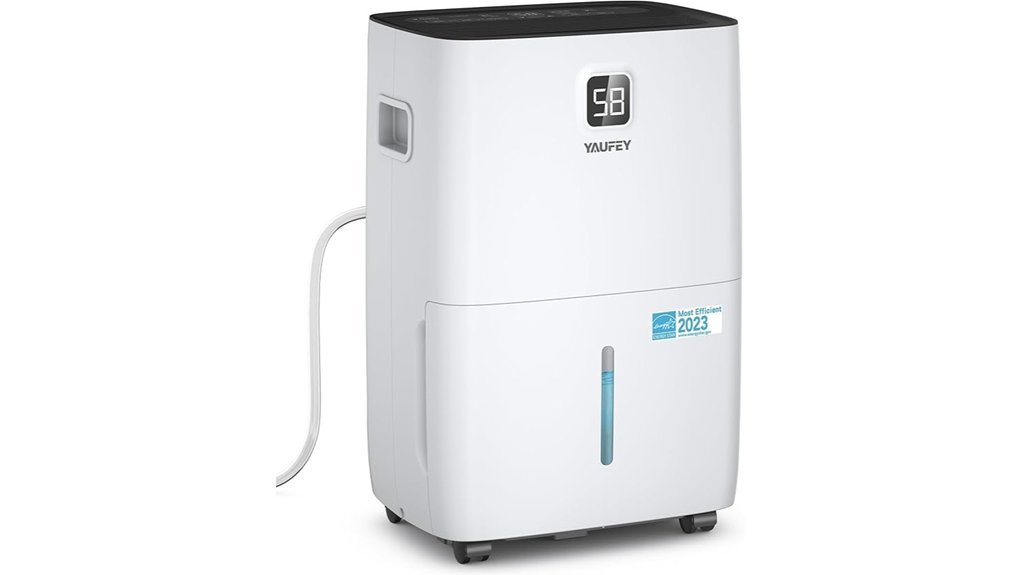
Best for Large Humid Spaces: Yaufey’s 80-pint power makes it a strong pick for large, damp basements. You can cover up to 5,000 square feet and pull 80 pints a day in muggy conditions, or 60 pints in warmer spaces. Its Energy Star rating helps you save on electricity while running it around the clock. You get manual or continuous drainage, plus a visible tank with auto shut-off. Choose Sleep, Living, Basement, or Continuous mode, and use the LED touch panel, timer, washable filter, and child lock for easy, safe control.
This is a useful choice if your basement humidity changes by season. The preset modes make it easier to shift from light daily use to stronger continuous drying after storms, laundry, or long humid stretches.
Why You’ll Like It: The preset modes make the unit easier to match to real basement life, from quieter everyday drying to stronger continuous operation when humidity spikes.
Who Should Buy This: Choose it for a large basement, humid storage space, laundry-heavy area, or seasonal dampness that needs flexible settings.
Who Should Avoid This: Avoid it if you need a built-in pump or a very small compact unit.
Best For: Homeowners with large, humid spaces like basements who want a high-capacity, energy-efficient dehumidifier with easy drainage and simple controls.
Pros:
- Covers up to 5,000 sq. ft. and removes up to 80 pints of moisture per day in very humid conditions.
- Energy Star certified for better efficiency and lower operating costs over time.
- Offers flexible features like manual/continuous drainage, multiple modes, a timer, and a washable filter.
Cons:
- The 1.06-gallon tank may need frequent emptying if continuous drainage isn’t used.
- Its large-capacity design may be bigger and heavier than smaller home dehumidifiers.
- Best suited for damp, larger areas, so it may be more than needed for small rooms.
Bottom Line: This is a solid large-basement choice if you want strong capacity, Energy Star efficiency, and easy mode controls.
VEAGASO 34 Pint Dehumidifier for Basement and Home
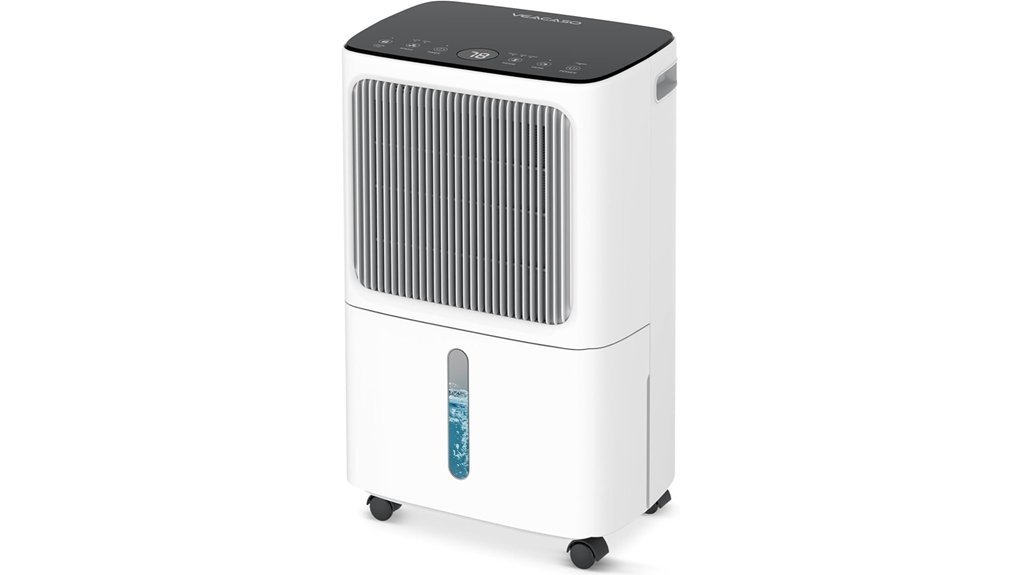
Best Moderate-Capacity Pick: VEAGASO’s 34-pint capacity makes it a smart pick if you need dependable basement moisture control. You can cover up to 2,500 square feet, so it works well in basements, large rooms, and bathrooms. Choose DEHU mode to hold your target humidity, DRY mode to speed laundry drying, or CONT mode for wet spaces. The LED touch panel lets you adjust settings, check humidity, and set a 1-to-24-hour timer. You can drain it into the 0.53-gallon tank or use the hose for continuous flow. It runs quietly at 40dB, moves easily, and restores settings after outages.
This is a good lower-capacity choice if you do not need an 80-pint basement machine. It is especially useful for mixed-use spaces where you want a dehumidifier for the basement, bathroom, laundry room, or damp spare room.
Why You’ll Like It: It gives you enough flexibility for common basement moisture problems without forcing you into a large, heavy, high-capacity unit.
Who Should Buy This: Buy it if you need a dehumidifier for a moderate basement, bathroom, laundry room, or multi-use damp area.
Who Should Avoid This: Skip it if your basement is very large, very wet, or needs continuous high-capacity drying every day.
Best For: Homeowners needing a quiet, easy-to-use dehumidifier for basements, large rooms, bathrooms, or laundry-drying support.
Pros:
- Covers up to 2,500 sq. ft., making it suitable for larger spaces.
- Offers multiple modes, including DEHU, DRY, and CONT, for different moisture needs.
- Quiet operation, continuous drainage option, and simple LED touch controls add convenience.
Cons:
- The 0.53-gallon tank may need frequent emptying in very damp conditions.
- Best performance is limited to indoor residential spaces, not whole-house HVAC use.
- Plastic construction may feel less premium than metal-bodied units.
Bottom Line: Choose this if you want a quieter, easier-to-move dehumidifier for a moderate basement or multi-use damp area.
Factors to Consider When Choosing a Dehumidifier for Basement
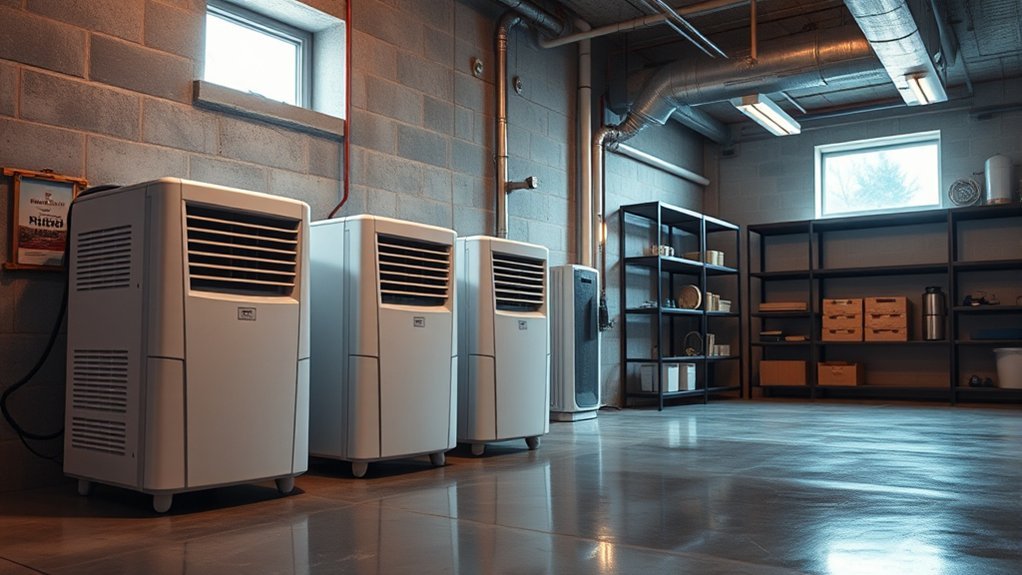
When you choose a basement dehumidifier, start by matching its coverage to your space and its moisture removal capacity to your humidity level. You’ll also want to check drainage options, noise, tank size, portability, and energy efficiency so it fits your daily routine. Smart humidity controls can make it easier to keep conditions steady without constant adjustments.
Basement Size Coverage
A dehumidifier’s coverage area should match your basement’s size, because undersized units won’t keep up and oversized ones can be unnecessarily costly. Check the square-foot rating before you buy; basement models usually cover anywhere from 1,500 to 7,000 square feet. If your space is large, choose a unit built for bigger areas so it can handle the load more effectively. You should also account for damp conditions, since a basement that feels muggy at 95°F with 90% relative humidity needs more power than a drier space. Adjustable humidity controls help you hold a comfortable 30% to 80% range. For expansive basements, continuous drainage can save you from constantly emptying the tank.
Moisture Removal Capacity
Once you’ve matched the unit to your basement’s square footage, the next spec to check is moisture removal capacity, measured in pints per day. This tells you how much moisture the dehumidifier can pull from the air in 24 hours, so it’s a key factor in controlling basement dampness. For larger spaces, you’ll often need a unit rated at 80 pints or more to keep humidity in check. Don’t ignore your basement’s conditions, either: warmer, wetter rooms push a dehumidifier harder and can call for more capacity. You should also match the output to your humidity needs, not just the floor area. If moisture changes with the seasons, choose a model with adjustable settings so you can fine-tune performance and stay comfortable year-round.
Drainage Options
Drainage options can make or break how easy your basement dehumidifier is to live with. Choose continuous drainage if you want to skip emptying a tank by hand. Many units include a 3- to 6-foot drain hose, so you can send water straight to a sump pump or floor drain and avoid buildup. If your basement sits below drain level, a model with a built-in pump helps by pushing water uphill through the hose. Also check tank size and automatic shutoff; when the tank fills, the unit should stop before it overflows. Finally, make sure you can reach and clean the drainage parts easily, since regular maintenance keeps the system working well and extends the dehumidifier’s life.
Noise And Efficiency
When you’re choosing a basement dehumidifier, noise and efficiency matter just as much as capacity. You’ll usually see sound levels between 40 and 47 dB on many home models, so pick a quieter model if you plan to sleep, work, or relax nearby. Efficiency can save you real money, so look for ENERGY STAR certification; efficient models can reduce power waste compared with older or less efficient units. Match capacity to your basement’s size and moisture level, too, because an undersized unit runs longer and wastes power. In humid spaces, an 80-pint unit often fits areas up to 5,000 square feet. Automatic defrost and continuous drainage also help the unit work smarter, not harder, and they reduce unnecessary interruptions.
Smart Humidity Controls
Smart humidity controls make basement dehumidifiers much easier to manage because you can set a target RH level, usually anywhere from 30% to 80%, and let the unit do the work. You won’t need to keep checking the air, since automatic sensors can adjust output in real time to hold your chosen level. If you want more control, look for programmable timers that run the unit only when it’s needed, which helps save energy. Many models also include continuous and sleep modes, so you can match performance to your schedule and comfort. If you already use smart home devices, choose a dehumidifier that connects to your phone or voice assistant so you can monitor moisture and change settings from anywhere.
Tank Size and Emptying
Tank size matters if you do not plan to use continuous drainage. A small tank can fill quickly in a damp basement, which means the unit may shut off before it finishes the job. If you want the least maintenance, choose a unit with a drain hose or pump. If you only need occasional moisture control, a tank-only setup may still be fine, especially in a finished basement or smaller room.
Portability and Placement
Basement dehumidifiers can be heavy, so look for casters, side handles, and a practical footprint. Place the unit where air can circulate around it, not tightly against a wall or blocked by boxes. If you plan to move it between a basement, laundry room, garage, or storage space, a lighter unit with wheels will be easier to live with.
Who Should Choose a Pump Dehumidifier?
A pump dehumidifier is useful when water must move upward or across a longer distance to reach a sink, drain, or window. Standard gravity drainage only works well when the hose can slope downward. If your basement drain is higher than the unit or not close by, a built-in pump can make daily use much easier.
What Size Dehumidifier Do You Need for a Basement?
For a small or finished basement, a 22- to 34-pint dehumidifier may be enough. For a larger basement, frequent musty smells, wet walls, or high humidity after rain, an 80-pint or larger unit is usually more practical. If you are unsure, choose based on both square footage and moisture level, not square footage alone.
Pro Tip: If your basement humidity keeps coming back quickly, the dehumidifier may not be the only issue. Check for foundation leaks, poor grading, clogged gutters, unsealed windows, or wet laundry habits. A dehumidifier helps control moisture in the air, but it should not replace fixing active water problems.
Safety Note: Always follow the manufacturer’s placement, cleaning, drainage, and electrical instructions. Avoid using extension cords unless the manual clearly allows it, and keep the unit away from standing water.
Before You Buy Checklist
- Measure your basement: Know the rough square footage before choosing a coverage rating.
- Check your moisture level: A slightly damp finished room needs less power than a musty unfinished basement.
- Plan drainage first: Decide whether you will empty a tank, run a hose downhill, or use a pump.
- Think about noise: Choose quieter models for finished basements, bedrooms, offices, or media rooms.
- Check maintenance needs: Look for washable filters, easy tank access, auto defrost, and accessible hose connections.
- Match the use case: A compact model is easier to move, while a large model is better for persistent basement humidity.
Frequently Asked Questions
How Often Should Basement Dehumidifier Filters Be Cleaned?
You should clean your basement dehumidifier filter every 2 to 4 weeks, and more often if you notice dust, pets, or heavy moisture. Check the manual, because clogged filters can cut performance and waste energy.
Can a Dehumidifier Run Continuously in Cold Basements?
Yes, you can run it continuously if your unit’s rated for low temperatures. You’ll want to watch for frost buildup, empty drainage properly, and use a model with auto-defrost for colder basements.
What Humidity Level Is Best for Basement Storage?
You should keep basement storage humidity around 30% to 50%, ideally near 40%. You’ll protect boxes, fabrics, and wood while discouraging mold, mildew, and pests. Check levels often and adjust your dehumidifier as needed.
Do Basement Dehumidifiers Need a Dedicated Drainage Setup?
Not always. You can empty the bucket manually, but you’ll save hassle with a dedicated drain or pump if you run it often. You should choose drainage when you expect constant basement moisture.
How Noisy Are Dehumidifiers During Overnight Operation?
Many basement dehumidifiers make a steady fan-like hum. If you are sleeping, working, or watching TV nearby, choose a lower-noise model and use sleep mode when available. For unfinished basements, noise is usually less of a concern than capacity and drainage.
Is a Basement Dehumidifier Worth It?
Yes, a basement dehumidifier is worth it if your basement feels damp, smells musty, stores valuables, or has humidity that stays too high. It can help protect furniture, boxes, tools, flooring, and indoor air quality by keeping moisture under better control.
Should You Use Continuous Drainage or the Water Tank?
Use continuous drainage if the dehumidifier will run daily or if your basement gets very humid. Use the water tank if you only need occasional moisture control or if you do not have a nearby drain. For most basements, continuous drainage is more convenient.
Is a Bigger Dehumidifier Always Better for a Basement?
Not always. A bigger dehumidifier can remove moisture faster, but it can also cost more, take up more space, and be unnecessary for a small finished basement. Choose based on both basement size and dampness level. If your basement is only mildly humid, a smaller model may be easier to use.
Where Should You Place a Basement Dehumidifier?
Place the dehumidifier in an open area where air can move around it. Keep it away from blocked corners, walls, boxes, and curtains. If you use a drain hose, make sure the hose is secure and slopes properly unless your model has a pump.
Final Recommendation
For very large damp basements: Start with the Waykar 120 Pint if you want maximum moisture removal and plan to use continuous drainage.
For most large basements: The Waykar 80 Pint and Yaufey 5000 Sq. Ft. models are practical choices because they balance coverage, capacity, and daily usability.
For hands-off drainage: The AEOCKY 4500 Sq.Ft model with a pump is the better fit when gravity drainage will not work.
For smaller or finished basements: The Midea 22 Pint, Aiusevo AS280, and VEAGASO 34 Pint are easier to place and more practical for moderate moisture control.
Best buying advice: Do not choose by square footage alone. Choose by square footage, moisture severity, drainage setup, and how often you want to empty the tank.
Conclusion
Choosing the right basement dehumidifier comes down to three things: basement size, moisture level, and drainage setup. If your basement is large or very damp, start with a higher-capacity model like the Waykar 120 Pint, Waykar 80 Pint, AEOCKY 4500 Sq.Ft, or Yaufey 5000 Sq. Ft. If your space is smaller or finished, the Midea 22 Pint, Aiusevo AS280, or VEAGASO 34 Pint may be easier to live with. If your drain is higher than the unit, choose a pump model. If your drain is nearby and lower than the hose outlet, a standard continuous-drain model may be enough. Pick the unit that fits your basement and your routine, and you can turn a damp, musty space into a drier, more comfortable part of your home.