Your basement still smells damp, and a listing that promised whole-house coverage only dries the room it stands in. A non-ducted whole house dehumidifier treats the air that reaches its intake, and nothing beyond it.
The best all-round pick is the Yaufey JD025Q-80, because it pairs a 1.06-gallon tank with an included gravity hose so it can run unattended. For the best documented running cost, the DECIUU DER32S01-50 publishes a 32 pint/day ENERGY STAR rating.
Every unit below was checked against its live listing, the manufacturer’s own specification sheet and the ENERGY STAR product finder, with peak-condition pint claims kept separate from standardized ratings.
Non-Ducted Whole House Dehumidifiers Compared
| Product | Best for | Headline rating | Rating to compare | Drainage |
|---|---|---|---|---|
|
Budget
|
Best overall balance | 80 pints/day at 95°F, 90% RH | 60 pints/day at 86°F, 80% RH | Tank or gravity hose |
|
Mid-range
|
Built-in pump drainage | 80 pints/day at peak conditions | 24.5 pints/day (ENERGY STAR) | Tank, gravity hose or pump |
|
Mid-range
|
Flexible basement drainage | 100 pints/day at peak conditions | Not published by Vellgoo | Tank, gravity hose or pump |
|
Mid-range
|
Very large open areas | 120 pints/day at 95°F, 90% RH | 35 pints/day (ENERGY STAR) | Tank or gravity hose |
|
Premium
|
Fixed professional install | 80 pints/day, AprilAire rating | 80 pints/day, same figure | Continuous drain only |
|
Premium
|
App control in a crawl space | 70 pints/day at 80°F, 60% RH | 53 pints/day at 73°F, 60% RH | Continuous drain, tubing included |
|
Premium
|
Heavy-duty fixed installation | 90 pints/day at AHAM conditions | 70 pints/day at DOE whole-house | Continuous gravity drain |
|
Mid-range
|
Pump drainage with a big tank | 100 pints/day at peak conditions | 32 pints/day on the matching record | Tank, gravity hose or pump |
|
Mid-range
|
Best documented running cost | 100 pints/day at peak conditions | 32 pints/day (ENERGY STAR) | Tank or gravity hose |
|
Mid-range
|
Automatic humidity control | 105 pints/day at 95°F, 95% RH | 72 pints/day at 86°F, 80% RH | Tank or gravity hose |
Non-Ducted Whole House Dehumidifier: Our Top Picks
1. Yaufey JD025Q-80 80-Pint Dehumidifier
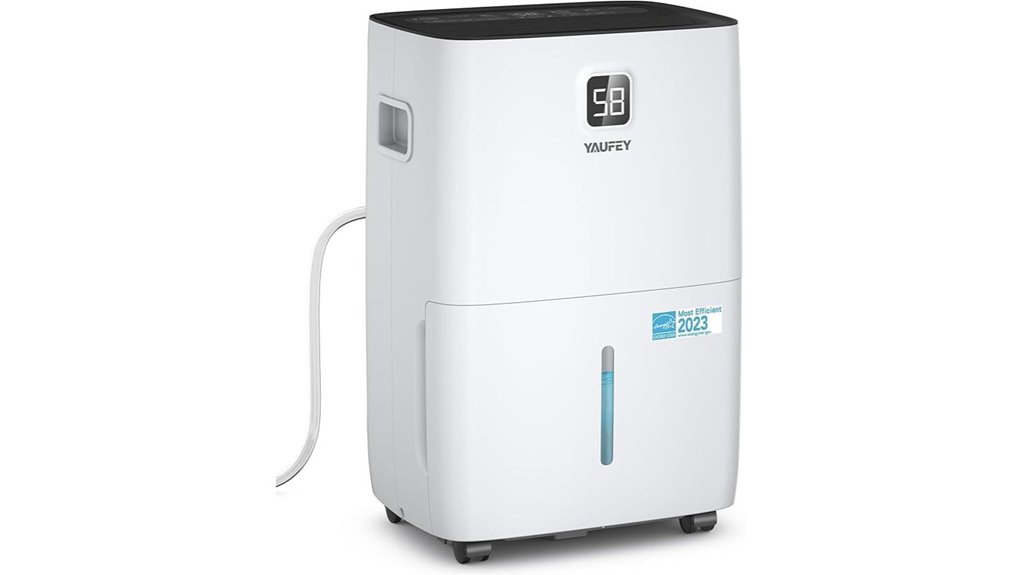
Bottom line: The Yaufey JD025Q-80 gives you continuous gravity drainage and four ready-made humidity presets without paying for a pump. Buy it for a large open basement or ground floor with a drain below the unit.
- Headline rating: 80 pints/day at 95°F and 90% RH, a peak-condition figure
- Rating to compare: 60 pints/day at 86°F and 80% RH, nearer to real basements
- Coverage claim: up to 5,000 sq. ft., only where air circulates freely
- Drainage: tank or the included 3.28 ft gravity hose, no pump
- Water tank: 1.06 gallons, cuts off and lights up when full
The preset modes do the thinking for you. Sleeping Area holds 55% RH, Living Area 50% and Basement 45%, while Continuous runs the compressor until you stop it. You can also set any level between 30% and 80% in 5% steps, which is a wider band than the 40% floor many units impose.
Three fan speeds, automatic defrost, a 24-hour timer, child lock, restart memory and a washable filter cover the rest of daily use. Wheels make it easy to reposition when you find the spot that actually dries the room.
- Drain hose included, so unattended running needs no extra parts
- Humidity adjusts from 30%, lower than most rivals allow
- Four presets remove the guesswork from a set point
- Restart memory brings settings back after a power cut
- Yaufey does not publish a DOE figure for this model number
- The 1.06-gallon tank fills fast in a wet space without the hose
- No pump, so the drain must sit below the unit
2. AEOCKY LEO-001 80-Pint Dehumidifier with Pump
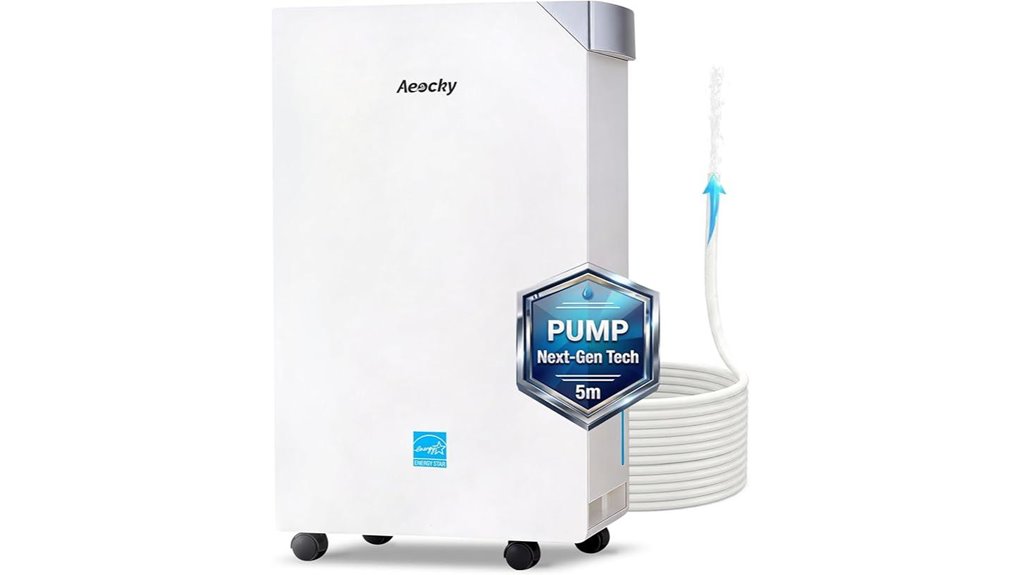
Bottom line: The AEOCKY LEO-001 with Pump moves condensate upward to a sink, window or raised drain, which is the one job gravity models cannot do. Buy it when your basement has no low drain point.
- Headline rating: 80 pints/day at the listing’s peak heat and humidity test
- Rating to compare: 24.5 pints/day on its ENERGY STAR record, the DOE test
- Coverage claim: up to 4,500 sq. ft. in one connected open space
- Drainage: tank, gravity hose, or pump lifting about 16.4 ft
- Water tank: removable tank with an automatic full cut-off
This is the only unit here carrying an ENERGY STAR Most Efficient designation on the public record, with an integrated energy factor of 1.87 L/kWh and 286 kWh a year at the test conditions. That record also confirms it uses R32 refrigerant, which has a lower global warming potential than older blends.
Day to day, an intelligent humidistat, timer, comfort mode, power-off memory, wheels and a washable filter keep intervention to a minimum. The trade-off is the pump itself: one more mechanical part, one more path to keep clean.
- Three drainage routes, so placement is not dictated by plumbing
- ENERGY STAR Most Efficient on the public certification record
- Published 24.5 pint DOE figure makes real comparison possible
- Power-off memory restores settings without a reset
- Pump path and nozzle need periodic cleaning
- Coverage claim is the smallest of the portables here
- The 80-pint headline uses extreme test conditions
3. Vellgoo DryTank Max 100 Pint Dehumidifier with Pump
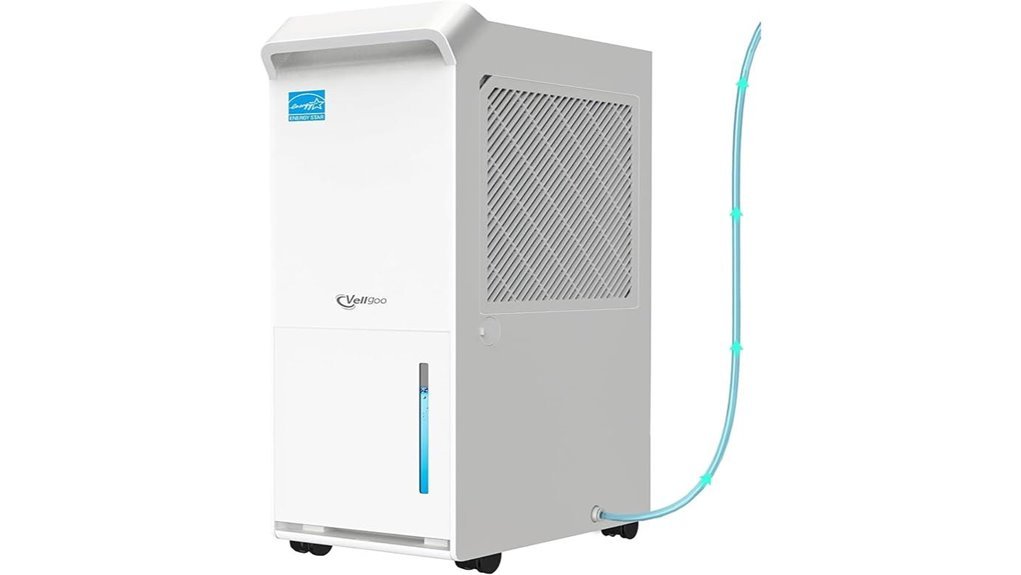
Bottom line: The Vellgoo DryTank Max 100 Pint with Pump is the second route to upward drainage, with a larger coverage claim than the AEOCKY. Buy it for a wide basement or garage where the drain is awkwardly placed.
- Headline rating: 100 pints/day at the listing’s maximum test conditions
- Rating to compare: not published by Vellgoo, so treat 100 as a ceiling
- Coverage claim: up to 5,000 sq. ft. within one open humidity zone
- Drainage: tank, gravity hose, or the built-in condensate pump
- Water tank: removable tank with an automatic full cut-off
Vellgoo lists ENERGY STAR, RoHS and ETL certification for the DryTank line, and the linked listing adds automatic defrost, automatic restart and smart humidity control. The listing promotes roughly 16.4 feet of lift for the pump, a figure we could not confirm against a manufacturer spec sheet.
Support runs a year, with a second year added on registration. A washable filter, wheels and a 24-hour timer round out the practical side.
- Three drainage methods, including upward pump drainage
- Larger coverage claim than the other pump model here
- Automatic defrost and restart support long unattended runs
- Second warranty year available on registration
- No standardized pint rating published for this model
- Pump cycling is more audible than fan-only running
- The 100-pint figure reflects extreme test conditions
4. Waykar YDZ-120 120-Pint Dehumidifier
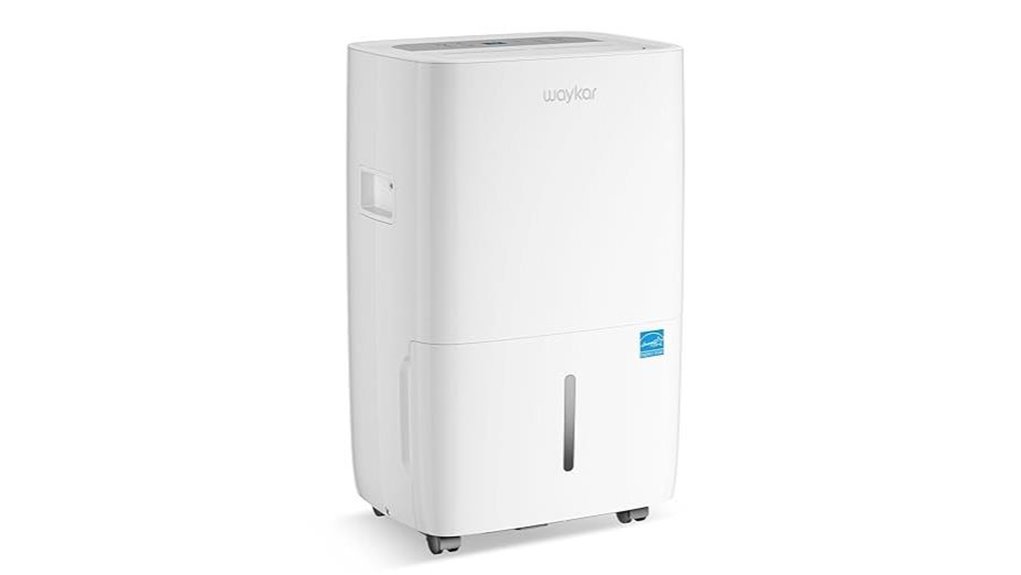
Bottom line: The Waykar YDZ-120 throws air further than the rest, thanks to a 90-degree oscillating outlet. Buy it for a wide, persistently damp single level with a drain below the unit.
- Headline rating: 120 pints/day at 95°F and 90% RH, the listing’s maximum
- Rating to compare: 35 pints/day on its ENERGY STAR record, the DOE test
- Coverage claim: up to 6,000 sq. ft., the widest claim among the portables
- Drainage: tank or the included 3.3 ft gravity hose, no pump
- Water tank: 1.14 gallons with an automatic full cut-off
The gap between 120 and 35 is the whole point of this guide. Both numbers are real, but only the 35 pint figure was measured the way every certified dehumidifier is measured, so it is the one to line up against rival units.
The certification record puts annual consumption at 382 kWh with an integrated energy factor of 2.02 L/kWh. Humidity adjusts from 30% to 80%, and automatic defrost, a self-drying cycle, a 24-hour timer, restart memory and a washable filter handle the rest. The swing function helps spread dry air across an open floor rather than a single corner.
- Highest standardized rating of the portable units here
- Oscillating outlet spreads dry air across a wide room
- Annual energy use published on the certification record
- Self-drying cycle helps keep the coil clean between runs
- No built-in pump for an elevated drain
- The 120-pint headline needs severe heat and humidity
- The tank needs frequent emptying if the hose is unused
5. AprilAire E080 Pro 80-Pint Whole-House Dehumidifier
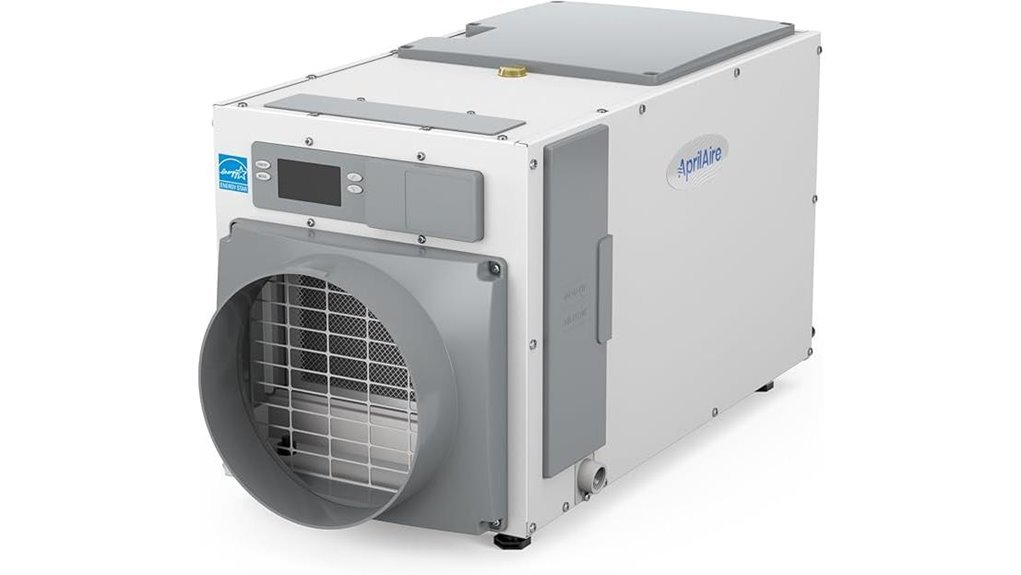
Bottom line: The AprilAire E080 Pro quotes one honest 80-pint number instead of a 95°F headline, and backs it with a metal cabinet and a five-year warranty. Buy it for a permanent basement or crawl-space installation.
- Headline rating: 80 pints/day on AprilAire’s own rating, not a peak figure
- Rating to compare: the same 80 pints/day, so nothing needs translating
- Coverage claim: up to 4,400 sq. ft. for basements, crawl spaces and homes
- Drainage: continuous drain only, through the included barbed fitting
AprilAire allows free-standing operation as well as ducted installation, so you can run it as a local unit provided you follow the manual on clearance, levelling and drainage. Airflow is rated at 185 CFM, and the unit weighs 63 pounds with no wheels, which tells you it is meant to be placed once.
The box includes 10-inch inlet and outlet duct collars, a backdraft damper, levelling feet, an 8-foot power cord and a washable MERV 8 filter. Corrosion-resistant aluminium coils and a digital control that mounts on the top or the inlet side suit a unit you will rarely stand over.
- Its rating needs no decoding against a marketing maximum
- Metal cabinet and aluminium coils built for permanent placement
- Washable MERV 8 filter avoids a recurring replacement cost
- Control panel mounts on the top or the inlet side
- Five-year manufacturer warranty
- No tank, so a reliable drain is not optional
- At 63 pounds with no wheels, it does not move between rooms
- No Wi-Fi or app control on this model
6. AprilAire E070W Wi-Fi Dehumidifier
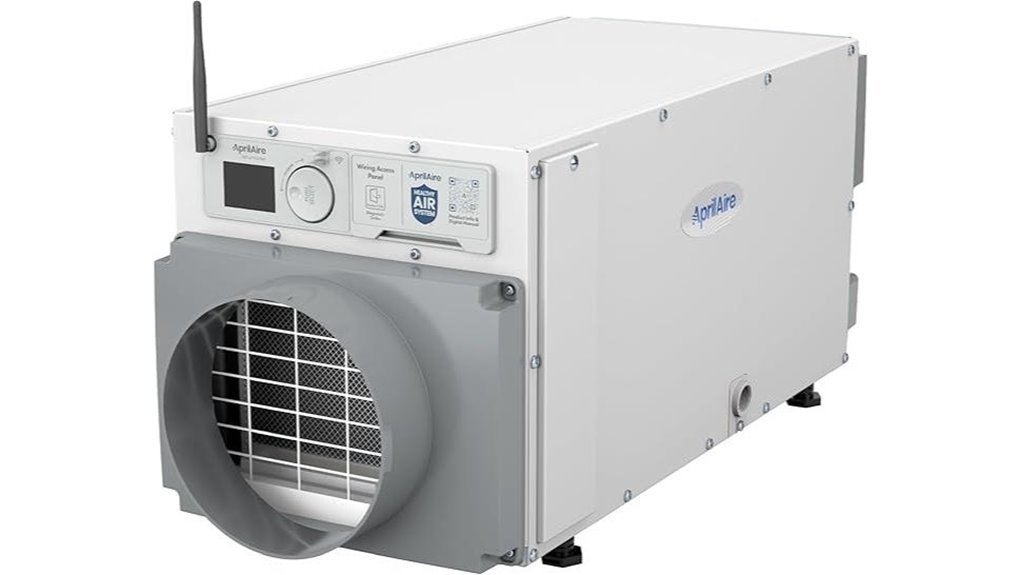
Bottom line: The AprilAire E070W is the one unit here you can check from your phone instead of climbing into a crawl space. Buy it for a sealed crawl space or basement you would rather not visit.
- Headline rating: 70 pints/day at AprilAire’s 80°F and 60% RH rating
- Rating to compare: 53 pints/day at 73°F and 60% RH on the E070 sheet
- Coverage claim: up to 2,200 sq. ft., the smallest figure in this guide
- Drainage: continuous drain with 10 ft of tubing supplied
Bluetooth pairing takes under three minutes, after which the Healthy Air App gives you humidity readings, set-point control, alerts and diagnostics from anywhere. The unit samples the air periodically, restarts when the reading drifts above your target, and can also be set to circulate air so humidity and temperature even out across the space.
AprilAire’s spec sheet for the E070 platform lists half-inch EPS cabinet insulation, a washable MERV 8 filter, corrosion-resistant aluminium coils, 8-inch duct collars, 200 CFM at zero external static pressure and 53 dBA when ducted. The linked listing adds a second year of parts cover on top of the five-year replacement warranty.
- Real Wi-Fi control with alerts and diagnostics, not just a humidistat
- Drain tubing and duct collars supplied in the box
- Insulated cabinet suits an unconditioned crawl space
- Publishes a second capacity figure at cooler conditions
- Smallest coverage claim here, despite the price bracket
- No tank, so continuous drainage is mandatory
- Gravity drain only, so a raised drain needs a separate pump
7. AlorAir Sentinel WHD100 Whole House Dehumidifier
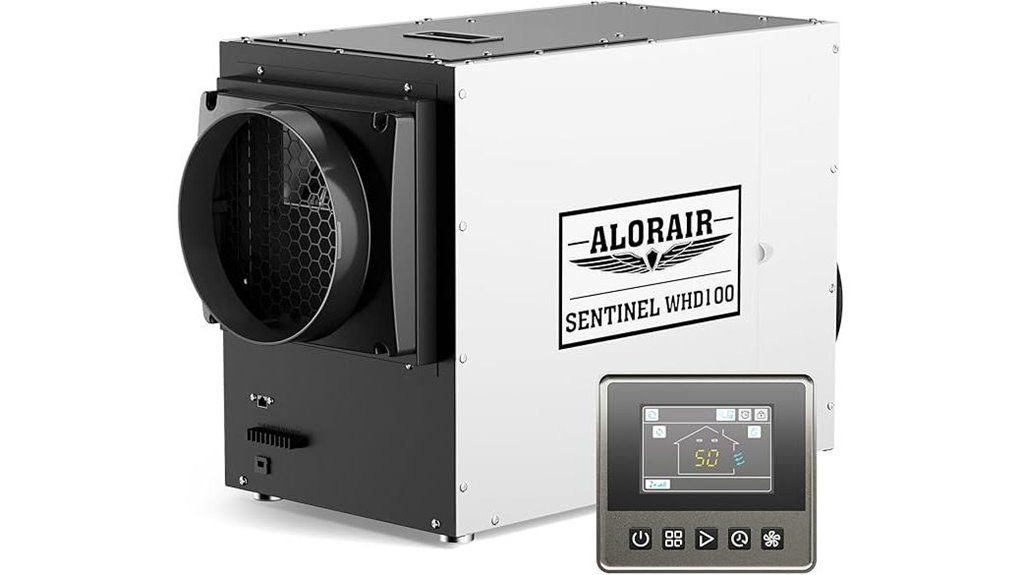
Bottom line: The AlorAir Sentinel WHD100 is restoration-grade hardware with a six-year warranty and adjustable airflow direction. Buy it for a demanding crawl space, garage or storage area you plan to leave it in.
- Headline rating: 90 pints/day at AHAM conditions, 80°F and 60% RH
- Rating to compare: 70 pints/day at DOE whole-house conditions, 73°F and 60% RH
- Coverage claim: up to 2,300 sq. ft. for homes, garages and crawl spaces
- Drainage: continuous gravity drain, no collection bucket
AlorAir quotes 2.6 L/kWh at AHAM conditions and 2.2 L/kWh at DOE whole-house conditions, uses R32 refrigerant and holds cETL certification. Publishing both test points is unusual at this size and makes the unit far easier to compare honestly.
The cabinet lets you rotate intake and discharge, choosing front-in with rear-out or front-in with top-out, which is what makes free-standing use practical in a tight utility space. Automatic defrost, continuous mode, a timer and restart memory cover unattended running, and ducting can be added later if your needs change.
- Publishes both AHAM and DOE capacity figures
- Six-year limited warranty, the longest cover here
- Rotatable intake and discharge suit awkward utility spaces
- Automatic defrost supports cool crawl spaces and garages
- Bigger and heavier to position than a wheeled portable
- Duct kits and remote accessories are sold separately
- No bucket, so the drain run has to be right first time
8. DECIUU Max 100 Pint Dehumidifier with Pump
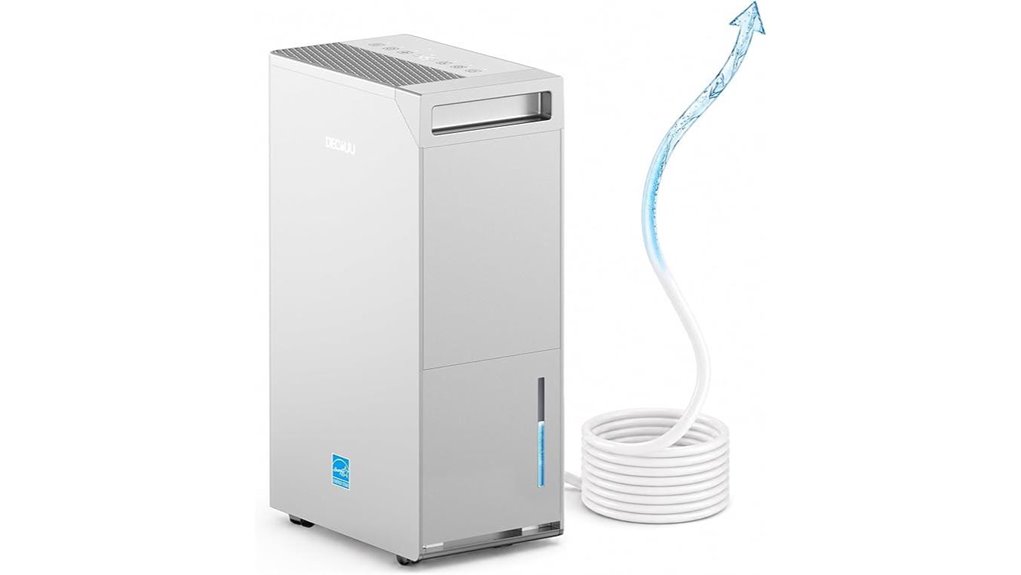
Bottom line: The DECIUU Max 100 Pint with Pump pairs upward drainage with the largest tank of the pump models, so it copes if the pump is switched off. Buy it when you want a pump but still want a fallback.
- Headline rating: 100 pints/day at the listing’s peak test conditions
- Rating to compare: 32 pints/day on DECIUU’s matching certification record
- Coverage claim: up to 5,000 sq. ft. within one open humidity zone
- Drainage: tank, 6.56 ft hose, or pump lifting up to 16.4 ft
- Water tank: 1.45 gallons with an automatic full cut-off
Three drainage routes is the real selling point. Beyond the tank and the supplied hose, the outlet takes a standard three-quarter-inch garden hose for longer runs, and the pump handles a sink, utility tub, window or raised drain.
Humidity sets between 35% and 80%, and a memory chip restores your last configuration after a power interruption. A washable filter, a hidden handle and 360-degree casters make it easy to reposition while you find the spot that works.
- Built-in pump lifts condensate up to 16.4 feet
- Largest tank among the pump-equipped models here
- Accepts a standard garden hose for long gravity runs
- Memory chip restores settings after a power cut
- Near-identical pump-free versions are sold alongside it
- The 100-pint number is not the standardized rating
- Pump components and hoses need periodic inspection
9. DECIUU DER32S01-50 100 Pint Dehumidifier with Hose
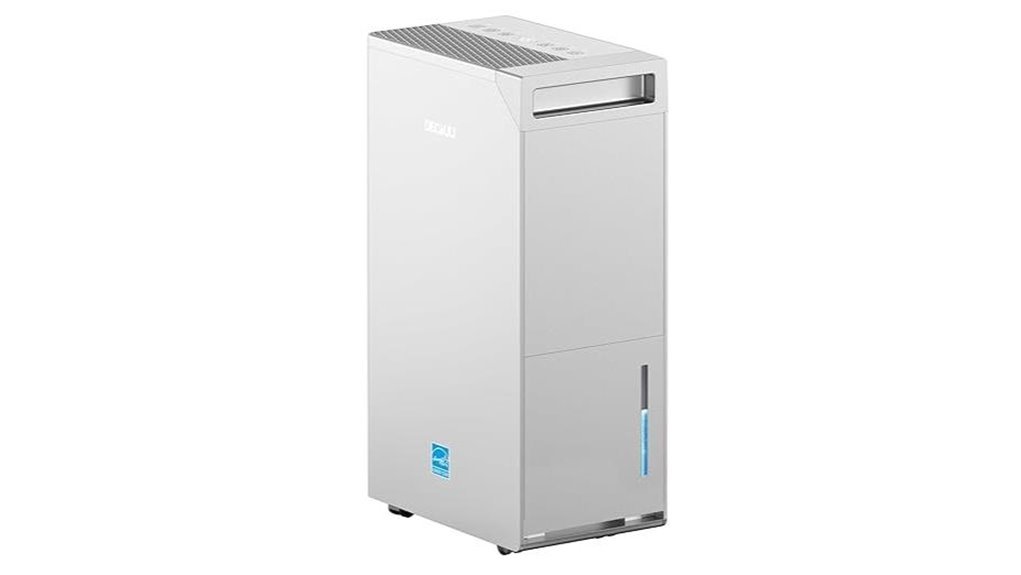
Bottom line: The DECIUU DER32S01-50 has the strongest published efficiency of any portable here, and no pump to maintain. Buy it for a large basement or open living area with a drain below the unit.
- Headline rating: 100 pints/day at the listing’s peak test conditions
- Rating to compare: 32 pints/day on its ENERGY STAR record, the DOE test
- Coverage claim: up to 5,000 sq. ft. within one open humidity zone
- Drainage: tank or the included gravity hose, no pump
- Water tank: removable tank with an automatic full cut-off
The certification record puts this model at 2.13 L/kWh and 334 kWh a year, the best efficiency figure of any portable we verified for this guide. If you plan to run a dehumidifier around the clock through a damp season, that number matters more than the one on the box.
Note the listing’s own “standard 70 pint” figure is not the DOE rating either. The 32 pint figure is the one measured under the test every certified unit must pass, so it is the number to carry across to rival models.
Humidity sets between 35% and 80% with a high-precision sensor, and the memory chip restores your settings automatically. Automatic defrost, a timer, a washable filter and casters cover everyday basement duty.
- Best published efficiency of the portables here
- Annual energy use listed on the certification record
- Gravity drainage avoids pump maintenance entirely
- Memory chip means no resetting after an outage
- No pump, so the drain must sit below the unit
- Humidity stops at 35%, not 30% like the Yaufey
- The listing’s headline and “standard” numbers both overstate the DOE rating
10. AEOCKY LEO-Lite-2 105-Pint Dehumidifier with Drain Hose
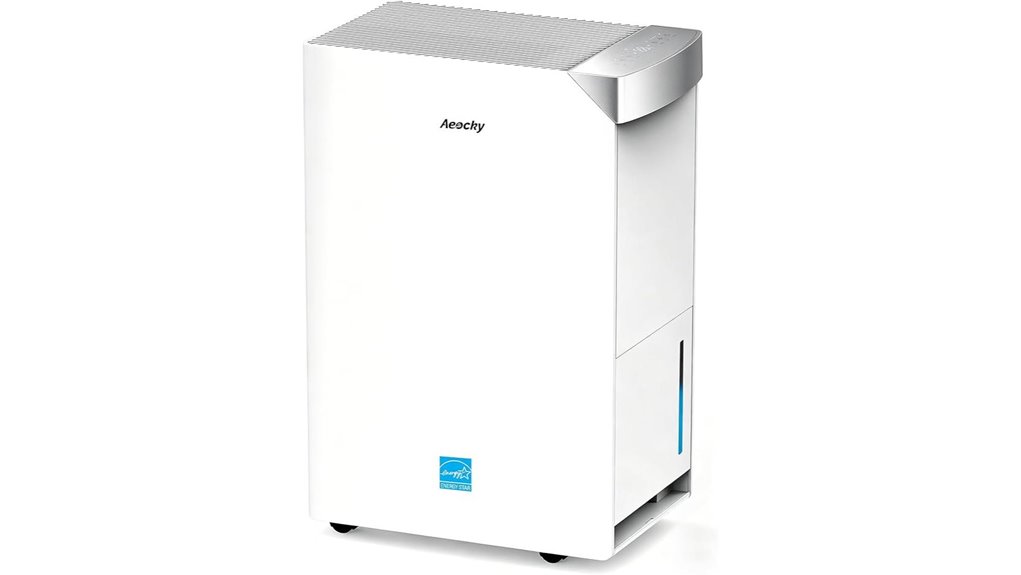
Bottom line: The AEOCKY LEO-Lite-2 publishes a second capacity figure at ordinary basement conditions, which is rarer than it should be. Buy it for a big open space where you want the humidistat left alone to do its job.
- Headline rating: 105 pints/day at 95°F and 95% RH, the peak figure
- Rating to compare: 72 pints/day at 86°F and 80% RH, a damp-basement figure
- Coverage claim: up to 5,500 sq. ft., the largest portable claim here
- Drainage: tank or the included gravity hose, no pump
- Water tank: removable tank with an automatic full cut-off
AEOCKY is pointed about certification on this listing, stating compliance with ENERGY STAR Version 6.0 rather than a year-stamped “Most Efficient” claim. That distinction is worth understanding: Version 6.0 is the current certification specification, while Most Efficient is a separate annual recognition that only a small share of certified models receive.
Operation is conventional in the best sense. An automatic humidistat cycles the compressor around your set point, automatic defrost protects the coil in cooler rooms, and the drain hose keeps you away from the tank. There is no app, so “smart” here means automatic sensing, not connectivity.
- Publishes a second figure at realistic basement conditions
- Largest coverage claim of the portable units listed
- Automatic humidistat and defrost reduce manual adjustment
- Drain hose included for continuous gravity drainage
- The word “smart” implies app control this model does not have
- No pump for an elevated drain point
- The 105-pint headline needs 95°F and 95% RH
Yaufey JD025Q-80 vs DECIUU DER32S01-50: Is the Upgrade Worth It?
Both are gravity-drain portables for one large open zone. The choice comes down to whether you value published efficiency data or a wider, better-signposted set of controls.
- Published rating: DECIUU lists 32 pints/day on the certification record; Yaufey publishes no DOE figure for this model
- Running cost: DECIUU’s record shows 2.13 L/kWh and 334 kWh a year, so a season of use is predictable
- Humidity range: Yaufey adjusts from 30% in 5% steps, where DECIUU stops at 35%
- Ease of setup: Yaufey’s Sleeping, Living and Basement presets choose a sensible target for you
Which Non-Ducted Dehumidifier Should You Buy?
- A big open basement with a floor drain: get the Yaufey JD025Q-80.
- A drain point above the unit: get the AEOCKY LEO-001 with Pump.
- A very wide open floor or workshop: get the Waykar YDZ-120.
- A permanent install with a rating you can trust: get the AprilAire E080 Pro.
- A sealed crawl space you would rather monitor by phone: get the AprilAire E070W.
- Months of continuous running on the lowest documented energy use: get the DECIUU DER32S01-50.
How We Chose
- We opened every linked listing and matched each ASIN to a manufacturer model number, so the product listing describes the product the link actually sells.
- We separated peak-condition pint claims from standardized ratings, checking each model in the ENERGY STAR product finder and against manufacturer specification sheets.
- We compared drainage in practical terms: gravity hose length, pump lift, tank size and whether a tank exists at all.
- We checked CPSC and manufacturer recall notices. None of the ten products appears in the current dehumidifier recalls, which cover other manufacturers.
- We did not test these units ourselves. Every specification here comes from a manufacturer document, a certification record or the live listing, and is labelled accordingly.
Factors to Consider When Choosing a Non-Ducted “Whole-House” Dehumidifier
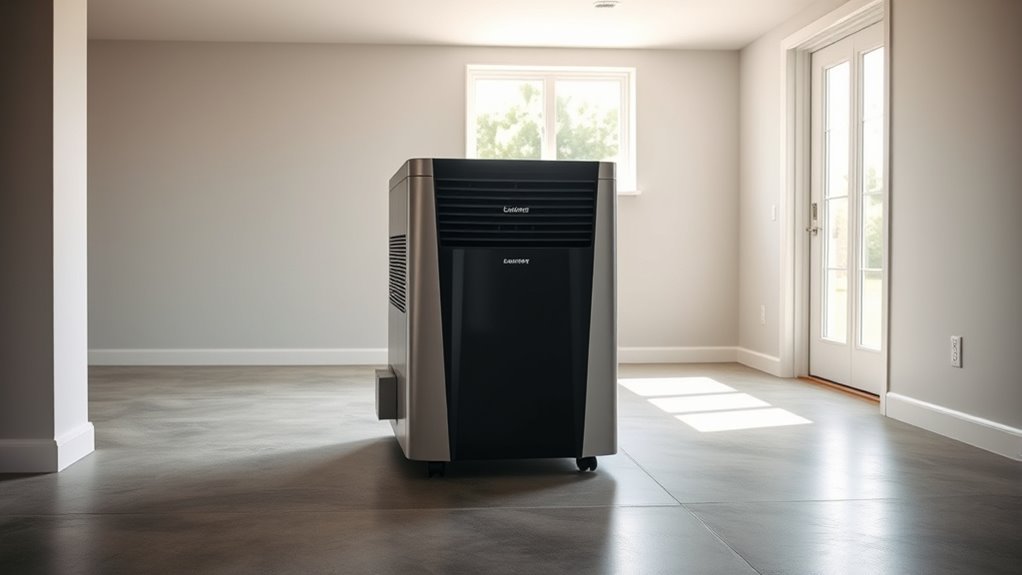
A standalone unit can manage a large open zone, but the right choice depends on far more than the square-foot number in the title. Work through capacity, layout, drainage, temperature, noise, controls, maintenance and installation before you buy.
What “Whole House” Means Here
In marketplace titles, “whole house” usually signals a high-capacity model with a large coverage claim. In use, a non-ducted unit treats the air that naturally reaches it and does not push dry air into closed rooms or other floors. Professional models such as the AprilAire and AlorAir units can run free-standing or ducted, but each setup has to follow the manufacturer’s instructions.
Portable Versus Fixed Standalone Units
A portable gives you a tank, wheels and freedom to move. A fixed professional model is heavier, needs continuous drainage and more planning, but returns a metal cabinet, higher airflow and a longer warranty. Decide which you value: mobility, or a setup you install once and forget.
Coverage Area and Layout
Coverage claims are useful for rough ranking, not for guarantees. Ceiling height, open doors, stairways, insulation, outdoor air leakage, moisture sources and starting humidity all change the result. In a divided home, map the separate humidity zones and put a hygrometer in each one before you choose.
Standardized Moisture-Removal Rate
Never rank products by the biggest number in the title. Portable units are tested for DOE and ENERGY STAR at 65°F and 60% RH, while marketing figures often come from 95°F and 90% RH. The Waykar YDZ-120 illustrates the gap perfectly: 120 pints in the title, 35 pints on the certification record. Look up the exact model number before treating two units as equal.
Drainage Options
Emptying a tank by hand is fine for occasional use and miserable in a wet basement. Gravity drainage is the simplest continuous option when the hose can slope down to a floor drain, sump or low outlet. Choose a built-in pump only when water has to travel up to a sink, window or raised drain, and respect the manual’s limits on lift and hose length.
Energy Efficiency
Check the exact model number in the ENERGY STAR product finder rather than trusting a badge in a listing title. The record gives you an integrated energy factor in L/kWh and an annual consumption figure, which is far more useful than a promised dollar saving. Real consumption still depends on humidity load, runtime, filter condition, fan speed and your set point.
Noise Levels
Published noise ratings are usually measured at the lowest fan speed and rarely include a pump cycling. For a bedroom or living room, look for a published low-speed figure and a sleep mode. For a basement or garage, airflow and drainage matter more than a couple of decibels. Keep the unit level and stop the cabinet or hose vibrating against a wall.
Wi-Fi Versus Automatic Controls
“Smart” covers two very different things. A Wi-Fi model such as the AprilAire E070W connects to an app for remote monitoring and alerts. An automatic humidistat simply cycles the compressor around a target. Confirm which one the exact model offers. Timers, restart memory and full-tank alerts remain useful without any app at all.
Cold-Basement Performance
Refrigerant dehumidifiers remove less water as the temperature falls, because cold air holds less moisture and the coil ices more readily. Automatic defrost prevents icing, but it will not restore summer output. Check the minimum operating temperature in the manual, and deal with leaks, ground moisture or missing insulation rather than asking the appliance to compensate.
Maintenance Needs
Inspect the filter regularly in heavy use and clean it on the manufacturer’s schedule. Wash the tank, check the float, look for slime or blockages in the drain hose, and clean the pump path if you have one. Leave the specified clearance around intake and outlet so the unit is not recirculating its own discharge.
Installation and Safety
Set the unit on a stable, level surface and use a grounded outlet matching the rating label. Do not run it on an undersized extension cord. Secure every drain connection, test for leaks before you leave it, and route the hose where nobody will trip on it. Fixed professional units may need extra clearance, drainage work or a qualified installer.
Mistakes to Avoid When Buying a Non-Ducted Dehumidifier
- Ranking by the biggest number: compare standardized ratings, not 95°F marketing maximums.
- Leaving drainage until delivery day: decide on gravity or pump before you order, and measure the run.
- Buying by square footage alone: a closed door defeats a 6,000 sq. ft. claim instantly.
- Assuming “whole house” reaches every room: a portable treats one open zone, nothing more.
- Setting the humidistat as low as it goes: every extra step down adds runtime and energy for little comfort gain.
FAQs
Can One Portable Dehumidifier Control Humidity Across Multiple Floors?
Usually not evenly. One high-capacity unit can influence nearby open areas, but closed doors, stairways and separate HVAC zones limit how much air actually reaches its intake. Put a hygrometer on each floor, run the unit for a few days, then compare readings. If one level stays damp, a second unit is normally the practical fix.
Which Pint Capacity Should I Compare?
Compare the standardized figure, not the headline. Portable units are tested for DOE and ENERGY STAR at 65°F and 60% RH, so a listing advertising 120 pints at 95°F and 90% RH may hold a 35 pint rating. Look the exact model number up in the ENERGY STAR product finder before you treat two units as equal.
What Drain Setup Works Best for Continuous Operation?
A gravity hose running downhill to a floor drain or sump is the simplest and the least likely to fail, because nothing has to switch on for it to work. Use a built-in pump only when the drain sits above the unit. Follow the manual’s maximum lift and hose length, and test for leaks before leaving it unattended.
Can a Professional Whole-Home Unit Run Without Ducts?
Some can. AprilAire and AlorAir both describe free-standing operation with air drawn in and discharged at the cabinet, but only where the manufacturer permits it for that model. You still need the specified clearances, a continuous drain, suitable power and a layout that lets air return to the unit. Read the installation manual before buying.
What Indoor Humidity Should I Target?
Most homes are comfortable between 30% and 50% relative humidity, and AprilAire recommends holding 40% to 60% for its whole-house units. Pick a set point in that band rather than the lowest number the panel allows. Every step down increases runtime and energy use without making the room feel meaningfully drier.
Do Portable Models Work Well in Cold Basements?
They work, but output falls as the temperature drops, because cold air holds less moisture and the coil ices more easily. Choose a model with automatic defrost, check the minimum operating temperature in the manual, and fix leaks or groundwater entry first. A desiccant unit suits spaces that stay below roughly 60°F.
Will a Dehumidifier Remove Existing Mold?
No. Lower humidity makes conditions less favorable for new growth, but it does not clean mold that has already taken hold and it does not repair the leak feeding it. Remediate affected materials safely, fix the water source, then use the dehumidifier to hold the space at a stable relative humidity.
What Does “Whole House” Mean on a Portable Model?
It usually means the manufacturer claims enough capacity for a very large area, not that the unit distributes dry air through every room. A portable model treats one open humidity zone. Treat the phrase as a capacity claim, check the standardized pint rating, and size the unit to the space air can actually reach.
Final Verdict
For most buyers the Yaufey JD025Q-80 is the right non-ducted whole house dehumidifier: two drainage options, presets that pick a sensible target, and a humidity floor of 30%. Match the drainage method to your layout first, then compare standardized ratings rather than headline pints.
If you plan to run it for months, the DECIUU DER32S01-50 has the best published efficiency here, and the AprilAire E080 Pro remains the pick for a permanent installation with a rating you can take at face value.