The best dehumidifier for a humid environment depends on the actual moisture load, not just the square-foot number in a product title. For a persistently damp basement, laundry area, or large room, a compressor model such as the AEOCKY 50 Pint or KNKA 34 Pint is the stronger choice. Compact semiconductor units such as the CLEVAST, UBBO, NineSky, BeOkay, Deyagoo, and KeepGlad models are better for lighter humidity in bedrooms, bathrooms, closets, RVs, and other enclosed spaces.
Affiliate disclosure: This article contains Amazon affiliate links. We may earn a commission from qualifying purchases at no extra cost to you.
Updated: August 2026. Product specifications and availability can change, so confirm the current listing and manual before ordering.
Quick Verdict
- Best overall for persistently humid rooms: AEOCKY 50 Pint Compressor Dehumidifier
- Best mid-size compressor option: KNKA 34 Pint Dehumidifier
- Best compact model with a drain hose: UBBO 95oz Dehumidifier
- Best quiet mini option: CLEVAST 30oz Mini Dehumidifier
- Best compact model with humidity display: KeepGlad 98OZ Dehumidifier
Important capacity note: A water-tank size tells you how much collected water the unit can hold; it does not tell you how quickly the unit removes moisture. For damp basements and high-load spaces, compare moisture removal in pints or liters per day, the stated test conditions, drainage options, and whether the unit has a true humidistat.
Quick Comparison
| Product | Type | Key Capacity Detail | Best For | Main Limitation | Amazon |
|---|---|---|---|---|---|
| AEOCKY 50 Pint | Compressor | Listed at up to 50 pints/day; 0.8-gallon tank | Basements and persistently damp rooms | Larger and louder than mini units | Check Price |
| KNKA 34 Pint | Compressor | Up to 34 pints/day at 95°F and 90% RH; 3L tank | Medium rooms, laundry areas, and basements | Hot-condition rating may exceed real-world output | Check Price |
| UBBO 95oz | Dual semiconductor | Seller states up to 1.2L/day in warm, humid conditions | Bathrooms, RVs, and small enclosed rooms | Not a substitute for a compressor unit in a wet basement | Check Details |
| KeepGlad 98OZ | Dual semiconductor | 98oz tank; seller-stated moisture output should be checked on listing | Small rooms needing display and hose drainage | Advertised coverage is not compressor-equivalent capacity | Check Price |
| CLEVAST 30oz | Semiconductor | Up to 10oz/day at 86°F and 85% RH | Closets, bedrooms, campers, and small bathrooms | Low output for severe humidity | Check Price |
| BeOkay 1657ML | Semiconductor | 1657ml tank; daily removal rate not clearly stated | Small rooms needing timers and multiple modes | Tank capacity must not be mistaken for daily output | Check Price |
| NineSky 95oz | Semiconductor | 95oz tank; daily removal rate not listed clearly | Bedrooms, bathrooms, closets, and RVs | Do not rely on the 1,000 sq. ft. claim alone | Check Price |
| Deyagoo 1500ML | Semiconductor | Up to 300ml/day at 86°F and 80% RH | Closets, small bedrooms, bathrooms, and RVs | Slow for very damp rooms | Check Price |
| Aromatherapy Dehumidifier | Semiconductor | Daily removal capacity not clearly verified | Small rooms where fragrance is a priority | Diffuser feature matters more than raw capacity | Check Details |
CLEVAST Small Quiet Mini Dehumidifier for Home
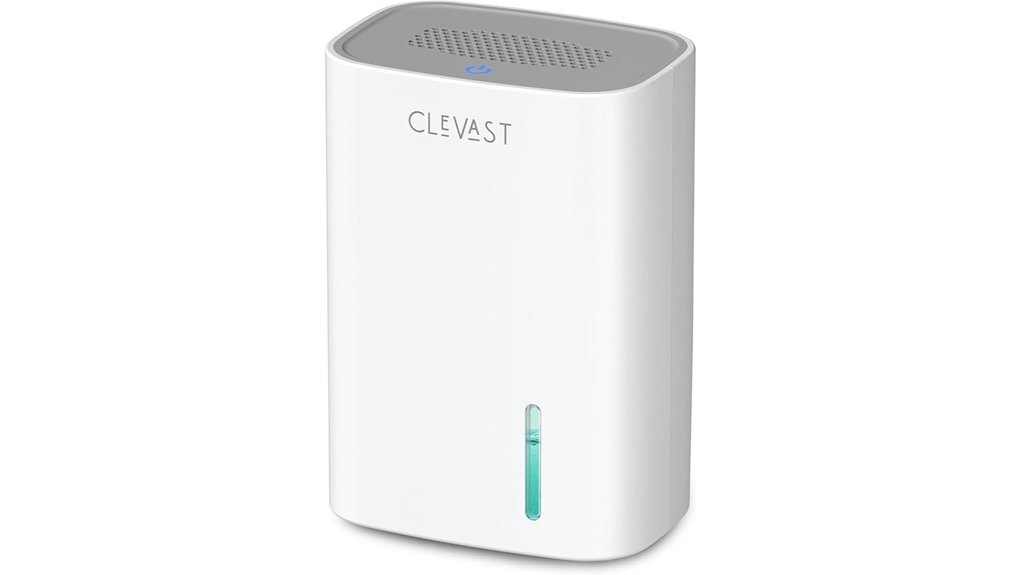
The CLEVAST is designed for light moisture control in small enclosed spaces. Its listing states that it can collect up to 10 ounces of water in 24 hours when tested at 86°F and 85% relative humidity. That makes it more suitable for a closet, compact bathroom, bedroom, camper, or similar area than for a damp basement or whole-floor problem.
The 30-ounce tank, carry handle, and automatic shutoff make it simple to move and maintain. The seller also lists a 24 dB quiet mode and daily consumption of about 0.55 kWh, although actual output and energy use will vary with temperature, humidity, airflow, and run time.
Best For: Buyers who want a quiet, portable mini dehumidifier for mild humidity in a small room.
Who Should Avoid It: Anyone dealing with wet walls, standing water, heavy basement dampness, or a large open-plan space.
Pros:
- Compact design with a built-in handle.
- Quiet mode is suitable for bedrooms and nighttime use.
- Automatic shutoff helps prevent tank overflow.
Cons:
- Low moisture-removal capacity compared with compressor models.
- Performance drops in cooler or less humid conditions.
- No continuous drain hose listed for this model.
AEOCKY 50 Pint Compressor Dehumidifier for Home
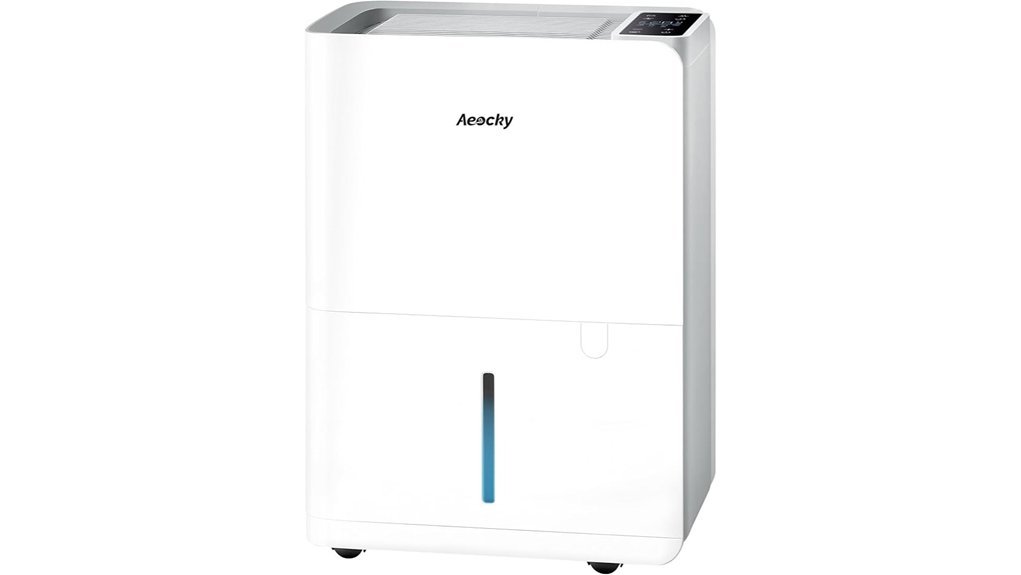
The AEOCKY 50 Pint is the most appropriate option in this roundup for a persistently humid basement, laundry room, or larger living area. Unlike the mini semiconductor models, it uses a compressor and is listed to remove up to 50 pints of moisture per day. The current listing also includes a drain hose, a 0.8-gallon collection tank, an adjustable humidistat, casters, and an integrated handle.
Its biggest advantage is moisture-removal capacity. A compressor model can manage a heavier moisture load and cycle around a chosen humidity setting. However, the advertised square-foot figure should still be treated as an estimate; room temperature, air movement, open doors, leaks, and the severity of dampness all affect performance.
Best For: Basements, laundry rooms, and larger spaces that remain damp for long periods.
Who Should Avoid It: Buyers who only need occasional moisture control in a tiny closet or who require an almost silent bedside unit.
Pros:
- Highest listed pint-per-day capacity among the retained products.
- Humidistat supports automatic humidity control.
- Continuous drainage reduces bucket-emptying work.
- Casters and a handle improve portability.
Cons:
- Larger footprint than semiconductor models.
- Compressor and fan noise may be noticeable in quiet rooms.
- The small bucket can fill quickly if the drain hose is not used.
BeOkay 1657ML Small Dehumidifier with Adjustable Features
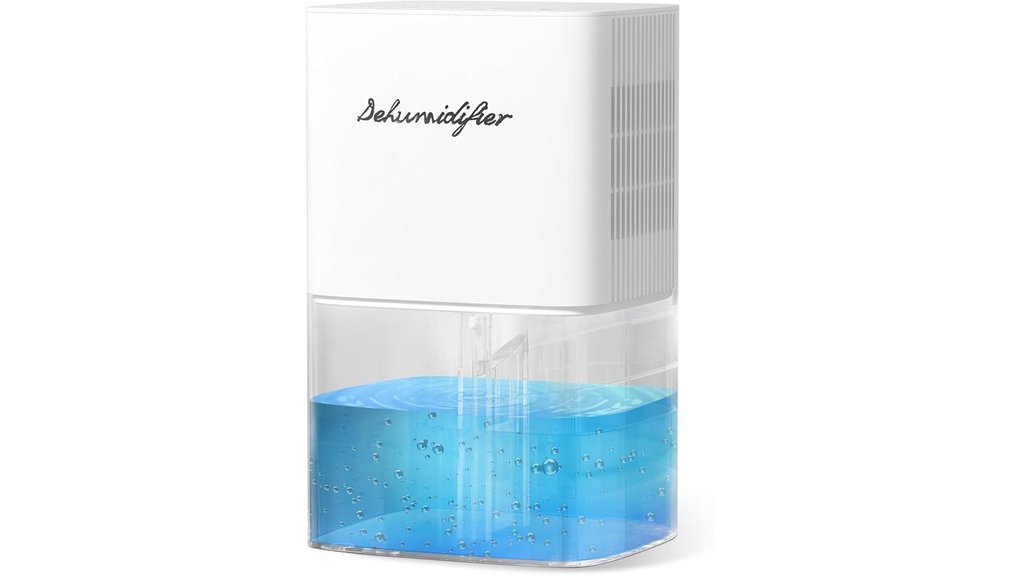
The BeOkay model has a 1657ml water tank, three operating modes, five timer choices, automatic shutoff, and adjustable lighting. The product listing incorrectly treated the tank size as the amount of moisture the unit could remove. Because the listing does not clearly provide a comparable daily extraction rate, this model should be judged as a convenience-focused mini dehumidifier rather than a high-capacity option.
Sleep mode is listed below 40 dB, while normal and performance modes increase airflow. Timer choices include 24, 48, 72, and 96 hours plus continuous operation. These features are useful in a bedroom or bathroom, but they do not overcome the basic limits of semiconductor technology in a heavily damp room.
Best For: Small rooms where adjustable modes, long timers, and a large mini-unit tank matter.
Who Should Avoid It: Buyers who need a verified pint-per-day rating for a basement or other high-moisture space.
Pros:
- Three operating modes and several timer choices.
- Large tank for a compact semiconductor model.
- Automatic shutoff and tilt-related protection are listed.
Cons:
- Daily moisture-removal capacity is not clearly stated.
- Advertised room coverage should not be treated as a performance guarantee.
- Lighting may be unnecessary for buyers who want a basic appliance.
UBBO 95oz Dehumidifier for Home with Drain Hose
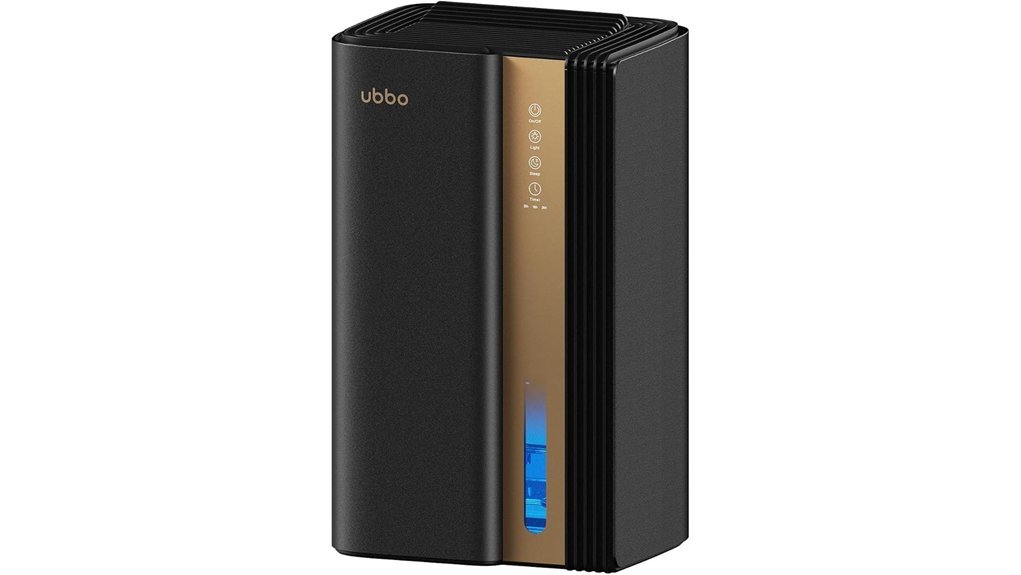
The UBBO combines a 95-ounce tank with dual semiconductor condensers and a drain-hose connection. The seller states that it can collect up to 1.2 liters per day at 86°F and 80% relative humidity. That is a warm, humid test condition, so real output may be lower in an air-conditioned bedroom, cool basement, or mildly humid room.
A sleep mode, timer, automatic shutoff, ambient lighting, and aromatherapy compartment add convenience. The hose is the most useful feature for buyers who want a compact unit to run without frequent manual emptying, provided the hose can slope continuously to a suitable drain.
Best For: Small bathrooms, RVs, closets, kitchens, and enclosed rooms where continuous drainage is practical.
Who Should Avoid It: Buyers expecting a compact semiconductor unit to control a wet or cold basement.
Pros:
- Drain hose can reduce manual tank emptying.
- Dual-semiconductor design is stronger than many basic mini units.
- Sleep mode and timer improve convenience.
Cons:
- Maximum output is based on warm, humid test conditions.
- The 1,000 sq. ft. marketing claim should not be compared directly with compressor capacity.
- Aromatherapy and lighting may not matter to every buyer.
NineSky 95oz Dehumidifier for Home
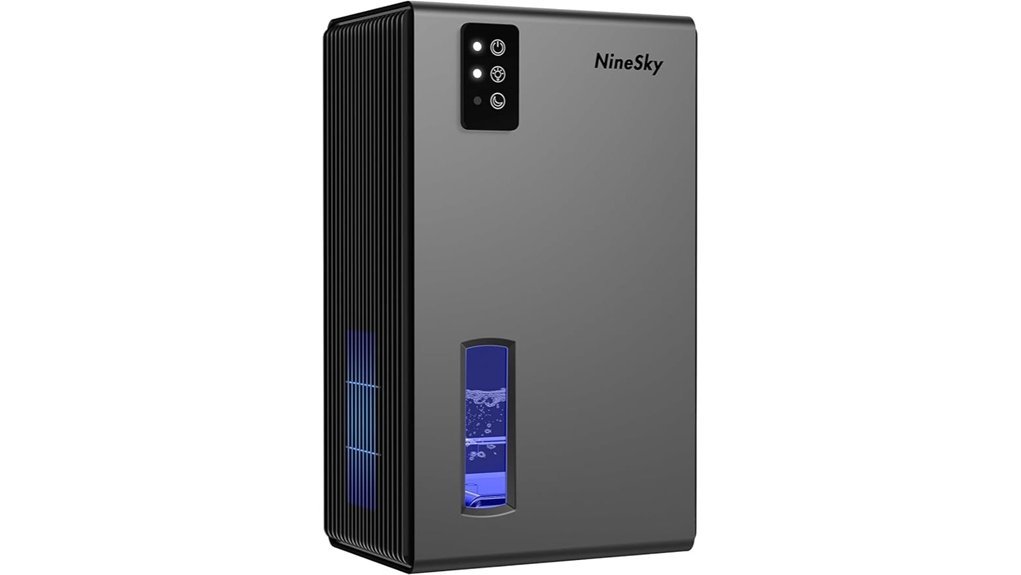
The NineSky has a 95-ounce tank, upgraded semiconductor dehumidification, automatic shutoff, a high-speed mode, a night mode, and seven-color lighting. It is compact enough for a bedroom, bathroom, closet, kitchen, or RV.
The listing promotes coverage up to 1,000 square feet, but it does not clearly provide a standardized daily water-removal rate. For that reason, the coverage figure should not be used as the main buying metric. Treat this as a compact moisture-control unit for one enclosed area, not as a replacement for a 20- to 50-pint compressor dehumidifier.
Best For: Buyers who want a straightforward mini dehumidifier with a large tank and night mode.
Who Should Avoid It: Anyone sizing a unit for a large basement based only on advertised square footage.
Pros:
- Large tank for a compact semiconductor unit.
- High-speed and night modes support different use cases.
- Automatic shutoff helps prevent overflow.
Cons:
- No clearly stated standardized daily extraction rate.
- Large-area coverage claim may create unrealistic expectations.
- No drain hose is highlighted in the retained listing details.
Deyagoo 1500ML Small Dehumidifier for Home
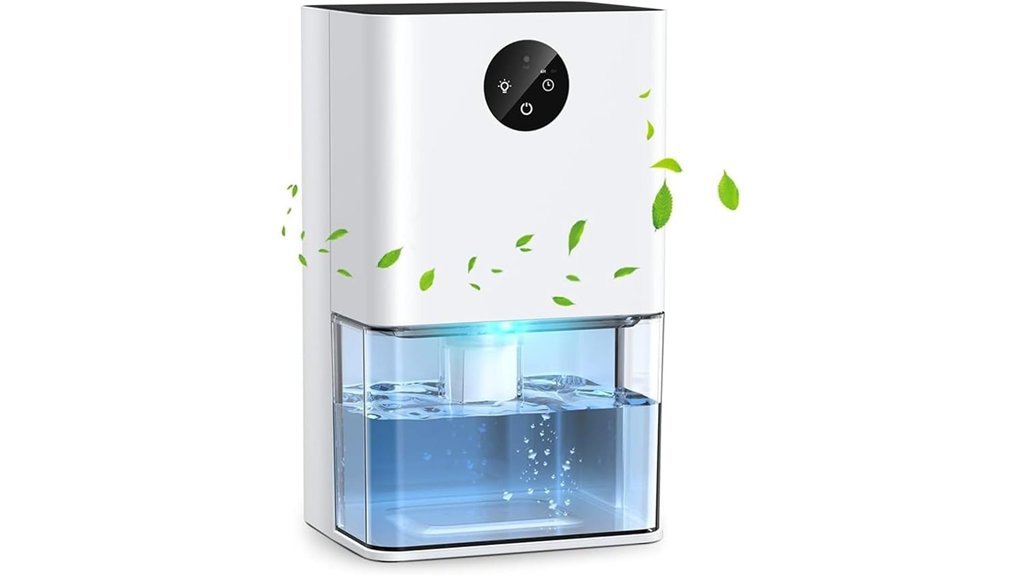
The Deyagoo DY501 is a compact semiconductor model with a 1500ml tank. Its listing states a maximum extraction rate of 300ml in 24 hours at 86°F and 80% relative humidity. It also includes automatic shutoff, a transparent tank, seven-color lighting, and a listed 30 dB operating level.
This is a practical choice for a closet, small bedroom, bathroom, or RV with mild humidity. It will work more slowly than the UBBO, KeepGlad, KNKA, or AEOCKY options and should not be selected for active leaks, wet walls, or a chronically damp basement.
Best For: Light moisture control in small enclosed spaces where low noise and a simple design are priorities.
Who Should Avoid It: Buyers who need rapid moisture removal or automatic humidity set-point control.
Pros:
- Compact footprint and transparent water tank.
- Seller-stated 30 dB operation suits quiet rooms.
- Automatic shutoff provides basic overflow protection.
Cons:
- Maximum 300ml/day output is modest.
- Output depends heavily on warm and humid conditions.
- No built-in humidistat or continuous drainage is highlighted.
Dehumidifier for Home with Aromatherapy Diffuser
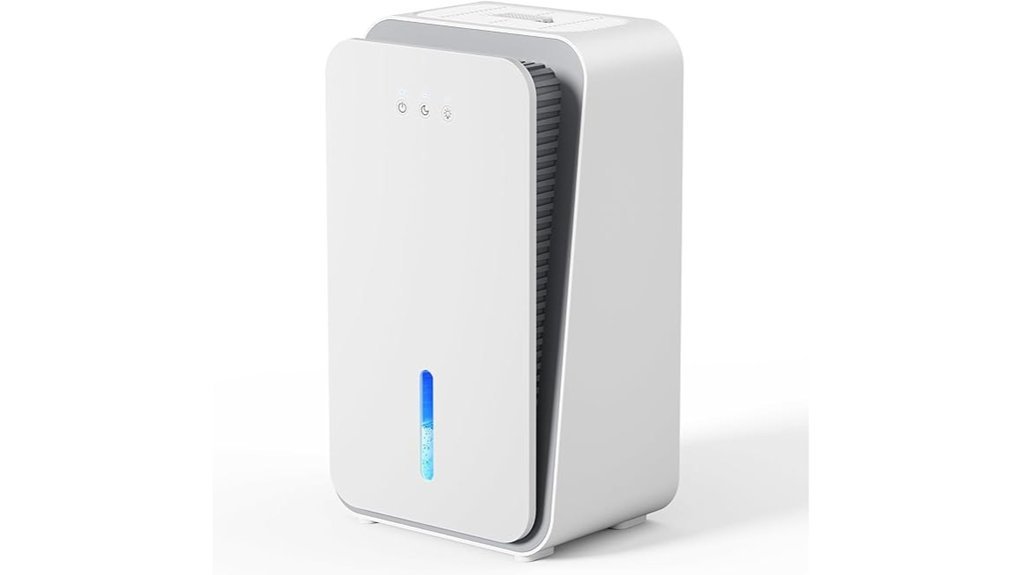
This semiconductor dehumidifier combines moisture collection with a built-in aromatherapy compartment, automatic shutoff, sleep mode, and seven-color LED lighting. It is most relevant for a bedroom, bathroom, or other small enclosed area where quiet operation and fragrance matter as much as moisture control.
The listing does not provide a clearly comparable daily moisture-removal rating in the source material, so the advertised 1,000 sq. ft. coverage should be treated cautiously. Use only the fragrance method and materials allowed by the product manual, and never add oils or liquids to the collection tank or electrical parts unless the manufacturer specifically instructs you to do so.
Best For: Buyers who want a compact dehumidifier with a dedicated scent feature for a small room.
Who Should Avoid It: Anyone prioritizing verified pint-per-day capacity over lighting and aromatherapy.
Pros:
- Combines small-space dehumidification with a dedicated aroma feature.
- Sleep mode and automatic shutoff support bedroom use.
- Compact design is easy to move.
Cons:
- Daily extraction capacity is not clearly verified.
- Not suitable for serious basement dampness.
- Fragrance can be undesirable for scent-sensitive users.
KNKA 2500 Sq.Ft Dehumidifier with Drain Hose
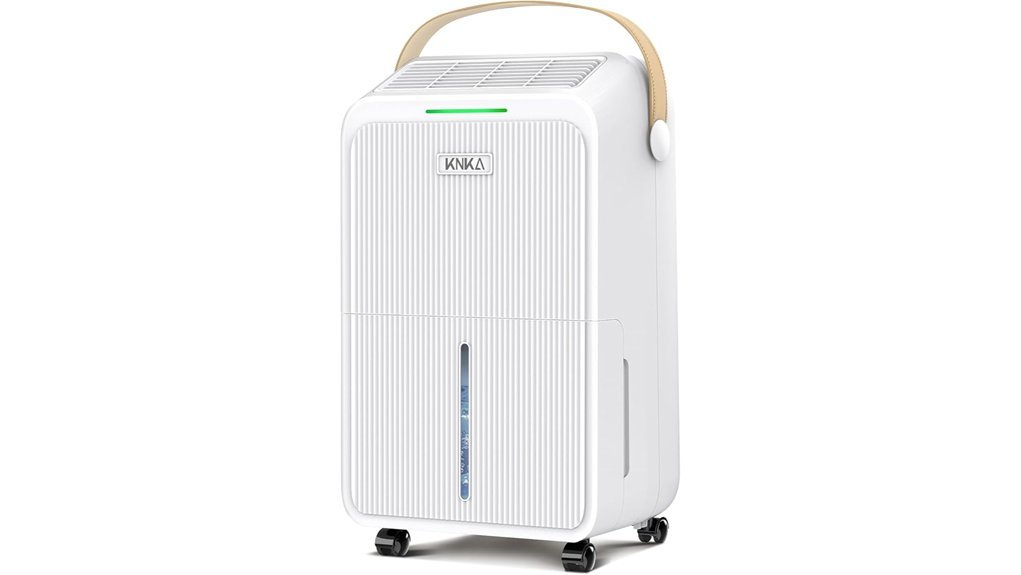
The KNKA is a compressor dehumidifier listed to remove up to 34 pints of moisture per day at 95°F and 90% relative humidity. It includes a 3-liter tank, continuous drainage, adjustable humidity control, a digital display, automatic defrost, washable filter, casters, and DEHU, DRY, and CONT modes.
This model is a better fit than the semiconductor units for a medium room, laundry area, garage, or basement with ongoing dampness. Keep in mind that its 34-pint figure is measured under hot, very humid conditions; actual output will generally be lower in cooler spaces. The listed 2500 sq. ft. coverage is also an estimate rather than a guarantee.
Best For: Medium spaces that need compressor performance, a humidistat, and continuous drainage.
Who Should Avoid It: Buyers who only need a tiny bedside unit or cannot place a drain hose with proper downward flow.
Pros:
- Compressor design handles heavier moisture loads than mini units.
- Continuous drainage and a 3L tank provide flexible water removal.
- Adjustable humidistat, defrost, and multiple modes improve control.
- Washable filter and casters simplify routine use.
Cons:
- Rated capacity is based on 95°F and 90% RH conditions.
- Heavier and less portable than semiconductor models.
- Compressor noise may be noticeable despite the seller-stated 37 dB figure.
KeepGlad 98OZ Dehumidifier for Home
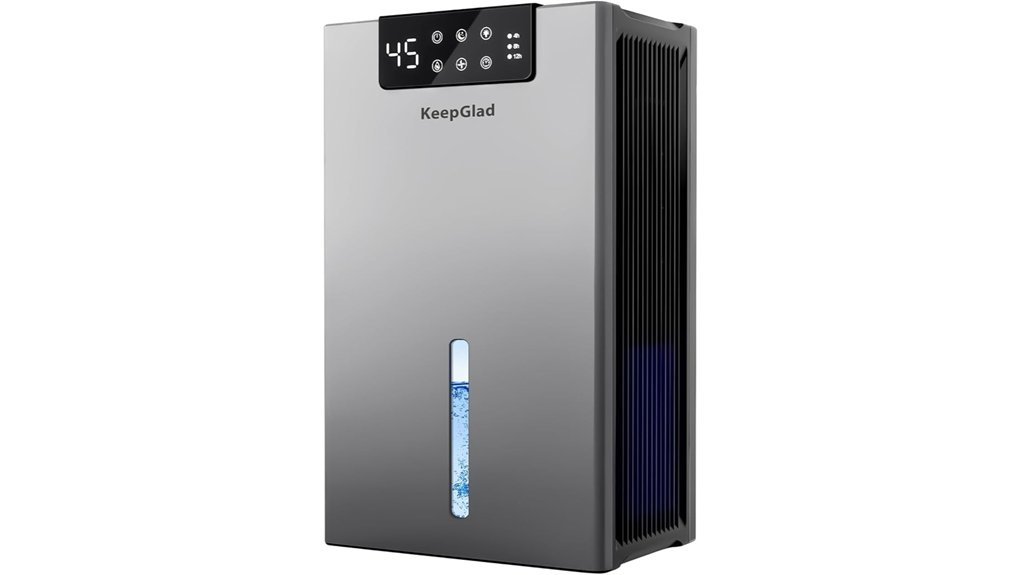
The KeepGlad uses a dual-semiconductor design and includes a 98-ounce tank, humidity display, washable filter, drain hose, timer, automatic shutoff, adjustable fan settings, and ambient lighting. These features make it more convenient than a basic mini dehumidifier for a small bedroom, bathroom, laundry nook, or RV.
The seller promotes use in spaces up to 1,000 square feet and states a high moisture-removal figure, but the listing does not present that performance in a clearly standardized way. It should therefore be treated as a capable compact unit rather than a whole-basement replacement. For sustained high humidity, the AEOCKY or KNKA compressor models are safer choices.
Best For: Small enclosed spaces where a humidity display, washable filter, and drain hose are valuable.
Who Should Avoid It: Buyers who need verified compressor-level capacity for a large or wet basement.
Pros:
- Humidity display helps users monitor room conditions.
- Drain hose supports longer unattended operation.
- Washable filter can reduce replacement-filter costs.
- Large tank for a semiconductor model.
Cons:
- Advertised coverage may overstate practical performance.
- Exact noise and daily extraction claims need confirmation on the current listing.
- 90-watt operation uses more power than many basic mini units.
Factors to Consider When Choosing a Dehumidifier for a Humid Environment
A humid room needs more than a large tank or an impressive square-foot claim. Use the following points to match the appliance to the moisture problem.
1. Match the Technology to the Moisture Load
Compressor dehumidifiers are generally the better choice for persistently damp basements, laundry rooms, large bedrooms, and spaces that remain above the desired humidity level. Semiconductor dehumidifiers are compact and quiet but usually remove much less water, making them more appropriate for closets, RVs, bathrooms, and small enclosed rooms with mild humidity.
2. Compare Daily Water Removal, Not Tank Size
Capacity is normally expressed as pints or liters removed per 24 hours. A 1500ml or 98oz tank only describes storage volume. Also check the test conditions: a unit rated at 86°F and 80% RH or 95°F and 90% RH may collect much less water in a cooler room. For compressor models, look for a current EnergyGuide or ENERGY STAR information when available.
3. Treat Square-Foot Claims as Secondary
Coverage numbers are useful only when paired with extraction capacity, room dampness, temperature, and airflow. A small semiconductor unit advertised for 1,000 square feet is not automatically comparable to a 34- or 50-pint compressor dehumidifier. Open doors, tall ceilings, leaks, and poor air circulation can further reduce effective coverage.
4. Choose the Right Drainage Setup
Manual tanks work for occasional use, but a drain hose is more practical in a very humid room. Gravity drainage requires the hose to slope downward without kinks. If the drain is higher than the unit, choose a model with a built-in pump or use a compatible external condensate pump rather than routing a gravity hose uphill.
5. Use a Humidistat or Separate Hygrometer
A true humidistat lets a compressor dehumidifier cycle around a selected target. Mini units may run continuously without precise control, so a separate hygrometer is helpful. The U.S. EPA generally recommends keeping indoor relative humidity below 60% and ideally around 30% to 50%, while avoiding over-drying.
6. Check Operating Temperature and Defrost
Cool air holds less moisture, and many dehumidifiers become less effective as temperatures fall. A compressor model for a basement or garage should have automatic defrost and a stated operating-temperature range. Semiconductor units also lose output in cool conditions.
7. Consider Noise in the Actual Room
Seller-listed noise figures may reflect a low or sleep mode rather than maximum output. For bedrooms, compare sleep-mode noise and whether lights can be turned off. For basements and laundry rooms, moisture-removal capacity may matter more than a few decibels.
8. Plan for Cleaning and Maintenance
Empty and rinse the tank regularly, clean washable filters according to the manual, keep air inlets and outlets clear, and inspect drain hoses for clogs or leaks. Automatic shutoff is useful, but it does not replace routine checks. A dehumidifier also will not fix plumbing leaks, foundation seepage, or inadequate bathroom and dryer ventilation.
Before You Buy
- Measure the room and check how damp it remains without dehumidification.
- Choose compressor capacity for persistent or heavy humidity.
- Confirm the test conditions behind any pint, ounce, or liter-per-day claim.
- Decide whether you can use gravity drainage or need a pump.
- Check operating temperature, filter access, warranty, and replacement-part support.
- Use a hygrometer to verify the result after installation.
Frequently Asked Questions
What Humidity Level Should I Aim For?
A common indoor target is about 30% to 50% relative humidity. Conditions, climate, and comfort vary, but prolonged humidity above 60% can support condensation and mold growth. Use a hygrometer instead of judging by how the air feels.
How Often Should I Empty the Water Tank?
Empty it whenever the full-tank indicator appears. In a very humid room, that may be daily or more often. A continuous drain hose can reduce this work, but the connection and hose path should still be checked regularly for leaks and blockage.
Can a Mini Dehumidifier Handle a Basement?
Usually not if the basement is persistently damp, cool, large, or affected by seepage. Mini semiconductor units are better for small enclosed zones and mild moisture. A compressor model with a meaningful pint-per-day rating and continuous drainage is generally more suitable for basement humidity.
Can Dehumidifiers Help With Allergies and Asthma Symptoms?
A dehumidifier can reduce excess moisture that supports mold and dust mites, but it is not a medical treatment and does not work like an air purifier. People with asthma or allergies should follow their healthcare plan and address visible mold or water damage directly.
How Do I Choose the Right Size?
Use the room size and dampness together. ENERGY STAR guidance recommends higher pint-per-day capacity as spaces become larger or move from moderately damp to very damp or wet. Advertised square footage alone is not enough.
Do Dehumidifiers Use a Lot of Electricity?
Energy use varies by technology, capacity, humidity setting, and run time. Mini semiconductor units use less power but also remove less water. Compressor models draw more power while running, but a correctly sized model with a humidistat may reach the target faster and cycle off.
Should I Run a Dehumidifier Continuously?
Continuous operation can be useful when first drying a damp room or when using a drain hose, but a humidistat is better for long-term control. Once the target is reached, allow the unit to cycle instead of driving humidity unnecessarily low.
Conclusion
For a genuinely humid basement or larger room, the AEOCKY 50 Pint is the strongest overall choice in this list, while the KNKA 34 Pint is a practical mid-size alternative. For a bathroom, RV, closet, or small bedroom with lighter moisture, the UBBO, KeepGlad, or CLEVAST models offer compact designs and quieter operation.
Final Recommendation
Choose by daily moisture-removal capacity, room conditions, drainage, and humidity control. Do not choose by tank size, LED features, or square-foot marketing alone. If the space has leaks, standing water, or visible mold, correct the moisture source as well as using a dehumidifier.