Updated: August 2026
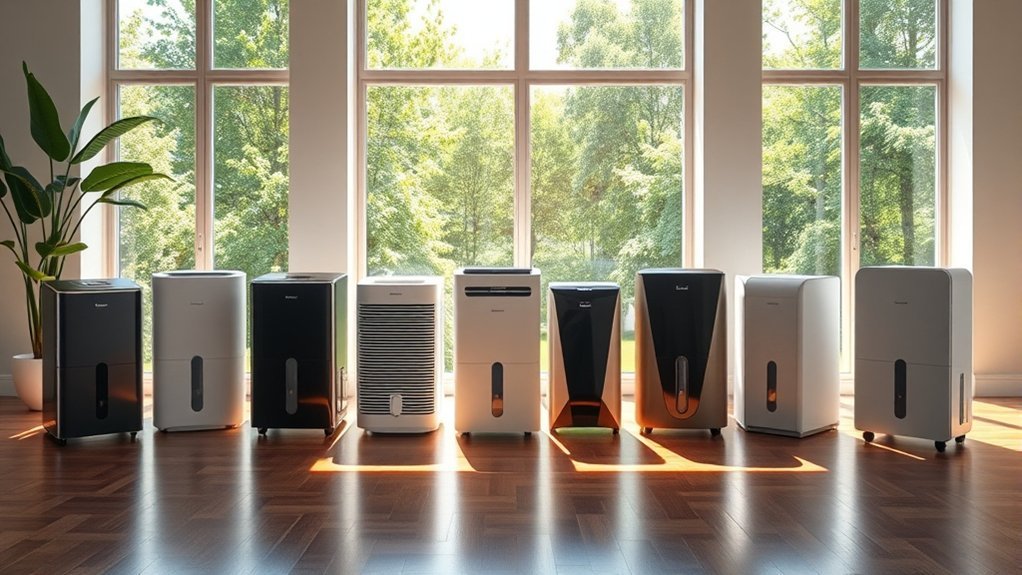
The best wireless dehumidifiers for an RV are reusable silica-gel moisture absorbers that work without a cord while placed inside a camper, closet, cabinet, or storage bay. They do not use batteries, a fan, a compressor, or a collection tank. Electricity is required only when the moisture-absorbing material needs to be regenerated.
The Eva-Dry E-333 is the best overall option in this comparison for one small enclosed RV area. The Eva-Dry E-500 offers a larger listed coverage range, while the Afloia TOPZ 2+1 provides two placement points and a short advertised heating-base cycle. The Afloia TOPZ 4+1 is better suited to several separated compartments, and the Wisedry 2-Pack is another practical two-unit alternative.
These products are designed for mild, localized moisture control in places such as wardrobes, bathroom cabinets, under-sink spaces, pantries, storage bays, and closed RV compartments. They are not substitutes for repairing a water leak, drying soaked materials, improving ventilation, or running a powered dehumidifier when humidity affects the entire RV.
How We Evaluated These Products
We compared each product’s package configuration, regeneration method, advertised coverage guidance, moisture indicator, portability, suitability for enclosed RV spaces, and main limitations. These are passive moisture absorbers, so their coverage claims and total adsorption capacities should not be compared directly with the pint-per-day ratings of powered compressor dehumidifiers.
Quick Verdict
Choose the Eva-Dry E-333 for one small RV compartment and straightforward plug-in regeneration. Choose the Eva-Dry E-500 when you want a larger renewable unit for an enclosed area. The Afloia TOPZ 2+1 is the better fit when quick regeneration and two placement points matter.
For several cabinets, storage bays, or separate moisture-prone zones, consider the Afloia TOPZ 4+1. The Wisedry 2-Pack is a useful alternative when you want two absorbers, an included charging base, and a short advertised regeneration cycle.
Important: These products work best in enclosed or lightly ventilated spaces. One passive absorber should not be expected to maintain a selected humidity level throughout an open RV cabin.
Quick Comparison of Wireless RV Dehumidifiers
| Product | Best For | Configuration | Regeneration Method | Listed Coverage Guidance | Main Limitation | Amazon |
|---|---|---|---|---|---|---|
| Eva-Dry E-333 | Best Overall for one compact RV zone | One renewable unit | Plug the complete unit into a compatible outlet | Up to approximately 333 cubic feet | Not intended for severe whole-cabin humidity | Check Current Amazon Availability |
| Afloia TOPZ 2+1 | Best Fast-Recharge Set | Two absorber sticks and one heating base | Place a saturated stick on the powered base | Small enclosed spaces; claims apply to individual placement zones | Designed for compartments rather than an entire RV | Check Current Amazon Availability |
| Eva-Dry E-500 | Best Higher-Capacity Single Unit | One larger renewable unit | Plug the complete unit into a compatible outlet | Up to approximately 500 cubic feet | Longer regeneration period than heating-base systems | Check Current Amazon Availability |
| Afloia TOPZ 4+1 | Best Multi-Zone Kit | Four absorber sticks and one heating base | Regenerate saturated sticks on the powered base | Four separate compact placement zones | Multiple sticks may need sequential regeneration | Check Current Amazon Availability |
| Wisedry 2-Pack | Best Dual-Unit Alternative | Two rechargeable absorbers and one charging base | Place a saturated unit on the powered base | Up to 108 square feet for the set, according to the listing | Performance depends heavily on enclosure and airflow | Check Current Amazon Availability |
Comparison note: Manufacturer coverage claims are general placement guidance. Cubic-foot and square-foot figures are not directly comparable, and actual performance varies with temperature, humidity, ventilation, compartment volume, and how often the space is opened.
Eva-Dry Wireless Mini Dehumidifier, White (E-333): Best Overall
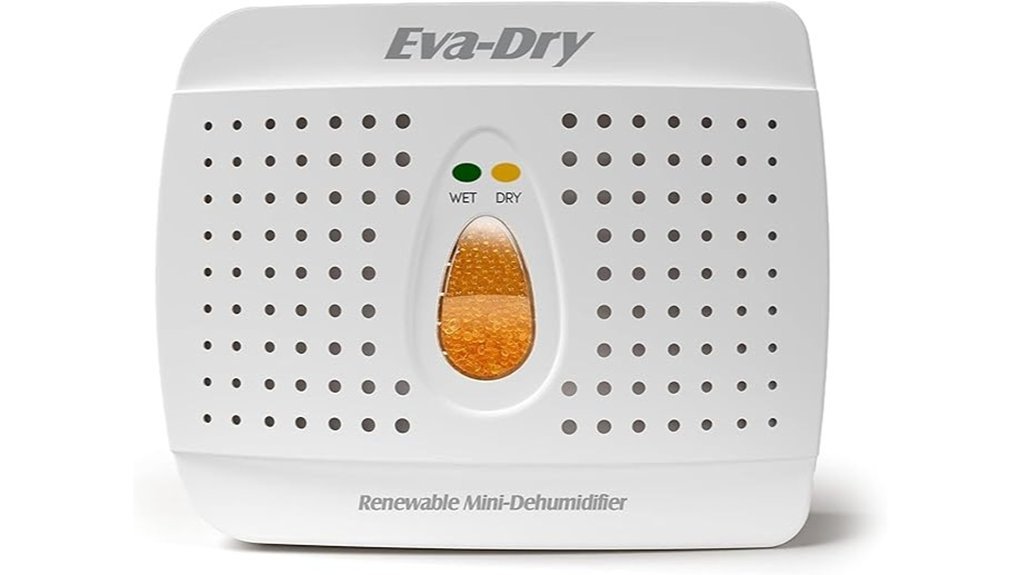
The Eva-Dry E-333 Wireless Mini Dehumidifier is the most straightforward option in this comparison for controlling mild moisture in one compact RV area. It uses renewable silica-gel beads and operates without a cord, fan, compressor, disposable refill, or water tank while absorbing moisture.
The product is listed for enclosed spaces up to approximately 333 cubic feet. That makes it better suited to a wardrobe, pantry, under-sink cabinet, bathroom storage area, safe, or small storage compartment than to an open RV living area.
The indicator beads change color as the silica gel becomes saturated. You then remove the unit from the RV and plug the complete device into a compatible outlet until the indicator returns to its dry color. Current manufacturer information for the U.S. model identifies 110-120V regeneration and an approximately 10-12-hour renewal period, but buyers should follow the instructions supplied with the current product.
Why You’ll Like It
The E-333 provides simple, silent moisture control without requiring a separate heating base. Its flat, compact body and hanging hook make it easier to position on a shelf or inside a narrow RV storage area.
Best For: RV owners who want one uncomplicated, renewable moisture absorber for a small enclosed area.
Who Should Avoid It: Buyers trying to control persistent condensation throughout a large RV or remove moisture caused by a plumbing, roof, window, or seal leak.
Pros:
- Compact design fits in many RV cabinets and storage areas.
- Cordless and silent while absorbing moisture.
- Color-changing indicator shows when regeneration is needed.
- No disposable refill packs or removable collection tank.
- Does not require a separate regeneration base.
Cons:
- The moisture capacity is a total amount between renewals, not a daily extraction rate.
- Regeneration takes longer than the short cycles advertised by heating-base systems.
- One unit may not be enough for several separated RV compartments.
- The complete unit must be removed from the RV compartment and connected to power for renewal.
Afloia TOPZ 2+1 Cordless Dehumidifier Set: Best Fast Recharge
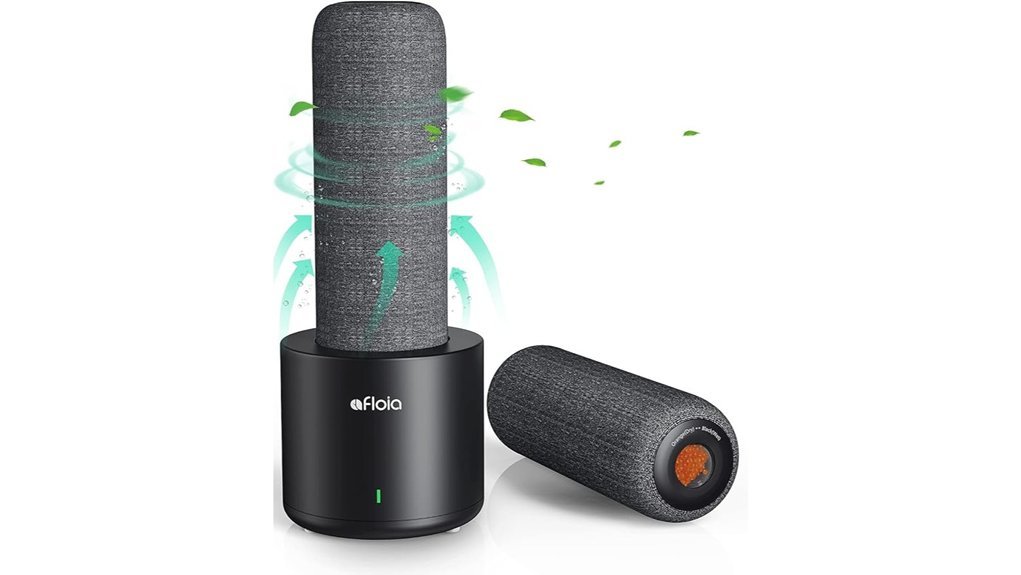
The Afloia TOPZ 2+1 is a useful choice when your RV has two separate moisture-prone compartments. The linked package contains two moisture-absorbing sticks and one powered heating base, so you can place one stick in a wardrobe and the other in a bathroom cabinet, storage bay, or under-sink space.
Each stick uses renewable silica-gel beads and a circular air-intake design. The indicator changes color when the material is saturated. You then place the affected stick on the heating base instead of connecting the absorber itself directly to an outlet.
Afloia advertises an approximately two-hour regeneration cycle and automatic shutoff for the heating system. Actual cycle time may vary, so allow the stick to complete the manufacturer’s specified cycle and cool before returning it to an RV compartment.
Why You’ll Like It
Two independent sticks make it easier to protect separated areas without moving one absorber back and forth. The short advertised regeneration cycle also reduces downtime when humid conditions cause the silica gel to saturate frequently.
Best For: RV owners who want two cordless placement points and a faster heating-base regeneration system.
Who Should Avoid It: Buyers who need one active device to circulate air and lower humidity throughout an open RV cabin.
Pros:
- Includes two portable absorber sticks for separate compact zones.
- Heating-base design provides a short advertised regeneration cycle.
- Color-changing beads make saturation easier to monitor.
- No batteries, fan noise, compressor, or collection tank during use.
- One stick can remain in service while the other is being managed, depending on your placement needs.
Cons:
- The heating base requires a compatible electrical outlet.
- Small passive absorbers cannot match an active dehumidifier during severe humidity.
- Coverage claims are approximate because RV airflow and compartment layouts vary.
- Both sticks share one regeneration base.
Eva-Dry E-500 Renewable Wireless Mini Dehumidifier: Best Higher-Capacity Pick
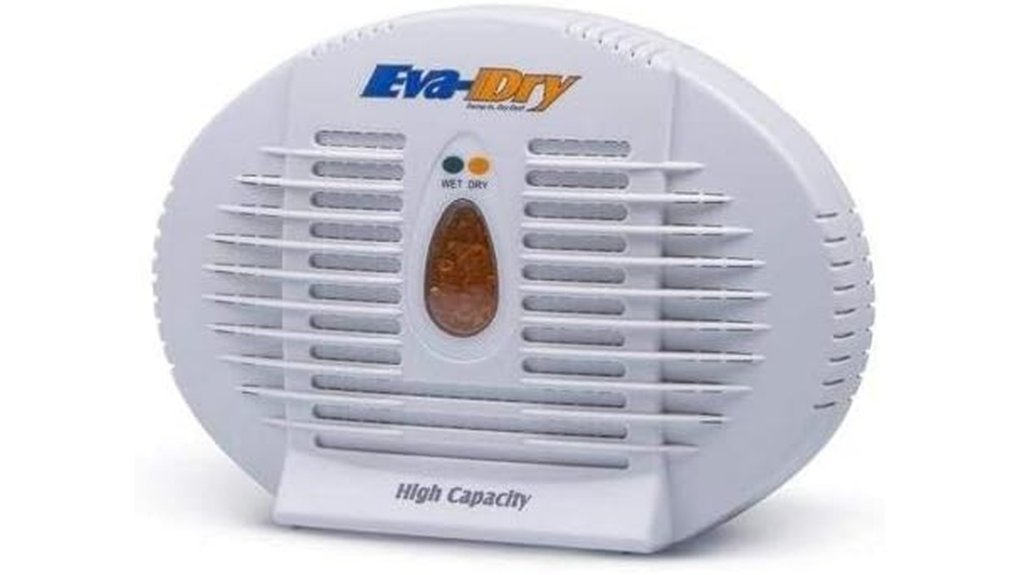
The Eva-Dry E-500 Renewable Wireless Mini Dehumidifier is the larger Eva-Dry option in this comparison. Its listed coverage of up to approximately 500 cubic feet makes it a better candidate for a larger RV closet, bathroom zone, storage compartment, or other enclosed area where the smaller E-333 may feel undersized.
Like the E-333, the E-500 works silently without electricity during normal moisture absorption. Its renewable silica-gel material changes color when it is ready for regeneration. The complete unit must then be connected to a compatible outlet until the beads return to their dry color.
Current manufacturer information identifies an approximately 10-12-hour regeneration period and 110-120V power for renewal. Published moisture-capacity figures have varied between manufacturer pages, so this article does not assign the E-500 a definite ounce capacity. Confirm the current package dimensions, voltage, stated capacity, and renewal instructions before ordering.
Why You’ll Like It
The E-500 offers a larger nominal enclosed-space range than the E-333 while retaining the same quiet, tank-free design. It is useful when you want one larger absorber instead of monitoring several smaller units.
Best For: Larger enclosed RV storage areas or buyers who prefer one higher-capacity renewable unit.
Who Should Avoid It: Anyone who needs rapid regeneration, automatic humidity control, continuous drainage, active airflow, or whole-cabin dehumidification.
Pros:
- Higher nominal enclosed-space coverage than the E-333.
- Silent and cordless during moisture absorption.
- Renewable design avoids disposable refill packs.
- Indicator beads provide a visible regeneration reminder.
- One-piece design does not require a separate charging base.
Cons:
- Larger than the E-333, so placement options may be more limited.
- Regeneration requires an extended plug-in period.
- The complete unit is unavailable for moisture absorption while being regenerated.
- Published capacity figures have varied, so current listing details should be checked carefully.
Afloia TOPZ 4+1 Rechargeable Cordless Dehumidifier Set: Best Multi-Zone Kit
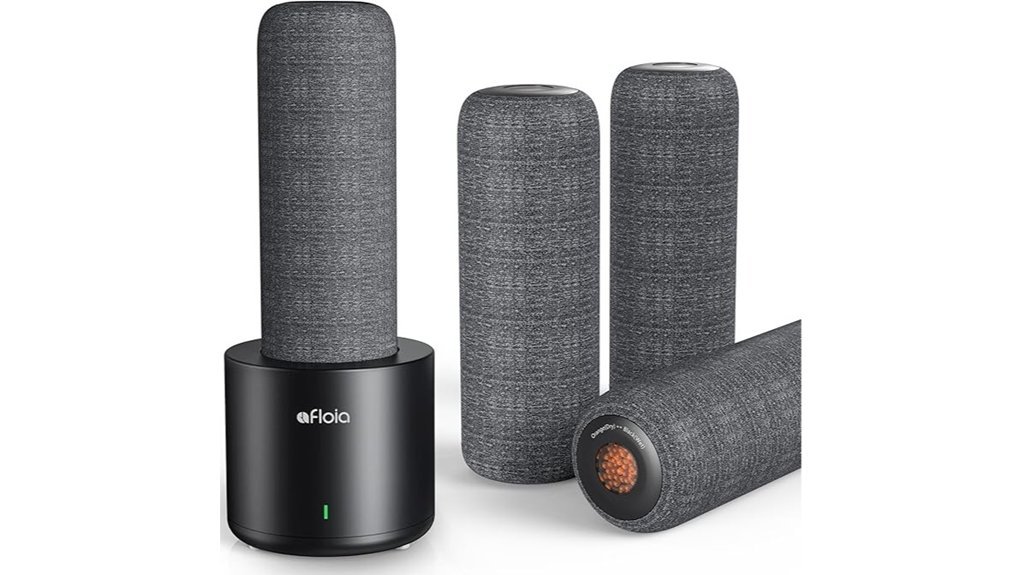
The linked Afloia TOPZ 4+1 product is a multi-unit set rather than one portable dehumidifier. It includes four reusable moisture-absorbing sticks and one heating base, making it the strongest option in this article for targeting several separated RV zones at the same time.
You could place the sticks in locations such as a wardrobe, bathroom cabinet, under-sink compartment, pantry, or exterior storage bay. Each stick uses silica-gel beads and a visual moisture indicator. When a stick becomes saturated, it is removed from the RV and returned to the powered heating base for regeneration.
The regeneration system is advertised with an approximately two-hour cycle and automatic shutoff. Because the package includes one base, several saturated sticks may need to be regenerated one after another. This is an important consideration during very humid weather.
Why You’ll Like It
The four-stick configuration gives you more placement flexibility than one large absorber. This is especially useful in an RV because closed cabinets and exterior storage bays can have different moisture conditions from the main living area.
Best For: RV owners who want reusable moisture control in several separated compartments.
Who Should Avoid It: Buyers who only need one absorber or who do not want to monitor and regenerate several separate sticks.
Pros:
- Four absorber sticks can be distributed across several RV compartments.
- Only one powered base is required for regeneration.
- Color indicators help identify which sticks need attention.
- No cords or batteries are required while the sticks absorb moisture.
- Individual sticks can be moved as seasonal moisture patterns change.
Cons:
- Several sticks require more monitoring than one larger unit.
- The heating base still requires electricity during regeneration.
- One base means multiple saturated sticks may need sequential cycles.
- The kit manages localized dampness rather than automatically controlling whole-RV humidity.
Wisedry Wireless Mini Dehumidifier 2-Pack: Best Dual-Unit Alternative
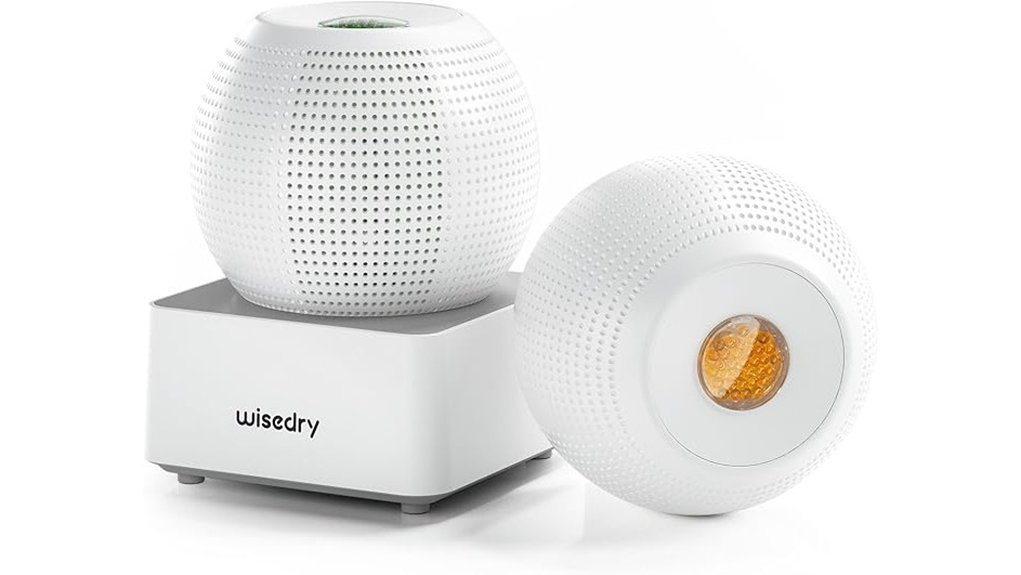
The Wisedry Wireless Mini Dehumidifier 2-Pack includes two cord-free moisture absorbers and a powered charging base. The two-unit configuration lets you protect separate RV areas or rotate one absorber through regeneration while the other remains in use.
The manufacturer advertises an approximately two-hour regeneration cycle, automatic power-off for the charging system, and an indicator window that shows orange when the beads are dry and green when regeneration is needed.
The product page advertises absorption of up to approximately 200 ml at a time, but it does not clearly establish whether that figure applies to each absorber or to the set as a whole. It should therefore be treated as general manufacturer guidance rather than a verified per-unit capacity. The advertised coverage of up to 108 square feet also applies to the product configuration and will vary substantially in an RV.
Why You’ll Like It
The set combines two placement points with a short advertised regeneration cycle. It may appeal to buyers who prefer the rounded Wisedry design while retaining the reusable, tank-free concept offered by the Afloia systems.
Best For: RV owners who want two rechargeable absorbers for separate compact areas.
Who Should Avoid It: Buyers dealing with extensive window condensation, wet flooring, active leaks, soaked insulation, or consistently high whole-cabin humidity.
Pros:
- Two units can be used together or in separate RV locations.
- Short advertised regeneration time reduces downtime.
- Indicator windows make it easier to see when regeneration is needed.
- Automatic power-off is advertised for the regeneration system.
- The package includes the charging base required for renewal.
Cons:
- The published 200 ml figure is not clearly defined as a per-unit capacity.
- Coverage claims may not reflect performance in a cold, open, or poorly ventilated RV.
- Periodic powered regeneration is still required.
- Both absorbers share one charging base.
Factors to Consider When Choosing a Wireless Dehumidifier for an RV
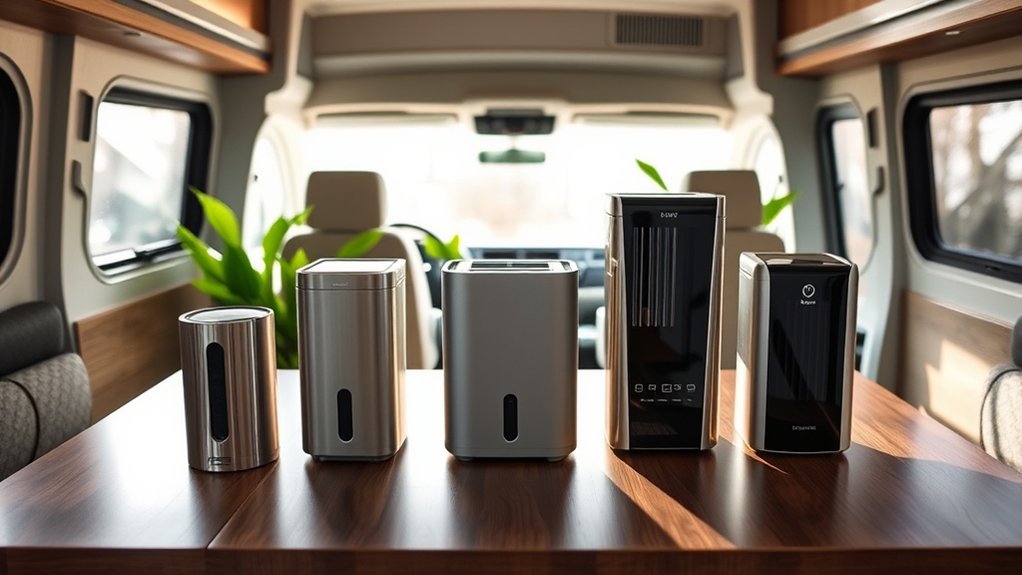
A wireless RV dehumidifier should fit the specific compartment you want to protect, offer a practical regeneration method, and provide an indicator that is easy to check. It is equally important to understand the limitations of passive silica-gel products before comparing them with powered dehumidifiers.
Understand What “Wireless” Means
In this product category, wireless means cordless during moisture absorption. The unit does not rely on a power cord or battery while sitting in an RV compartment, but electricity is required later to dry or regenerate the silica gel.
Eva-Dry models plug the complete absorber into an outlet. Afloia and Wisedry systems use a separate powered base. None of the products in this comparison is a battery-powered compressor dehumidifier.
Match the Unit to the Moisture-Prone Zone
Do not choose only by the total floor area of your RV. These products work best in small enclosed or lightly ventilated spaces. Identify where moisture actually collects:
- Wardrobes and clothing cabinets
- Bathroom storage areas
- Under-sink compartments
- Pantries and food-storage cabinets
- Exterior storage bays
- Drawers and electronics compartments
- Closed RVs during seasonal storage
A multi-pack may be more useful than one large unit when moisture-prone compartments are separated by doors, walls, or sealed storage panels.
Choose Between One Unit and a Multi-Pack
A single Eva-Dry unit is easier to monitor and regenerate. It is a practical choice when you have one main problem area.
A two-unit or four-unit kit is more useful when several cabinets or storage bays remain closed for long periods. However, multi-unit kits generally include one regeneration base, so several saturated absorbers may need to be processed sequentially.
Compare Total Adsorption Capacity Carefully
Reusable silica-gel dehumidifiers normally advertise how much moisture they can hold before regeneration. This is not the same measurement as the pints-per-day rating used for an electric compressor dehumidifier.
A larger stated capacity may extend the interval between regeneration cycles, but the actual interval depends on relative humidity, temperature, ventilation, air leakage, wet materials, and compartment volume. An absorber may saturate much faster during rainy weather or when damp clothing is stored nearby.
Published capacity figures can also be unclear or inconsistent. Confirm whether a stated amount applies to one absorber, the complete set, or a specific laboratory condition.
Consider Regeneration Time and Method
Heating-base systems may advertise regeneration in about two hours. Plug-in-body units can require a substantially longer cycle. A faster cycle is useful when you have only one or two absorbers and need to return them to service quickly.
Also consider how many units can be regenerated at one time. A four-stick kit with one base offers broad placement flexibility but may take several cycles if every stick becomes saturated together.
Confirm Electrical Compatibility
Check the voltage and power instructions for the exact model and country version you plan to buy. Do not assume that a U.S. plug-in model is suitable for every RV electrical system or international campground connection.
Follow the current manufacturer instructions before using shore power, an inverter, a power strip, an adapter, or an extension cord. Do not improvise a connection that is not supported by the product manual.
Check the Moisture Indicator
A clear color-changing indicator reduces guesswork. Confirm which color means dry and which means saturated because the color system can differ between models.
Check the indicator regularly during humid weather instead of relying only on an advertised number of days. Closed storage bays may saturate an absorber at a different rate from an interior wardrobe.
Treat Coverage Claims as Estimates
Some listings use cubic feet while others use square feet. These figures are not directly interchangeable without knowing ceiling height, airflow, temperature, humidity, and test conditions. Passive absorbers also work more slowly than powered dehumidifiers.
Use coverage claims as general placement guidance, not as a guarantee that one unit will maintain a target relative humidity throughout an RV.
Use a Hygrometer to Check Results
A small digital hygrometer provides more useful feedback than smell alone. Place it near the moisture-prone area and watch whether conditions improve after adding the absorber.
If humidity remains persistently high despite frequent regeneration, the compartment may need better airflow, a larger moisture-control system, or inspection for water intrusion.
Regenerate the Product Safely
Renewable silica-gel products avoid disposable refill containers and normally use no electricity during moisture absorption. However, regeneration creates heat and requires appropriate placement.
- Follow the instructions supplied with the current product.
- Place the unit or heating base on a stable, heat-resistant surface.
- Keep the heating system uncovered and away from flammable materials.
- Do not place a regenerating unit on bedding, upholstery, or carpet unless expressly permitted.
- Do not regenerate a unit inside a closed cabinet.
- Do not regenerate a unit while driving.
- Allow the product to cool before returning it to an RV compartment.
- Inspect the housing, plug, base, and cord for visible damage.
- Keep loose units secured while the RV is moving.
- Do not open the housing or allow children or pets to access the desiccant material.
Know When You Need a Powered Dehumidifier
A reusable mini dehumidifier is best for mild, localized dampness. Consider a powered RV-compatible dehumidifier, ventilation changes, professional drying help, or a leak inspection when you notice:
- Water running down several windows
- Wet walls, flooring, mattresses, or insulation
- A persistent musty smell throughout the cabin
- Visible mold or mildew growth
- Humidity that remains high despite frequent regeneration
- Evidence of roof, plumbing, seal, vent, or window leakage
- An absorber that becomes saturated unusually quickly
Before You Buy
- Identify the exact cabinet, bathroom, closet, or storage bay you want to protect.
- Measure the available shelf or hanging space.
- Decide whether one unit or a multi-pack makes more sense.
- Check the current package quantity and included regeneration equipment.
- Confirm voltage, plug type, regeneration instructions, dimensions, and heat clearance.
- Check whether the listed capacity applies per unit or to the complete set.
- Use an RV hygrometer to measure conditions instead of judging only by smell.
- Do not expect a passive absorber to solve an active water leak.
Frequently Asked Questions
Are Wireless RV Dehumidifiers Battery-Powered?
The products in this comparison are not battery-powered dehumidifiers. They absorb moisture passively without electricity while in use. Electricity is needed later to regenerate the silica gel through a built-in plug or a separate heating base.
How Do I Maintain a Wireless RV Dehumidifier?
Check the moisture indicator regularly and regenerate the unit when the beads reach the saturated color shown in its instructions. Wipe dust from the exterior and air openings with a dry or slightly damp cloth, but do not immerse the housing or allow water to enter electrical components.
Inspect the plug, heating base, cord, indicator, and casing before every regeneration cycle. These reusable silica-gel products normally do not have a removable water tank or washable air filter.
Can I Use One While Driving My RV?
A passive cordless absorber can generally remain in place while the RV is moving if it is secured so it cannot fall, roll, block a walkway, or strike another object. Do not plug in or regenerate the product while driving. Follow the current product manual and your RV’s electrical-safety requirements.
How Long Does a Renewable Dehumidifier Last?
Lifespan varies by brand, construction, regeneration frequency, operating conditions, and storage. Some manufacturers market renewable models for repeated use over several years, but that should not be treated as a guaranteed lifespan for every unit.
Replace the product if its housing, plug, cord, base, indicator, or heating system becomes damaged or stops operating correctly.
Are Wireless Dehumidifiers Energy-Efficient for RV Use?
They use no electricity while passively absorbing moisture. Electricity is required only during regeneration. This can make them economical for small compartments, but it does not mean they are more effective than a powered dehumidifier for controlling high humidity throughout an RV.
How Do I Know When to Regenerate the Unit?
You do not empty a water tank. Check the indicator beads or viewing window. When the indicator reaches the saturated color specified by the manufacturer, regenerate the product using its built-in plug or heating base.
Return the absorber to the RV only after the regeneration cycle is complete and the unit has cooled.
Can a Wireless Dehumidifier Control Humidity in an Entire RV?
Usually not by itself. These products work best in small enclosed zones. A larger RV may need several absorbers, improved ventilation, air conditioning, a powered dehumidifier, or a combination of methods.
A digital hygrometer can help determine whether the humidity in the main cabin is actually decreasing.
Do Wireless Dehumidifiers Work in a Cold RV?
They can still absorb moisture, but actual performance and the rate at which they become saturated will vary with temperature, humidity, airflow, and condensation conditions. Do not rely on a passive absorber alone when cold surfaces are causing extensive window, wall, or mattress condensation.
Will a Wireless Dehumidifier Prevent Mold?
It may help reduce some excess moisture in a small area, but it cannot guarantee mold prevention. Repair leaks promptly, dry wet materials, improve airflow, clean existing growth using an appropriate method, and monitor indoor humidity.
Where Should I Place It in My RV?
Place it in a stable location where surrounding air can reach the unit, such as a closet shelf, cabinet, bathroom storage area, under-sink space, or storage bay. Do not cover the air openings or place the product where it can fall, become wet, contact food, or obstruct a walkway.
How Many Wireless Dehumidifiers Do I Need for an RV?
The answer depends more on the number of separated moisture-prone compartments than on the RV’s total floor area. One unit may be enough for a single wardrobe or cabinet. Two or four absorbers may be more practical when the bathroom, under-sink area, pantry, and exterior storage bays are separated from one another.
Conclusion
A wireless RV dehumidifier can be a convenient way to manage mild moisture in compact cabinets, closets, bathrooms, and storage compartments. These reusable absorbers operate silently and without a cord during normal use, but they must be regenerated periodically with electricity.
The Eva-Dry E-333 is the strongest all-around choice for one small enclosed area, while the Eva-Dry E-500 offers a larger nominal coverage range. The Afloia TOPZ 2+1 is useful when quick regeneration and two placement points are priorities. The Afloia TOPZ 4+1 is better for several separated RV zones, and the Wisedry 2-Pack offers another flexible two-unit setup with an included charging base.
Final Recommendation
Start with the Eva-Dry E-333 when you need simple moisture control in one compact RV space. Choose a two-unit heating-base set when you have two separated damp areas or want a shorter regeneration cycle. Select the Afloia TOPZ 4+1 when several closed compartments need their own absorber.
Whichever product you choose, monitor the RV with a hygrometer and investigate persistent condensation, musty odors, wet materials, or visible mold. A reusable moisture absorber can support an RV humidity-control plan, but it cannot correct water intrusion or replace adequate ventilation and active drying when conditions are severe.