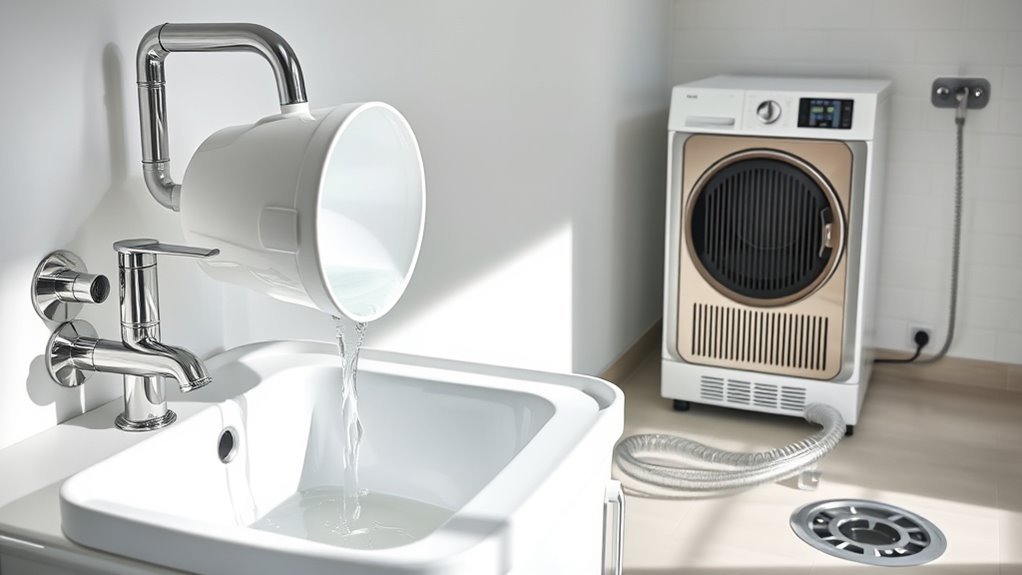
To empty a dehumidifier, turn it off, remove the water bucket with both hands, carry it level, pour the condensate into a sink, floor drain, or toilet bowl, and reinstall the bucket until it is fully seated. If your unit supports continuous drainage, you can instead use the model-approved gravity hose or pump. Gravity drain lines must remain downhill from the drain port, while pumps can lift water only within the limits specified for the model. Treat collected dehumidifier water as nonpotable.
Quick Answer
Turn the dehumidifier off, remove the bucket carefully, pour the water into an appropriate household drain, and reinstall the bucket firmly. For automatic drainage, use only the hose, adapter, or pump setup approved for your model. Keep a gravity hose continuously downhill, stay within any pump-lift limit, and test every connection for leaks before relying on unattended drainage.
Scope: This guide focuses on portable household dehumidifiers with removable buckets, gravity-drain connections, or built-in pumps. Whole-home dehumidifiers normally use installed drainage and should be maintained according to the manufacturer and installer instructions.
Key Takeaways
- Most portable dehumidifiers stop automatically when the bucket is full, but moisture removal cannot resume until the bucket is emptied and correctly reinstalled.
- Turn the unit off before removing the bucket. Unplug it before cleaning, clearing a clog, or working around the drain connection.
- There is no universal dehumidifier hose size. Check the owner’s manual for the correct hose, adapter, gasket, length, and pump-lift limit.
- A gravity hose must run continuously downhill without kinks, loops, or a submerged outlet.
- Dehumidifier condensate is nonpotable. Do not drink it or substitute it for potable or distilled water required by food, pet, appliance, or medical uses.
At a Glance
| Time Required | About 2 to 5 minutes for manual emptying; a new hose setup usually takes longer because the route and connections must be checked |
| Difficulty | Easy |
| Tools Needed | Sink or approved drain, soft cloth, mild dish soap, and a model-compatible hose if using continuous drainage |
| Cost | No cost for manual emptying; hose, adapter, or pump costs vary by model |
Which Dehumidifier Drain Method Should You Use?
Choose the drainage method based on where the dehumidifier sits and where the water can safely go. A removable bucket is the simplest option. A gravity hose works when the drain is lower than the dehumidifier’s outlet. A built-in or approved condensate pump is useful when water must travel to a higher drain.
| Method | Best When | Key Requirement | Main Limitation |
|---|---|---|---|
| Manual bucket | The unit is easy to reach and the bucket does not fill too often | Empty and reinstall the bucket whenever the full indicator appears | Requires carrying water and stops operation when the bucket is full |
| Gravity hose | A floor drain, sump, or other approved outlet is lower than the drain port | A clear, model-compatible hose that stays continuously downhill | Cannot reliably move water uphill |
| Built-in or approved pump | The discharge point is higher than the dehumidifier | Correct pump hose, pump mode, and model-specific lift and length limits | More components can clog, disconnect, or fail |
Recommended Products

[Convenient] This drain hose automatically drains water from the dehumidifier to the drain for uninterrupted use.
Do You Have to Empty a Dehumidifier?
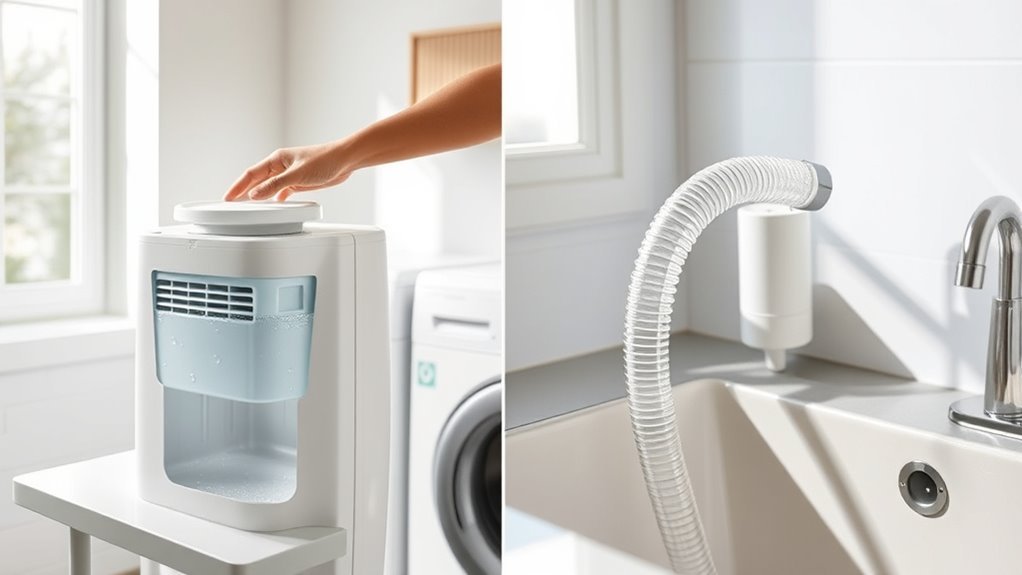
Yes, you must empty the bucket unless the dehumidifier is connected to a working gravity drain or pump system. Moisture removed from the air collects as condensate, and a portable unit has only a limited amount of bucket storage.
Most portable models include a full-bucket indicator and automatic shutoff, and many use a float or bucket sensor to detect the water level. When the bucket reaches its limit, the unit normally stops collecting moisture instead of allowing the bucket to overflow. ENERGY STAR’s dehumidifier guidance identifies automatic full-bucket shutoff as a common feature.
You do not have to wait for the bucket to become completely full if it is easier to carry when partly filled. The important step is to empty and reinstall it when the full indicator appears so the dehumidifier can resume operation.
Note: Many dehumidifiers still require the bucket to be fully seated even when a drain hose or pump is being used. If the unit will not run after drainage is connected, check the bucket position and float or bucket sensor before assuming the machine has failed.
How Often Should You Drain a Dehumidifier?
There is no fixed emptying schedule for every room or machine. The bucket fills faster when the room is humid, the reservoir is small, doors or windows are open, or moisture is entering through leaks, damp materials, laundry, or outdoor air.
The dehumidifier’s pint-per-day rating is not the same as its bucket size. ENERGY STAR defines dehumidifier capacity in pints of moisture removed per 24 hours, so a high-capacity model can still have a much smaller bucket that needs frequent emptying.
During the first day of operation, check the bucket several times so you can learn how quickly your unit fills under current conditions. After that, follow the full-bucket indicator and your observed fill rate rather than a universal schedule.
| Condition | What to Expect | Best Approach |
|---|---|---|
| Very damp room or recent water problem | The bucket may fill several times in one day. | Check frequently and consider continuous drainage. |
| Moderate seasonal humidity | The bucket may need attention once a day or less. | Follow the full indicator and your observed fill rate. |
| Gravity hose installed | Routine bucket emptying should be unnecessary when flow is unobstructed. | Inspect the hose, connection, and outlet regularly. |
| Built-in pump installed | Water is pumped out when the model’s activation conditions are met. | Test pump operation and stay within its lift and hose-length limits. |
The EPA recommends keeping indoor relative humidity below 60%, ideally between 30% and 50%, to help control moisture and discourage mold growth.
Use a separate hygrometer if you need an independent humidity reading. Also address plumbing leaks, foundation seepage, wet carpeting, or poor ventilation. A dehumidifier can reduce humidity, but it cannot repair the source of unwanted water.
If you are trying to decide whether the amount of collected water is normal, see how much water a dehumidifier should collect per day.
How to Empty a Dehumidifier by Hand
For manual emptying, turn the machine off, remove and support the bucket, carry it level to a suitable drain, pour out the condensate, inspect or clean the bucket if needed, and reinstall it fully. Follow any additional shutdown or bucket-removal steps listed in the manual for your model.
Warning: Keep your hands dry around the plug and control panel. Turn the unit off before removing the bucket, and unplug it before washing the bucket, clearing a drain blockage, or working near electrical components.
- Turn the dehumidifier off. Wait for the fan and compressor to stop. If the manual tells you to wait briefly before removing the bucket, follow that instruction so residual condensate can finish dripping.
- Remove the bucket carefully. Pull it straight out using its handle or designated grip points. Support the bottom with your other hand if it is heavy.
- Carry it level. Avoid tilting or squeezing the bucket while walking to the sink, floor drain, or toilet.
- Pour out the water slowly. Use the molded spout when provided so water does not run down the outside of the bucket.
- Inspect the bucket. Look for cracks, slime, mineral residue, a stuck float, or debris around the drain path.
- Clean it when needed. Wash visible residue with mild soap and water, then rinse and wipe or air-dry the bucket.
- Reinstall it firmly. Slide the bucket into its guides until it sits correctly and the full-bucket indicator clears.
Recommended Products

Country of Origin: CHINA

Powerful Moistue Absorption: Camco’s RV Moisture Absorber Bucket effortlessly absorbs 3x its weight in moisture, making it perfect for tackling humidity and creating a comfortable environment.

AUTOMATIC CONDENSATE PUMP: features a vertical-type switch to reduce footprint and is designed to automatically remove condensate produced by boilers, furnaces, air conditioners and de-humidifiers
How to Clean the Bucket and Filter
Emptying and cleaning are separate tasks. Inspect the bucket when you empty it and clean it when you notice film, odor, slime, dust, algae, or other residue. Follow the model manual for any specified cleaning schedule and for instructions on removable bucket parts.
Frigidaire’s cleaning guidance recommends mild soap and water for the bucket to help limit odor and algae buildup. Follow your owner’s manual before removing a splash guard, float, handle, or pump component because bucket construction varies.
- Unplug the dehumidifier before cleaning.
- Use mild soap, warm water, and a soft cloth or nonabrasive sponge.
- Do not soak the electrical housing or allow water to enter the controls or vents.
- Avoid harsh chemicals unless the manual specifically permits them.
- Rinse away soap and allow excess water to drain before reinstalling the bucket.
- Clean or replace the air filter according to the manual or filter indicator. Inspect it more often in dusty rooms.
Do not store the dehumidifier with standing water in the bucket. Before long-term storage, empty and clean the bucket and allow the applicable removable parts to dry according to the manufacturer’s instructions.
How Do You Set Up Continuous Drainage?
Continuous drainage sends condensate directly to an approved drain instead of requiring you to carry the bucket. Use gravity drainage when the discharge point is lower than the dehumidifier. Use a built-in or approved condensate pump when the water must travel higher, subject to the model’s lift and hose-length limits.
Warning: Do not assume that every dehumidifier accepts a 5/8-inch hose. Some use a standard garden-hose fitting, some specify a minimum inside diameter, and others use supplied tubing or an adapter. Check the exact model manual before buying or attaching a hose.
Recommended Products
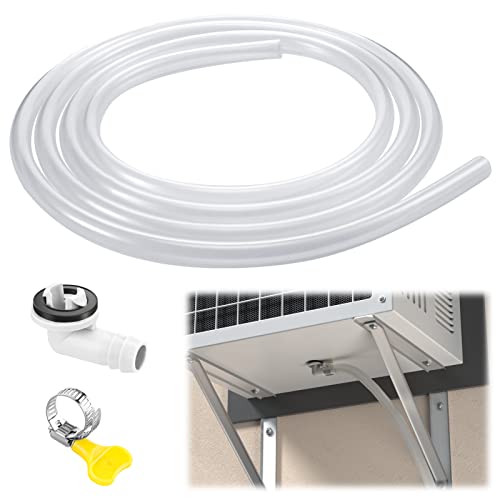
Extra Long 10FT Hose,Fits Multiple AC Units: At 10 feet long (twice the length of standard hoses), this drain hose reaches different heights with ease. The The 3/5 inches drain hose connector is compatible with LG window ACs, Midea U-shaped units, Midea A/C, and 10K BTU models. Please measure your drain hole size before ordering

Versatile Drain Hose: The dehumidifier drain hose is designed for multi-applications, including dehumidifier drainage and various household and garden equipment. It can be easily cut to the desired length, efficiently solve daily drainage problems

MULTIFUNCTIONAL UNIVERSAL DRAIN HOSE: This drain hose has multiple uses, in addition to being suitable for dehumidifier drainage, it is also suitable for air conditioner drainage as well as being suitable for a variety of gardening tasks. Additionally our dehumidifier drain hose can be cut to your desired length to customize it for different situations.
How Do You Set Up a Gravity Drain Hose?
- Confirm that the model supports continuous drainage. Find the drain-port instructions in the owner’s manual.
- Place the unit on a firm, level surface. Keep the required clearance around the intake and exhaust.
- Remove the drain cap or plug. Keep any cap, plug, or adapter in a safe place for future bucket use.
- Attach the approved hose. Fit the required gasket or washer and tighten the connection according to the manual. Do not cross-thread plastic fittings.
- Route the hose continuously downhill. The outlet must remain below the dehumidifier’s gravity-drain connection.
- Remove kinks, loops, and unnecessary low spots. Do not allow the hose end to sit underwater.
- Reinstall the bucket if required. Many units will not operate unless the bucket switch or sensor is engaged.
- Run a supervised test. Check the connection, hose, and discharge point for flow, backup, and leaks.
GE Appliances’ drainage instructions show why model-specific guidance matters: applicable GE gravity-drain models use a standard garden hose, depend on gravity, and require the bucket to remain installed.
If the bucket keeps filling after a hose is connected, use the dedicated guide to why your dehumidifier is not draining through the hose for the full troubleshooting sequence.
Pro Tip: Test a new drainage setup while you are nearby. Dry the hose connection and the floor first, run the unit under humid conditions, and confirm that water reaches the drain without appearing beneath the machine. A floor leak detector can add protection in finished basements.
How Does a Built-In Pump Drain?
A built-in pump can move water to a drain that is higher than the dehumidifier’s gravity outlet, but it does not provide unlimited lift. Use the pump hose supplied or approved by the manufacturer, activate pump mode if required, and stay within the manual’s maximum vertical rise, horizontal routing, and hose-length limits.
Secure the discharge end so it cannot fall out of a sink or drain. Test the pump through at least one complete activation cycle before relying on it. Some models activate the pump only after an internal reservoir or bucket reaches a specified level, so water may not appear immediately after startup.
Where Should You Drain a Dehumidifier?
Choose a stable drainage point that can accept the expected water without backing up or spilling. Depending on the model, installation, and local requirements, suitable options may include:
- a floor drain;
- a utility sink;
- a sump opening approved for condensate;
- a condensate pump connected according to its instructions;
- a toilet bowl when manually emptying the bucket; or
- another location specifically approved in the dehumidifier manual.
Before discharging outdoors, check the dehumidifier instructions and applicable local plumbing, drainage, or building requirements. Protect the hose from freezing, keep discharged water from returning toward the foundation, and avoid creating standing water, erosion, or a slip hazard.
Do not place a gravity hose into a drain where its end becomes submerged. Standing water can interfere with gravity drainage and cause water to back up toward the dehumidifier.
Quick Checks If Automatic Drainage Stops
Turn the machine off when you discover unexpected water. Dry the area and unplug the unit before handling wet connections or clearing the drain path. Start with the hose route, outlet, fitting, bucket position, and pump settings before assuming an internal component has failed.
For a more detailed hose-by-hose diagnostic procedure, see why your dehumidifier is not draining through the hose.
| Problem | Likely Cause | What to Check |
|---|---|---|
| Full-bucket light appears with a gravity hose attached | Blocked hose, uphill section, low spot, loose connection, or submerged outlet | Empty the bucket, inspect and clear the hose, lower the outlet, and reconnect it according to the manual. |
| Water leaks around the hose connector | Loose fitting, damaged threads, missing gasket, damaged hose, or incorrect installation | Level the unit and inspect the fitting, gasket, hose, and drain-port threads. |
| Pump runs but no water reaches the drain | Kink, clog, frozen tubing, loose pump line, or excessive lift or hose length | Clear the line, secure both ends, and compare the route with the model’s pump limits. |
| Unit will not restart after emptying | Bucket not seated, float or sensor stuck, target humidity reached, or a model-specific restart delay | Reinstall the bucket, check the accessible float or sensor, review the humidity setting, and follow any restart-delay instructions in the manual. |
| Ice forms on refrigerant-model coils | Low room temperature, restricted airflow, or a dirty filter | Turn the unit off to defrost, clean the filter, improve clearance, and confirm that the model is rated for the room temperature. |
GE’s drain-hose troubleshooting guidance recommends checking the hose connection, downward route, excess length, clogs, and whether the hose outlet is touching standing water.
If a pump fault returns after the hose is cleared and correctly installed, stop using pump mode and follow the manufacturer’s service guidance. Repeated resetting without correcting the cause can allow another leak.
Can You Reuse Dehumidifier Water?
Dehumidifier water is condensate, not drinking water. EPA guidance on condensate warns that untreated condensate can contain dissolved contaminants and bacteria and should not be considered potable. A household dehumidifier and its collection bucket are not a drinking-water treatment system, so the safest general rule is to treat the collected water as nonpotable.
Building-scale systems can sometimes collect, treat, and reuse condensate for approved nonpotable purposes, but that does not make untreated household bucket water universally suitable for reuse. Unless you have a properly designed, treated, and code-compliant reuse system, do not use household dehumidifier water for:
- drinking or cooking;
- washing food or food-contact items;
- pet drinking water;
- CPAP machines, humidifiers, vaporizers, or other respiratory or medical devices;
- an appliance whose instructions require potable, distilled, or deionized water; or
- watering edible plants when no approved treatment or reuse guidance is in place.
For simple disposal, pour the bucket slowly into a sink, floor drain, or toilet bowl and flush. Do not store untreated condensate for later household use unless it is part of a properly designed water-reuse system.
Frequently Asked Questions
Where should I drain a dehumidifier pump?
Route the pump hose to a secure floor drain, utility sink, sump, or another location approved by the manufacturer. Keep the hose free of kinks and stay within the model’s maximum lift and length. Secure the outlet so it cannot fall out or spray water nearby.
How often should I empty a dehumidifier?
Empty it whenever the full-bucket indicator appears or before the water becomes too heavy for you to carry safely. There is no universal schedule because fill rate depends on room humidity, bucket size, run time, temperature, and ongoing moisture sources. Check it several times during the first day to learn your unit’s normal pattern.
Can I pour dehumidifier water into the toilet?
Yes, you can pour the bucket slowly into the toilet bowl and flush it as a disposal method. Treat dehumidifier condensate as nonpotable and do not use it for drinking, cooking, pets, or medical and respiratory devices.
How should I use a basement dehumidifier?
Place it on a level surface with the clearance required by its manual. Keep basement doors and windows closed while it runs, aim for roughly 30% to 50% relative humidity, and use a tested drain hose or pump for long-term operation when appropriate. Repair foundation leaks, plumbing leaks, and drainage problems instead of relying on the machine alone.
Why is the bucket full when a drain hose is connected?
The hose may be kinked, clogged, routed uphill, connected incorrectly, or submerged at the outlet. A loose connection or incorrectly installed adapter can also divert water toward the bucket. Empty the bucket, unplug the machine before clearing the drain path, and reinstall everything according to the manual.
Can I leave a continuously draining dehumidifier unattended?
Only after you have tested the setup and confirmed that the hose, pump, bucket, fittings, and drain remain secure. Inspect the system regularly, keep the discharge path clear, and consider a floor leak detector in finished or occupied areas.
Does the bucket need to stay installed when I use a drain hose?
Often, yes. Some dehumidifiers require the bucket to remain fully seated so a bucket switch, float, or sensor stays engaged even when water is draining through a hose or pump. Requirements differ by model, so follow the owner’s manual rather than removing the bucket automatically.
Can a dehumidifier gravity-drain hose run uphill?
No. A gravity-drain hose needs a clear downhill route from the dehumidifier to a lower discharge point. If the water must travel upward to a sink or another higher drain, use a model with a built-in pump or an approved external condensate pump and follow its lift and hose-length limits.
Conclusion
You need to empty a portable dehumidifier whenever its bucket fills unless the unit has a correctly installed gravity hose or pump. For manual emptying, turn the unit off, remove and support the bucket, dispose of the nonpotable condensate, clean visible residue when needed, and reinstall the bucket fully.
For automatic drainage, use the hose, adapter, and fittings specified for your exact model. Keep a gravity hose below the outlet, observe all pump-lift and hose-length limits, and test the system for leaks before relying on it. If the bucket still fills or the hose stops draining, follow the first-line checks above and then use the dedicated dehumidifier drain-hose troubleshooting guide.
Sources
- U.S. Environmental Protection Agency: Improving Your Indoor Environment — supports the recommended indoor humidity range and moisture-control guidance.
- ENERGY STAR: Dehumidifiers — supports full-bucket shutoff, capacity terminology, placement, humidity control, electrical safety, and drainage guidance.
- GE Appliances: Dehumidifier Draining Options — supports manual emptying, gravity-drain setup, bucket placement, and pump operation on applicable GE models.
- GE Appliances: Dehumidifier Drain Hose Issues — supports hose-slope, clog, connection, washer, and submerged-outlet troubleshooting.
- Frigidaire: Dehumidifier Clean and Care — supports unplugging before cleaning and washing the bucket with mild soap and water.
- U.S. EPA: Best Practices Guide for Water Efficiency in Laboratories — supports the general principle that untreated condensate can contain contaminants and bacteria and should not be considered potable.