Last reviewed: August 2, 2026. Product specifications can change, so confirm the current manual, electrical requirements, warranty, and Amazon listing before ordering.
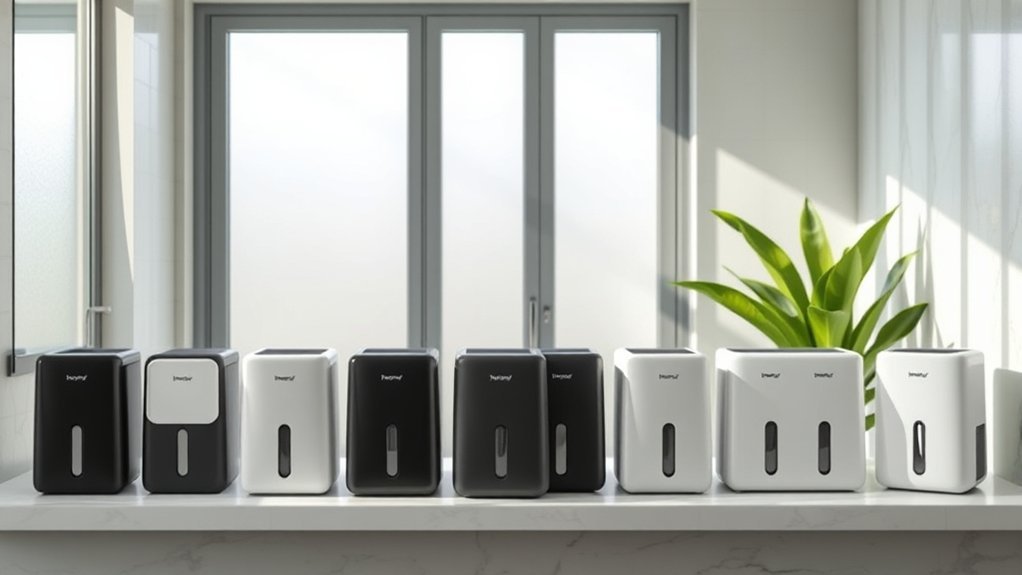
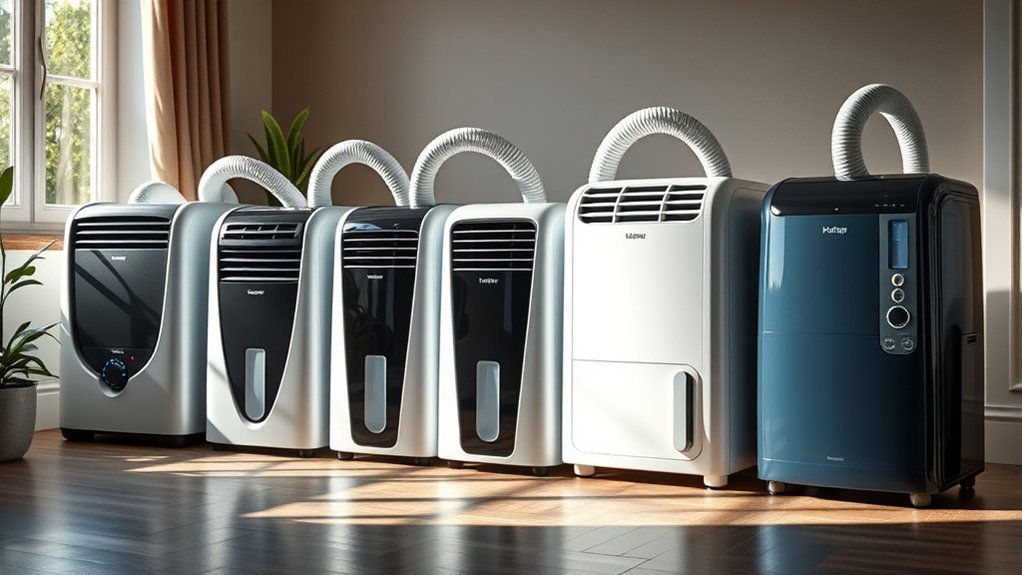
Choosing a commercial dehumidifier is easier when you compare capacity under the same test conditions. Maximum or saturation pints-per-day figures are commonly measured in very hot, humid air and can be much higher than output in a cooler basement, crawl space, warehouse, or restoration site. A manufacturer-listed AHAM PPD figure can be a better comparison point, but buyers should still confirm the stated test temperature, relative humidity, and standard. This guide compares nine commercial and industrial models for basements, crawl spaces, warehouses, water-damage restoration, storage areas, and other demanding applications.
Quick Comparison of the Best Commercial Dehumidifiers
| Product | Editorial Label | Moisture Rating | Drainage | Best Use | Amazon |
|---|---|---|---|---|---|
| Moiswell 260 Pints Commercial Dehumidifier with Pump | Best Overall High-Capacity | 260 PPD max; 110 PPD AHAM | Built-in pump; manufacturer lists up to a 16.4-ft pump route | Large commercial spaces and restoration work | Check Current Amazon Availability |
| Waykar 155 Pints Commercial Dehumidifier with Pump | Best Flexible Drainage | 155 PPD max at 95°F/90% RH | Built-in pump and gravity drain options | Large basements, warehouses, and commercial rooms | Check Current Amazon Availability |
| EUHOMY 160 Pints Commercial Dehumidifier with Pump | Best Easy-Mobility Cart | 160 PPD max at 95°F/90% RH | Pump-assisted and continuous drain options | Warehouses, basements, workshops, and drying projects | Check Current Amazon Availability |
| VEVOR 125 Pints Commercial Dehumidifier | Best Fixed-Drain Crawl-Space Pick | 125 PPD saturation; 60 PPD AHAM | Continuous hose drainage; no built-in pump listed | Crawl spaces, storage rooms, and fixed installations | Check Current Amazon Availability |
| MOUNTO 150 Pint Commercial Dehumidifier with Pump | Best for Restoration Crews | 150 PPD saturation; 80 PPD AHAM | Built-in pump with drain hose | Water-damage restoration, basements, and job sites | Check Current Amazon Availability |
| Airecoler GT-X5 125 Pints Commercial Dehumidifier | Best Compact Crawl-Space Pick | 125 PPD max; 60 PPD AHAM | Continuous drain hose | Low-clearance crawl spaces and tight basements | Check Current Amazon Availability |
| ALORAIR 170 PPD Commercial Dehumidifier with Pump | Best Portable LGR | 170 PPD saturation; 80 PPD AHAM | Built-in condensate pump | Commercial drying and water-damage restoration | Check Current Amazon Availability |
| MOUNTO 180 Pints Industrial Dehumidifier with Pump | Best Cart-Style Job-Site | 180 PPD max at 95°F/90% RH | Built-in pump and drain hose | Garages, basements, warehouses, and job sites | Check Current Amazon Availability |
| ALORAIR Commercial Dehumidifier with Pump, 180 PPD | Best Compact 85-PPD AHAM | 180 PPD saturation; 85 PPD AHAM | Built-in condensate pump | Crawl spaces, basements, and restoration drying | Check Current Amazon Availability |
Capacity note: “Max,” “saturation,” and AHAM ratings are not interchangeable. Use AHAM-labeled PPD only after confirming that the compared products use the same or clearly disclosed test conditions. Then check airflow, temperature range, drainage, electrical requirements, and the actual moisture load in your space.
Before You Buy Checklist
- Confirm the exact capacity test conditions, not only the headline PPD.
- Measure the available floor space, doorway width, and stair or crawl-space access.
- Plan a gravity drain or verify the built-in pump’s lift and hose route.
- Check the operating temperature range, voltage, amperage, plug type, and circuit requirements.
- Verify replacement-filter, pump, warranty, and service availability for the exact model.
Moiswell 260 Pints Commercial Dehumidifier with Pump
Best Overall High-Capacity
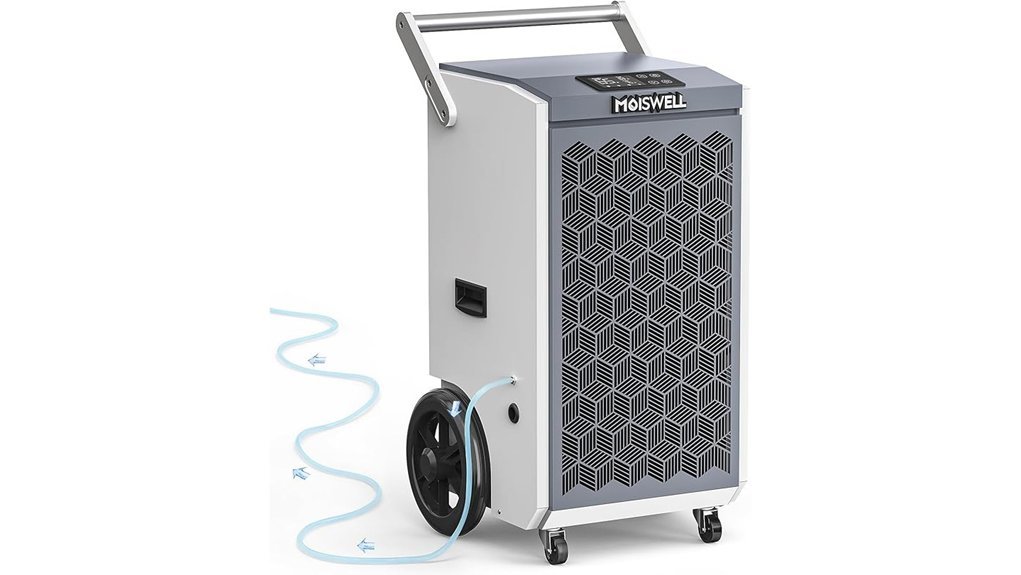
The Moiswell 260 Pints Commercial Dehumidifier has the highest manufacturer-listed AHAM figure in this lineup. The seller lists up to 260 pints per day under high-temperature, high-humidity conditions and 110 pints per day at AHAM conditions. That distinction matters because the AHAM number is the more useful comparison for typical indoor operation. A built-in pump, long drain hose, large rear wheels, and detachable handles make it practical for warehouses, basements, construction drying, and other demanding spaces.
Best For: Businesses, restoration crews, and property managers who need high moisture removal plus pumped drainage.
Why You’ll Like It: It combines the highest manufacturer-listed AHAM figure in this roundup with job-site mobility and automatic condensate removal.
Who Should Avoid It: Avoid it if you need a lightweight unit for frequent stair carrying or only have a small room to dry.
Pros:
- Seller lists 110 PPD at AHAM conditions and up to 260 PPD at maximum test conditions.
- Built-in pump reduces the need to position the unit above a floor drain.
- Large wheels and detachable handles support movement across commercial sites.
Cons:
- At about 95 pounds, it may require two people on stairs or uneven access points.
- Its maximum 260-PPD figure should not be compared directly with AHAM-only ratings.
- The large chassis may be excessive for small basements or single rooms.
Waykar 155 Pints Commercial Dehumidifier with Pump
Best Flexible Drainage
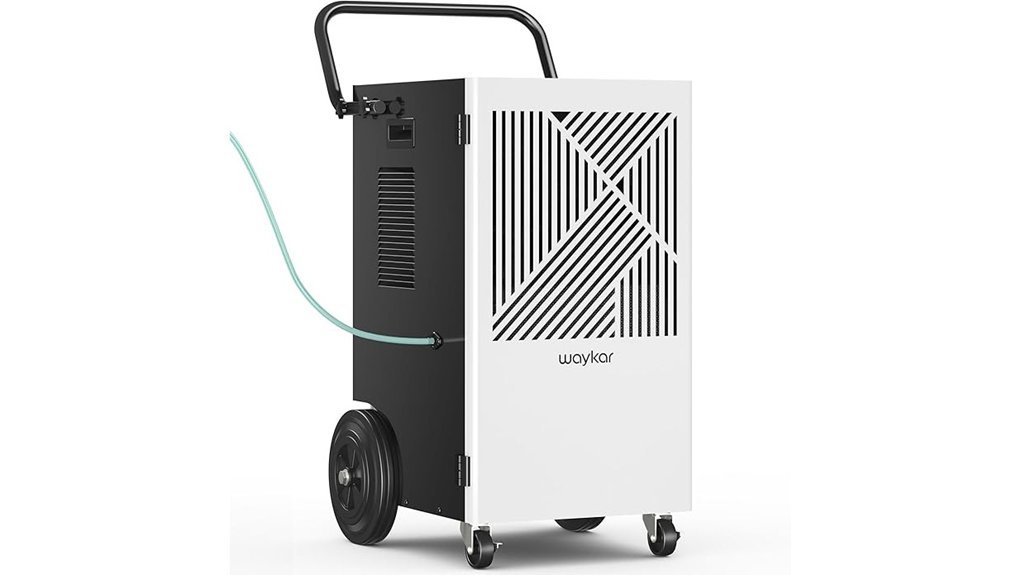
The Waykar 155 Pints Commercial Dehumidifier targets large indoor areas where automatic drainage and broad humidity adjustment are useful. The manufacturer lists 155 pints per day at 95°F and 90% RH, so treat that as a maximum-condition rating rather than an AHAM comparison figure. Current coverage wording varies across seller and manufacturer pages, so size the unit from moisture load, room volume, and required drying speed instead of a square-foot headline. The model is also listed with a washable filter, wheels, and a detachable handle.
Best For: Buyers who want a wheeled pump-equipped unit for a large basement, warehouse, storage area, or commercial room.
Why You’ll Like It: The broad control range and two drainage approaches make it easier to adapt to different layouts.
Who Should Avoid It: Avoid choosing it from a square-foot claim alone; severe moisture loads, high ceilings, infiltration, or active water damage may require more capacity or multiple units.
Pros:
- Built-in pump and gravity drainage provide flexible water removal.
- Adjustable humidity control supports different drying and maintenance use cases.
- Wheels, a detachable handle, and a washable filter improve day-to-day usability.
Cons:
- The 155-PPD figure is stated at hot, very humid conditions, not as an AHAM rating.
- Its large footprint and weight may make tight-space placement difficult.
- Coverage claims do not account for ceiling height, infiltration, or active water damage.
EUHOMY 160 Pints Commercial Dehumidifier with Pump
Best Easy-Mobility Cart
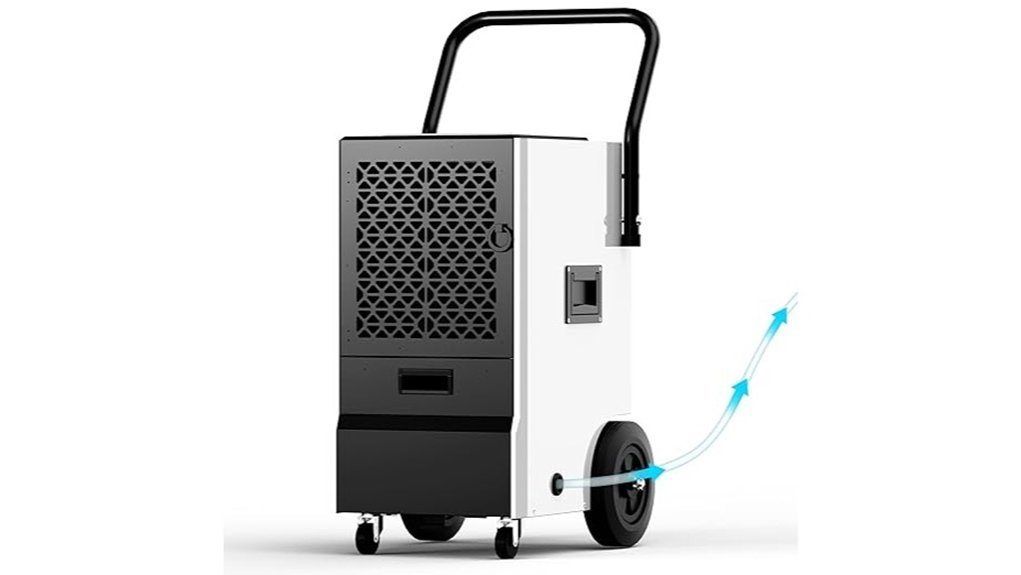
The EUHOMY 160 Pints Commercial Dehumidifier is designed for buyers who want high maximum-condition capacity, pumped drainage, and easy movement between rooms or work zones. The seller listing states up to 160 pints per day at 95°F and 90% RH, so the figure should not be compared directly with AHAM-rated output. The listing also describes adjustable humidity, continuous mode, a 24-hour timer, a push-pull handle, and four wheels. Confirm the current manual and operating-temperature range because complete manufacturer documentation was not clearly available during this review.
Best For: Facilities, workshops, large basements, and temporary drying jobs where the unit may need to move regularly.
Why You’ll Like It: Four wheels and a full-height handle can be more convenient than compact crawl-space units that must be carried.
Who Should Avoid It: Avoid treating the 160-PPD maximum as typical indoor output, and confirm the operating temperature range for cold spaces.
Pros:
- Four-wheel design and push-pull handle support frequent repositioning.
- Built-in pump and continuous drainage reduce manual water handling.
- Adjustable humidity and timer controls provide useful automation.
Cons:
- The headline capacity is measured at 95°F and 90% RH.
- A large wheeled cabinet may not fit crawl spaces or low-clearance areas.
- Filters and drainage components still need regular inspection during dusty restoration work.
VEVOR 125 Pints Commercial Dehumidifier
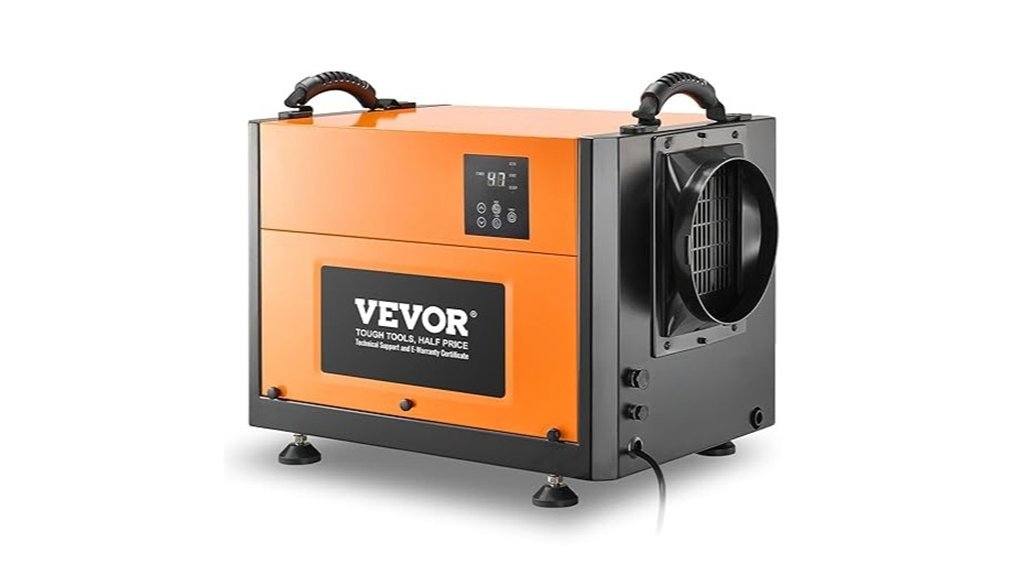
Best Fixed-Drain Crawl-Space Pick
The VEVOR 125 Pints Commercial Dehumidifier is a compact galvanized-steel model intended for crawl spaces, basements, and storage areas. The manufacturer separates its ratings into 125 pints at saturation and 60 pints at AHAM conditions, which is more useful than a maximum figure alone. The current manufacturer page lists 210 CFM airflow, continuous hose drainage, auto defrost, and a compact cabinet for fixed installations.
Best For: Buyers who can route a gravity drain hose and want a compact, durable unit for a fixed location.
Why You’ll Like It: It provides a clearly stated 60-PPD AHAM figure and a compact metal housing without the bulk of a cart-style restoration unit.
Who Should Avoid It: Avoid it when water must be pumped upward or across a route that gravity drainage cannot handle.
Pros:
- Clear 60-PPD AHAM and 125-PPD saturation ratings improve apples-to-apples comparison.
- Galvanized-steel construction and compact dimensions suit crawl-space installations.
- Auto defrost and continuous drainage support unattended operation.
Cons:
- The current listing does not describe a built-in condensate pump for this ASIN.
- Any overhead or joist installation requires secure mounting, correct clearances, and careful handling.
- The seller-listed coverage area should be adjusted for real moisture load and temperature.
MOUNTO 150 Pint Commercial Dehumidifier with Pump
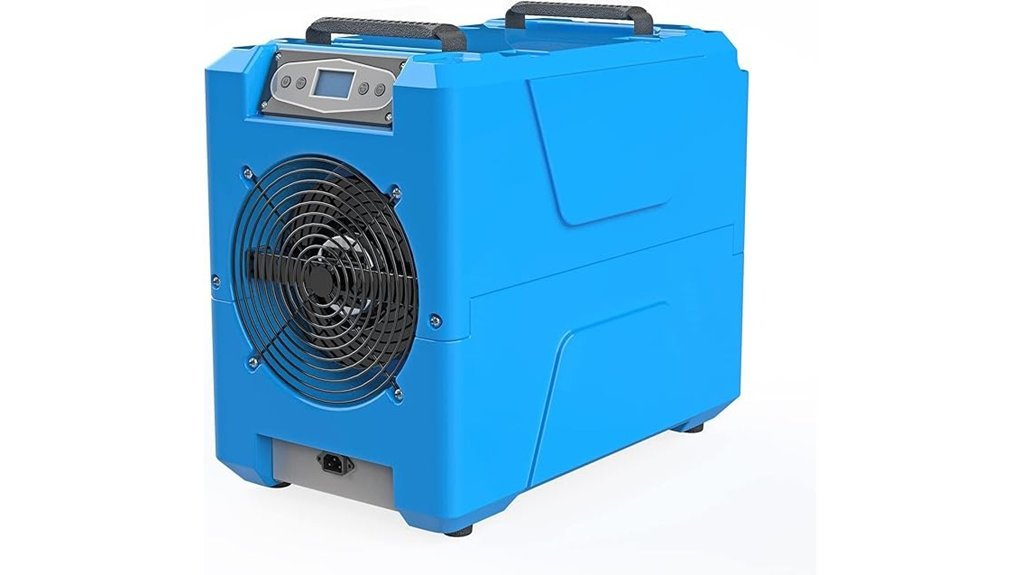
Best for Restoration Crews
The MOUNTO 150 Pint Commercial Dehumidifier is a restoration-oriented LGR unit with a listed split rating of 150 pints per day at saturation and 80 pints per day at AHAM conditions. Its compact, stackable cabinet, built-in pump, memory restart, LED display, and long power cord are practical for contractors who move equipment between job sites.
Best For: Restoration professionals and property managers who prioritize stackability, pumped drainage, and restart after power interruption.
Why You’ll Like It: Its 80-PPD AHAM rating gives buyers a more realistic comparison point than a saturation number alone.
Who Should Avoid It: Avoid it if you mainly need a quiet residential unit or a lightweight machine for frequent stair carrying.
Pros:
- Seller lists 80 PPD at AHAM conditions and 150 PPD at saturation.
- Compact, stackable form supports transport and storage.
- Built-in pump and memory restart fit restoration workflows.
Cons:
- The saturation number is much higher than the AHAM rating, so comparison labels can be misleading.
- A commercial LGR unit will be audible in occupied living or office spaces.
- Regular filter and pump maintenance is important in dusty environments.
Airecoler GT-X5 125 Pints Commercial Dehumidifier
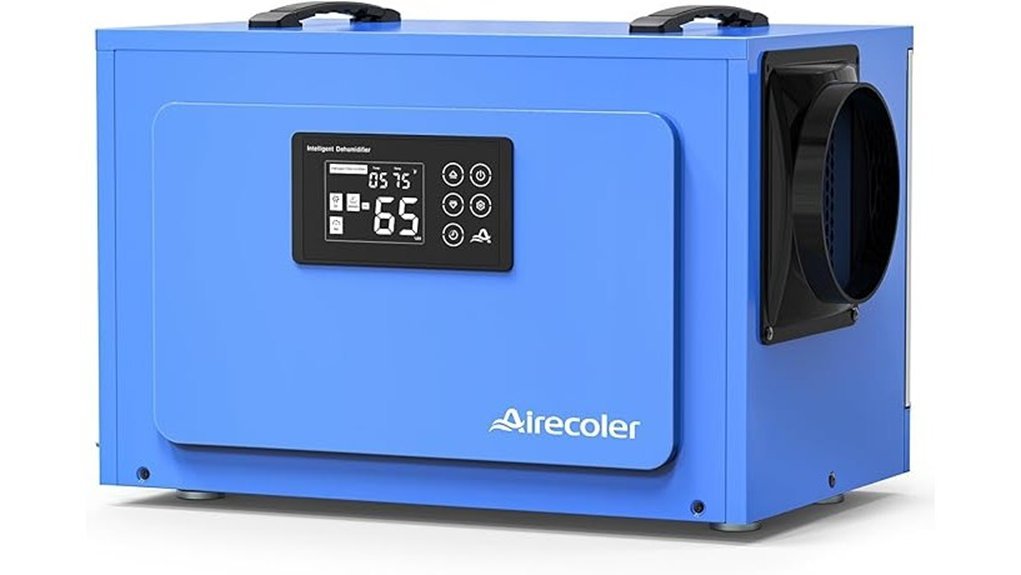
Best Compact Crawl-Space Pick
The Airecoler GT-X5 is one of the more compact choices in the roundup. The manufacturer lists up to 125 pints per day at maximum conditions and 60 pints per day at AHAM conditions. Its low-profile cabinet, 24-hour timer, auto defrost, continuous mode, drain hose, and restart memory suit crawl spaces and tight utility areas where a tall wheeled unit will not fit.
Best For: Homeowners and contractors who need a low-profile commercial dehumidifier for a crawl space or confined basement zone.
Why You’ll Like It: It balances a compact footprint with a clearly disclosed AHAM figure and continuous drainage.
Who Should Avoid It: Avoid it when the drain route requires upward pumping, because this ASIN is presented with a drain hose rather than a built-in pump.
Pros:
- Compact dimensions fit low-clearance spaces.
- Manufacturer lists 60 PPD at AHAM conditions.
- Auto defrost, timer, continuous mode, and memory restart support unattended use.
Cons:
- The 125-PPD headline is a maximum-condition figure.
- Gravity drainage limits placement when a lower drain is unavailable.
- The seller’s coverage claim should not replace a moisture-load calculation.
ALORAIR 170 PPD Commercial Dehumidifier with Pump
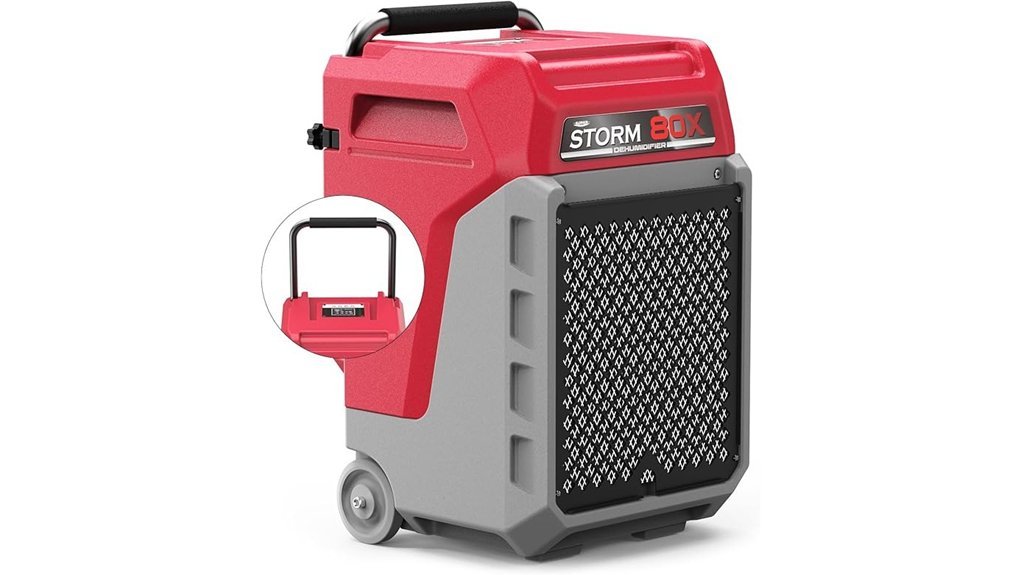
Best Portable LGR
The ALORAIR Storm 80X is a portable LGR dehumidifier rated by the manufacturer at 170 pints per day under saturation conditions and 80 pints per day at AHAM conditions. It includes a built-in pump, wheels, a retractable handle, auto defrost, and manufacturer-listed airflow of 200 CFM. The manufacturer presents it for restoration work and spaces up to 2,100 square feet, but actual sizing still depends on moisture load and drying goals.
Best For: Restoration work, damp basements, and commercial spaces where pumped drainage and wheeled mobility matter.
Why You’ll Like It: It combines an 80-PPD AHAM rating with a cart-style design that is easier to reposition than many compact box units.
Who Should Avoid It: Avoid choosing it only from the 170-PPD headline; use the 80-PPD AHAM figure for comparison with other rated models.
Pros:
- Clearly stated 80-PPD AHAM rating.
- Built-in pump, wheels, and retractable handle support mobile jobs.
- Auto defrost and a stated 200-CFM airflow support restoration-style drying.
Cons:
- The saturation rating is more than double the AHAM rating.
- The unit remains heavy despite its wheels.
- Commercial fan and compressor noise may be unsuitable for quiet occupied areas.
MOUNTO 180 Pints Industrial Dehumidifier with Pump
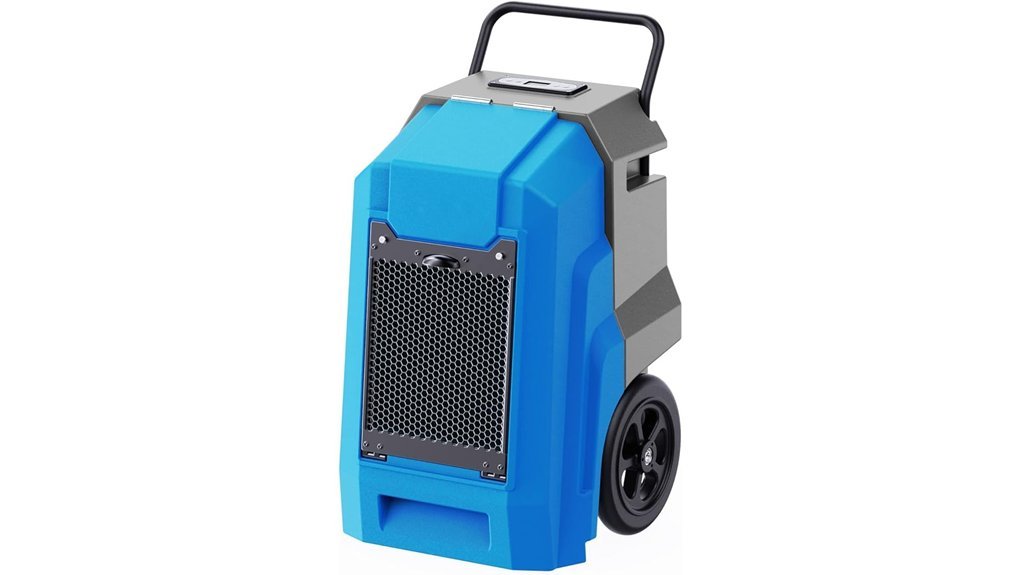
Best Cart-Style Job-Site
The MOUNTO 180 Pints Industrial Dehumidifier is a wheeled LGR-style unit for demanding drying jobs. Its listing states up to 180 pints per day at 95°F and 90% RH and coverage up to 3,000 square feet. The unit includes pumped drainage, digital humidity and temperature monitoring, adjustable humidity control, and automatic restart.
Best For: Contractors and facilities teams who want a high-capacity cart-style unit for repeated job-site use.
Why You’ll Like It: Its tall wheeled design, pump, and controls are well suited to repeated movement between commercial work zones.
Who Should Avoid It: Avoid assuming the 180-PPD maximum equals typical indoor performance; the listing information reviewed did not clearly surface an AHAM number.
Pros:
- Built-in pump supports continuous drainage without frequent tank handling.
- Wheels and digital controls improve job-site usability.
- Its cart-style format is easier to roll across flat floors than compact carry-only units.
Cons:
- The headline capacity is stated at 95°F and 90% RH.
- The heavy cart-style chassis may require assistance on stairs or during vehicle loading.
- Buyers should confirm the AHAM rating before comparing it with AHAM-labeled competitors.
ALORAIR Commercial Dehumidifier with Pump, 180 PPD
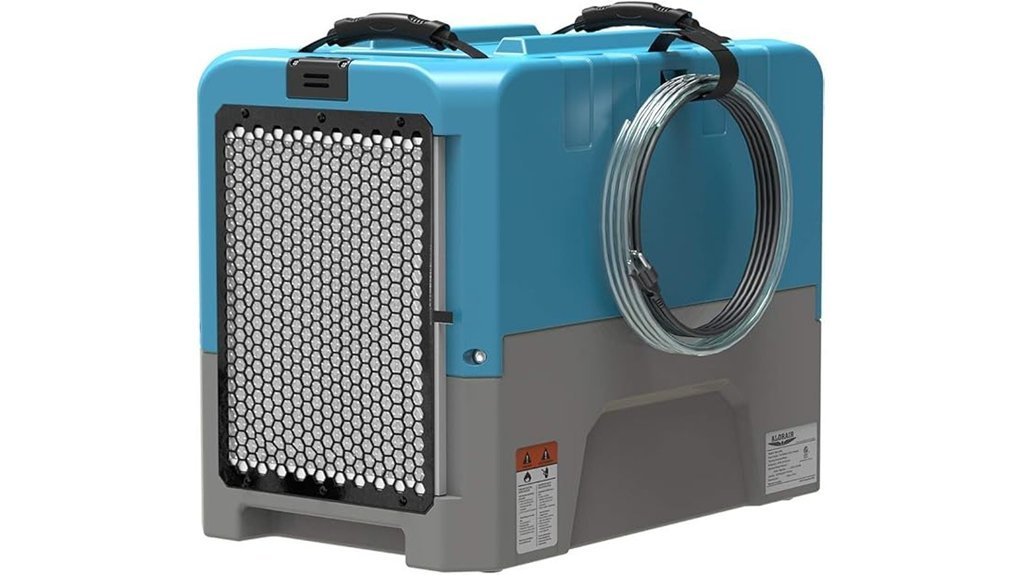
Best Compact 85-PPD AHAM
The ALORAIR Storm LGR Extreme pairs a compact cabinet with a seller-listed 180-PPD saturation rating and 85 PPD at AHAM conditions. It also lists 210 CFM airflow, a built-in condensate pump, auto defrost, automatic restart, and coverage up to 2,300 square feet. The compact proportions make it useful where a tall cart-style unit is awkward.
Best For: Restoration professionals and property owners who need strong AHAM capacity in a compact crawl-space-friendly body.
Why You’ll Like It: Its 85-PPD AHAM rating is one of the highest clearly disclosed ratings in the lineup, while the compact housing supports confined-space placement.
Who Should Avoid It: Avoid it if you need large wheels for rough terrain or prefer a tall handle for rolling long distances.
Pros:
- Seller lists 85 PPD at AHAM conditions and 180 PPD at saturation.
- Compact design fits crawl spaces and tight basements.
- Built-in pump and automatic controls support low-attention operation.
Cons:
- The compact cabinet is still heavy and may be awkward in narrow access points.
- The 180-PPD saturation figure can overstate expected output in ordinary rooms.
- Filter and pump maintenance remain necessary for reliable long-term use.
Factors to Consider When Choosing Commercial Dehumidifiers
The best commercial dehumidifier is not always the model with the largest headline number. Match the unit to your actual moisture load, drainage route, temperature, floor plan, and duty cycle. The following checks make the comparison safer and more useful.
Compare AHAM PPD With Maximum PPD
Start with the test conditions behind the capacity claim. A manufacturer-listed AHAM PPD figure is often more useful than a saturation number, but the label alone does not prove that every brand used the same test procedure or standard version. Confirm the stated temperature and relative humidity whenever possible. A maximum or saturation PPD rating is commonly measured around 90°F to 95°F and 90% relative humidity, so it can be much higher than expected output in a cooler basement or warehouse. Do not compare one product’s maximum PPD directly with another product’s AHAM-labeled PPD.
Treat Coverage Claims as a Starting Point
Square-foot coverage is a seller estimate, not a complete sizing calculation. Ceiling height, outdoor air infiltration, wet materials, open doors, ground moisture, active leaks, and desired drying speed can change the required capacity. For water damage, high ceilings, or repeated air exchange, prioritize AHAM capacity and airflow and consider whether more than one unit is needed.
Plan the Drainage Route Before Buying
A built-in condensate pump can move water upward or across a long hose route. Gravity drainage is simpler but requires a continuously downward path to a suitable drain. Confirm the pump lift, hose length, drain location, and whether the unit automatically restarts after a power interruption. A pump does not eliminate maintenance; hoses, check valves, and filters still need inspection.
Check Low-Temperature Operation and Auto Defrost
Commercial spaces can be cooler than residential rooms. Verify the manufacturer’s operating temperature range and look for automatic defrost if the unit will run in a crawl space, basement, garage, or unheated building. Running below the rated temperature can reduce moisture removal and cause coil icing.
Use Airflow to Judge Drying Work
Airflow in cubic feet per minute helps distribute dry air and pull moisture from wet materials. Restoration work often benefits from higher airflow and strategic placement with air movers. For a closed crawl space, a compact unit with ducting or directed airflow may be more useful than a taller cart-style machine.
Compare Energy Use With Moisture Removed
Do not judge efficiency from wattage alone. Compare AHAM PPD per kilowatt-hour, COP when supplied, Energy Star certification where applicable, and expected runtime. A higher-capacity unit may finish a drying cycle faster, while an undersized unit may run continuously without reaching the target humidity.
Match Portability to the Job Site
Large wheels and tall handles help on flat floors, while compact stackable units are easier to load into vehicles or position in tight spaces. Check total weight, lifting handles, stair access, doorway width, and whether the unit can be safely mounted or suspended. Wheels do not solve stair or overhead-placement challenges.
Look for Useful Automatic Controls
Helpful controls include an adjustable humidistat, continuous mode, timer, auto restart, memory settings, real-time humidity display, and pump-failure alerts. For unattended operation, confirm that the unit resumes safely after a power outage and that the drain setup will not overflow.
Consider Construction and Serviceability
Commercial units often use metal or rotomolded housings, washable filters, reinforced handles, and serviceable pumps. Construction quality matters, but so does access to replacement filters, drain hoses, pumps, coils, and technical support. A long warranty is useful only when its coverage terms, registration rules, and service process are clear.
Plan Routine Maintenance
Inspect and clean the filter according to the manual, more often on dusty restoration sites. Check the drain hose for kinks, clean the pump and reservoir as directed, keep air inlets clear, and inspect coils for dirt or ice. Before buying, confirm warranty length, what parts are covered, and whether service is available in your area.
Frequently Asked Questions
How Noisy Are Commercial Dehumidifiers During Operation?
Commercial compressor dehumidifiers are audible and may be disruptive in bedrooms, offices, or occupied living areas. Noise varies by airflow, compressor design, fan speed, and cabinet construction. Check the manufacturer’s stated dB(A) figure when available, and remember that sound can increase when the unit sits on a resonant floor or against a wall.
What Is the Average Lifespan of a Commercial Dehumidifier?
There is no guaranteed universal lifespan. Service life depends on daily runtime, temperature, dust, water quality, filter care, pump maintenance, storage, and access to replacement parts. A well-maintained commercial unit can last for years, but heavy restoration use may require earlier pump, fan, sensor, or compressor service.
Can I Use a Dehumidifier in Unheated Spaces?
Yes, but only within the model’s stated operating temperature range. Choose a unit with automatic defrost for cool basements, crawl spaces, garages, or warehouses. Below the rated temperature, moisture removal can fall sharply and the evaporator coil may ice.
How Often Should I Clean the Filters?
Follow the manual. As a practical starting point, inspect the filter every one to two weeks during continuous or dusty use and clean it whenever airflow is restricted. Restoration sites, pet hair, construction dust, and warehouse debris may require more frequent checks.
Are There Energy-Efficient Options Available?
Yes. Look for Energy Star certification where applicable, a disclosed COP or integrated energy factor, and an AHAM capacity that matches your moisture load. The most efficient purchase is not simply the lowest-watt model; it is the unit that removes the required moisture without running endlessly.
What Humidity Level Should I Set?
For occupied indoor spaces, a target within roughly 30% to 50% relative humidity is a common moisture-control range, with many basement users starting near 45% to 50%. Sensitive storage materials and restoration projects may require a different target based on manufacturer guidance or material moisture readings. Avoid setting the target lower than necessary because it can increase runtime and energy use.
Is AHAM PPD Always Directly Comparable?
No. “AHAM” is useful only when the seller or manufacturer clearly identifies the test conditions or applicable standard. Different test temperatures, humidity levels, and older versus newer procedures can produce different capacities. Compare models using the same disclosed conditions whenever possible.
Can a Dehumidifier Fix a Flooded Building by Itself?
No. Stop the water source, remove standing water, address electrical and contamination hazards, and remove materials that cannot be safely dried. Restoration drying may require multiple dehumidifiers, air movers, moisture meters, containment, and qualified professional oversight.
Do I Need a Built-In Pump?
You need a pump when the drain point is above the dehumidifier or when the hose cannot maintain a continuous downward slope. If a nearby floor drain is lower than the unit, gravity drainage is simpler and may reduce maintenance.
Conclusion
The best choice depends on how and where you will use it. Choose the Moiswell 260 when the highest manufacturer-listed AHAM figure in this roundup is the main priority. Pick the MOUNTO 150, ALORAIR Storm 80X, or ALORAIR Storm LGR Extreme for restoration-style work with pumped drainage. Choose the VEVOR 125 or Airecoler GT-X5 for compact crawl-space installations with a suitable gravity drain route. The Waykar 155 and EUHOMY 160 are cart-style alternatives for large rooms where mobility and automatic drainage matter. Before ordering, confirm the exact capacity test conditions, operating temperature, pump lift, electrical requirements, dimensions, warranty terms, and drain route for your site.