Affiliate disclosure: As an Amazon Associate, we may earn from qualifying purchases. This does not affect which products are included or how they are evaluated.
Commercial dehumidifiers can help control the excess moisture that allows mold to grow in basements, crawl spaces, warehouses, storage areas, and water-damaged buildings. They do not remove existing mold or repair the leak that caused it. For effective moisture control, choose a unit based on its rating conditions, airflow, drainage system, operating temperature, and the actual water load in your space.
This guide compares six relevant options: the ALORAIR Storm Pro, MOUNTO 150-Pint, Yaufey 155-Pint, Airecoler GT-X5, Airzentti 155-Pint, and HBN 125-Pint. Each solves a different problem, from restoration work and low-clearance crawl spaces to large rooms that need pumped drainage.
Important mold safety note
A dehumidifier helps reduce moisture, but it does not clean established mold. Fix leaks and water intrusion, remove or clean contaminated materials appropriately, and dry the area thoroughly. Consider qualified remediation help for widespread growth, contaminated floodwater, hidden mold, or HVAC contamination.
For flood-damaged or visibly moldy areas, confirm that electrical power is safe before operating equipment. Avoid using fans on established mold until contaminated surfaces and materials have been addressed, because air movement can spread spores.
Key Takeaways
- Compare moisture-removal ratings measured under similar temperature and humidity conditions.
- Choose gravity drainage only when the hose can run continuously downhill; otherwise, select a verified pump model.
- Treat square-foot coverage as a rough guide, not a substitute for evaluating the actual moisture load.
Quick Verdict and Comparison
Quick recommendation: The ALORAIR Storm Pro is the strongest all-around choice for restoration and demanding commercial work because it provides a published 85-pint AHAM rating, 210 CFM airflow, a built-in pump, and remote monitoring. The MOUNTO is easier to store and stack, while the Airecoler GT-X5 is better for a low crawl space with a nearby floor drain.
Capacity warning: Maximum or saturation ratings are measured in hotter and wetter conditions than most occupied buildings. Compare standardized ratings whenever possible instead of choosing solely by the largest number on the product name.
| Product | Capacity Information | Drainage | Best Use | Amazon |
|---|---|---|---|---|
| ALORAIR Storm Pro | 180 PPD maximum; 85 PPD at AHAM conditions | Built-in condensate pump | Restoration jobs and demanding commercial drying | Check Details |
| MOUNTO 150-Pint | 150 PPD maximum; 80 PPD at AHAM conditions | Built-in pump and drain hose | Compact, stackable restoration equipment | Check Details |
| Yaufey 155-Pint | 155 PPD maximum at 95°F and 90% RH | Built-in pump; advertised 16.4-ft pump hose included | Large open basements and commercial rooms | Check Details |
| Airecoler GT-X5 | 125 PPD maximum; about 58–60 PPD under listed standard conditions | Gravity drain; no integrated lift pump | Low-clearance crawl spaces with a nearby drain | Check Details |
| Airzentti 155-Pint | 155 PPD maximum claimed; listing claims 70 PPD at AHAM conditions; ENERGY STAR record lists 49.83 PPD for model ACD155P-PG100(B) | Built-in pump | Large portable applications where certification matters | Check Details |
| HBN 125-Pint | 125 PPD at 95°F and 90% RH; related retail listing states 60 PPD at AHAM conditions | Built-in pump and gravity drain advertised; verify exact model | Low-profile commercial spaces where the exact model is verified | Check Details |
How We Compared These Dehumidifiers
The recommendations are based on product relevance, stated moisture-removal conditions, airflow, drainage flexibility, portability, low-temperature operation, control features, warranty transparency, and suitability for commercial or restoration work. Manufacturer coverage figures were treated as estimates rather than guaranteed sizing rules, and claims that could not be matched to an exact model were labeled for verification.
- Capacity transparency: Preference was given to products that publish both maximum and standardized ratings.
- Continuous drainage: Pumped or gravity drainage must suit the installation location.
- Commercial practicality: Handles, wheels, stackability, service access, and restart functions matter on active job sites.
- Honest limitations: Weight, drain restrictions, rating differences, and verification gaps are included rather than hidden.
ALORAIR Storm Pro Commercial Dehumidifier with Pump
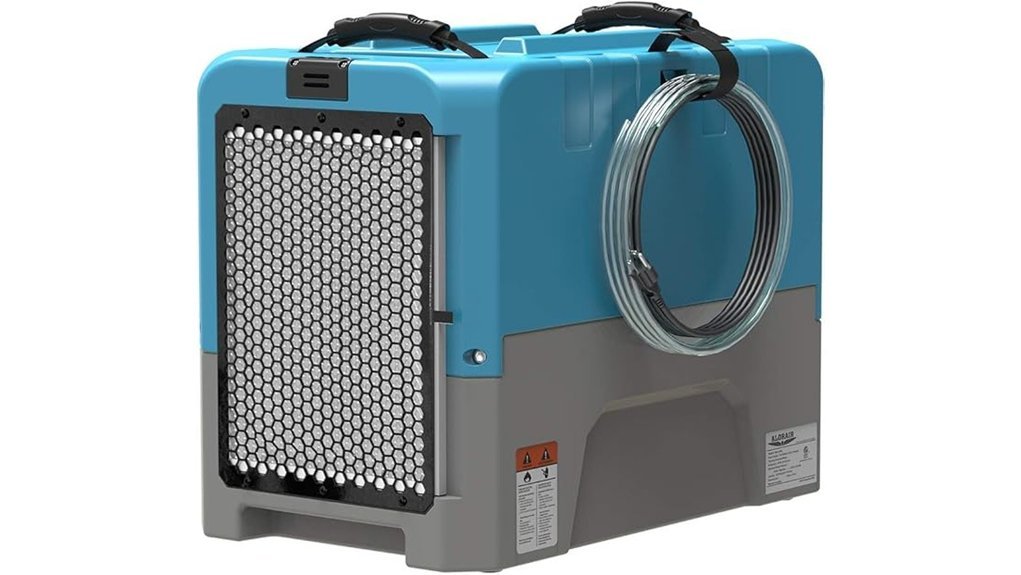
The ALORAIR Storm Pro is the strongest fit for water-damage restoration and demanding commercial drying in this comparison. Its published capacity is 180 pints per day under saturation conditions and 85 pints per day under AHAM conditions, making its everyday performance easier to compare than products that publish only a maximum number.
It provides approximately 210 CFM airflow, a built-in heavy-duty condensate pump, automatic defrost, memory restart, an hours-run meter, and smart Wi-Fi monitoring. The manufacturer lists coverage up to 2,300 square feet, although actual sizing still depends on temperature, moisture load, air movement, and building materials.
At approximately 99.2 pounds and about 38 inches tall, this is not a lightweight crawl-space machine. It is better suited to users who value restoration-oriented construction and remote monitoring more than one-person portability.
Best For: Restoration contractors, large damp basements, warehouses, and users who need pumped drainage with remote status monitoring.
Why You’ll Like It:
- Publishes both maximum and AHAM moisture-removal ratings.
- Built-in pump supports continuous unattended drainage.
- Smart Wi-Fi, auto defrost, memory restart, and an hours-run meter improve job-site management.
- The manufacturer advertises a six-year limited warranty, with full coverage limited to the first two years and all coverage subject to the written terms.
Who Should Avoid It:
- Anyone who needs a lightweight unit for frequent stair or crawl-space transport.
- Small rooms with modest seasonal humidity.
- Installations that cannot accommodate its tall commercial housing.
MOUNTO 150-Pint Commercial Dehumidifier with Pump
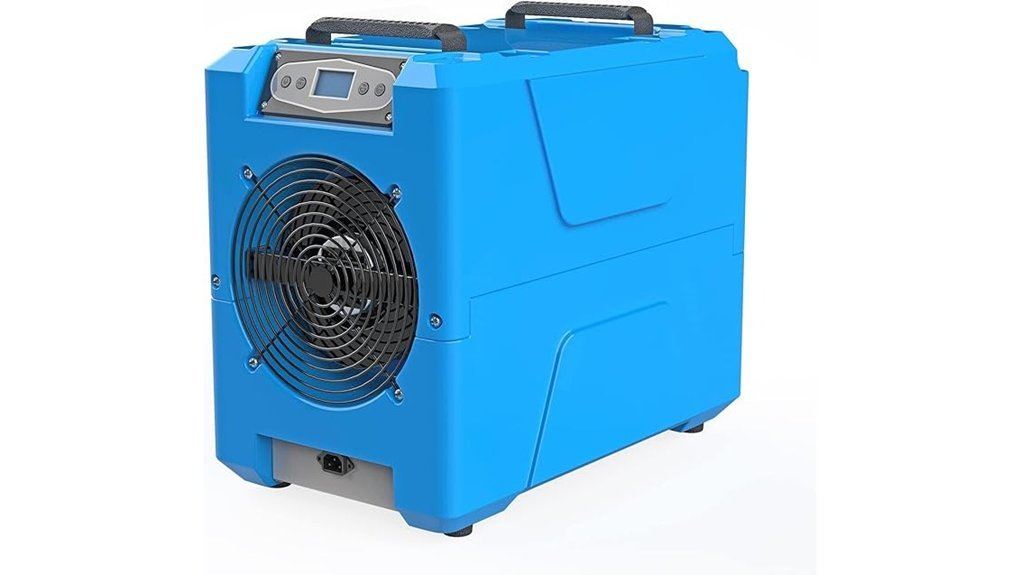
The MOUNTO is designed for restoration work where storage space and transport efficiency matter. Its 150-pint figure is a saturation rating; the more useful comparison figure is approximately 80 pints per day at AHAM conditions. That distinction makes it a capable commercial unit without overstating what buyers should expect in normal indoor conditions.
The housing measures roughly 22 × 13 × 19 inches and is designed to be stacked for transport or storage. A built-in pump and drain hose support continuous water removal, while the LED panel provides basic humidity and operating information.
Specification note: Current retailer listings for model DH80 are not fully consistent about standardized capacity and coverage. Confirm the exact model, AHAM figure, pump lift, dimensions, and included hoses on the Amazon page before ordering.
Best For: Restoration teams, construction drying, warehouses, and buyers who need a compact commercial machine that stores efficiently.
Why You’ll Like It:
- Commercial LGR-style design for water-damage and high-moisture applications.
- Approximately 80 PPD at AHAM conditions and 150 PPD at saturation.
- Stackable housing saves space in a vehicle or equipment room.
- Integrated pump reduces dependence on a nearby floor drain.
Who Should Avoid It:
- Buyers who want app control or extensive consumer convenience features.
- Small finished rooms where a quieter residential model would be sufficient.
- Anyone who cannot confirm replacement parts and service options in their region.
Yaufey 155-Pint Commercial Dehumidifier with Pump
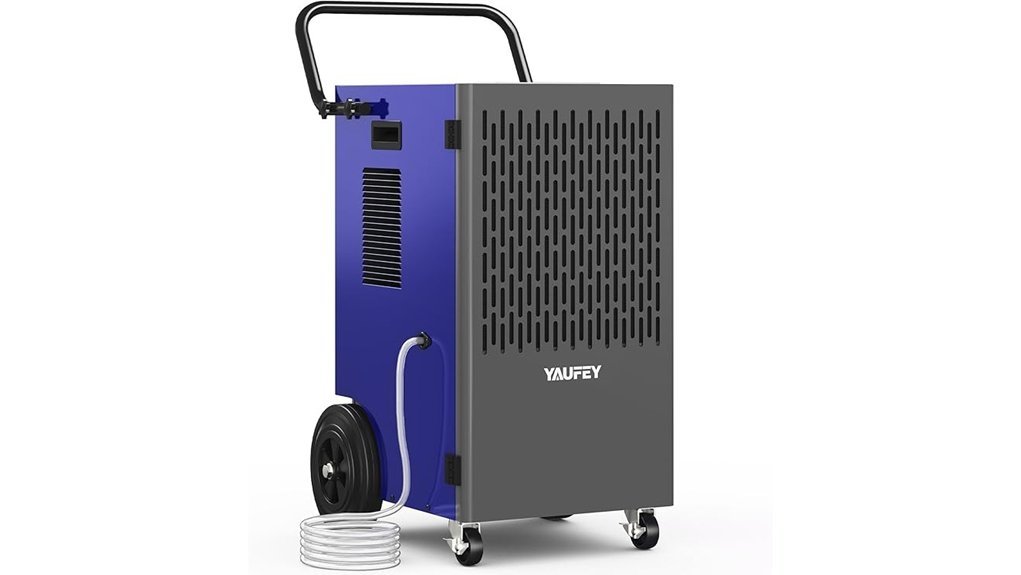
The Yaufey DP605C combines a high advertised maximum capacity with easy mobility. The manufacturer states that it removes up to 155 pints per day at 95°F and 90% RH, provides 164.7 CFM airflow, and is intended for spaces up to 8,000 square feet. The capacity and coverage numbers should be treated as maximum-condition figures rather than guaranteed performance in a cooler basement.
The built-in condensate pump includes an advertised 16.4-foot pump hose and can operate automatically as condensate collects. The manufacturer identifies 16.4 feet as the included hose length, so it should not be treated as a verified vertical-lift rating unless the current manual or listing states that separately. Gravity drainage is also available when a suitable lower drain is nearby. Front swivel wheels, larger rear wheels, a handle, automatic defrost, a reusable filter, and a 24-hour timer improve everyday usability.
Best For: Large open basements, garages, storage rooms, warehouses, and users who need a wheeled unit with pumped drainage.
Why You’ll Like It:
- Useful pump and gravity-drain flexibility.
- Wheeled design is easier to reposition than tall restoration units.
- Automatic defrost and a washable filter simplify routine operation.
- Digital humidity controls support set-and-maintain use.
Who Should Avoid It:
- Buyers comparing products only by the headline 155-pint number.
- Restoration contractors who require a published AHAM rating and rugged stackable housing.
- Small spaces where its size and capacity are unnecessary.
Airecoler GT-X5 125-Pint Commercial Dehumidifier
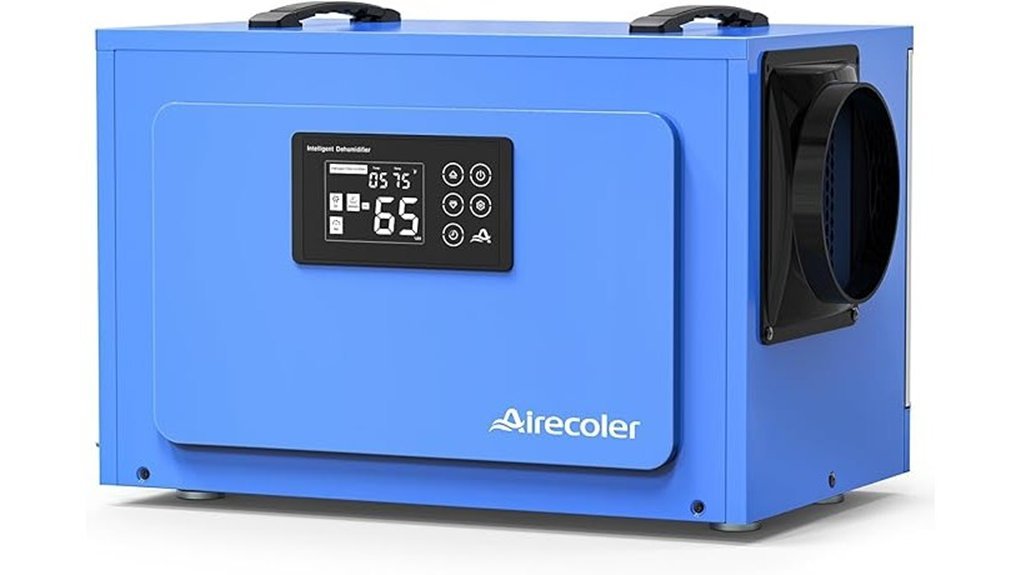
The Airecoler GT-X5 is a compact commercial dehumidifier for crawl spaces, low basements, garages, storage areas, and similar locations. Its published performance is up to 125 pints per day under maximum conditions and approximately 58 to 60 pints per day under the manufacturer’s standard rating conditions.
Its most useful feature is the low housing, which measures roughly 19.2 × 12.2 × 13.4 inches. Despite the compact size, the manufacturer lists approximately 265 CFM airflow and an operating range of about 41°F to 95°F. It also provides automatic defrost, automatic restart, adjustable humidity control, a washable filter, and continuous gravity drainage.
Drainage warning: The GT-X5 does not have an integrated lift pump. Its drain hose must slope downward to a suitable drain, or you will need a compatible external condensate pump.
Best For: Encapsulated crawl spaces and low-clearance installations with access to a lower drain.
Why You’ll Like It:
- Low-profile housing fits areas that cannot accommodate an upright machine.
- High listed airflow for its physical size.
- Automatic restart and defrost support unattended operation.
- Publishes both maximum and more realistic performance figures.
Who Should Avoid It:
- Installations where water must be pumped upward.
- Mobile restoration jobs that require a rugged wheeled housing.
- Spaces with no practical continuous-drain route.
Airzentti 155-Pint Commercial Dehumidifier with Pump
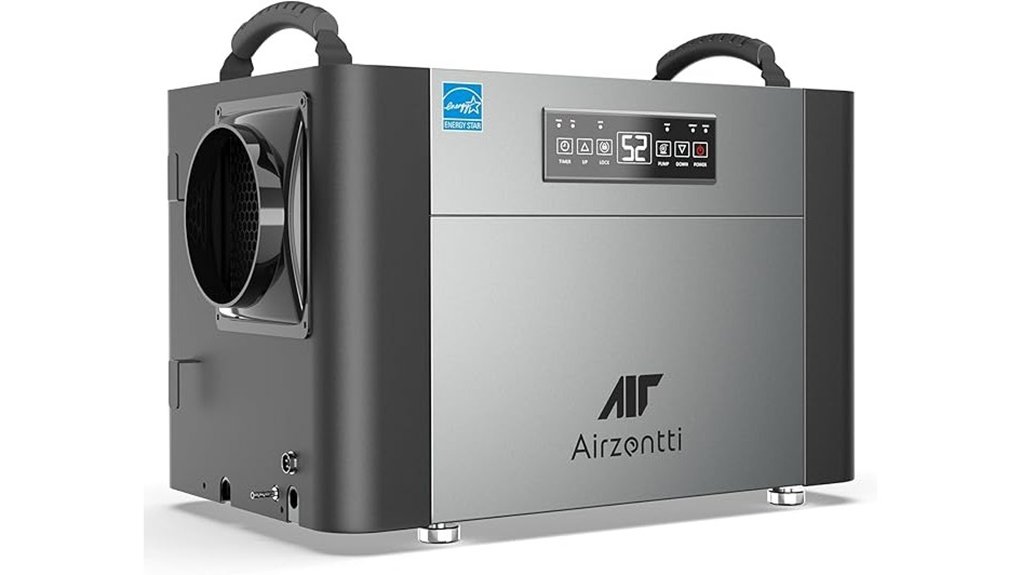
The Airzentti listing is marketed for large basements, crawl spaces, warehouses, and other demanding spaces. It claims up to 155 pints per day under near-saturation conditions, approximately 70 pints per day at stated AHAM conditions, about 220 CFM airflow, advertised coverage up to 7,500 square feet, a built-in condensate pump, and a duct collar.
Capacity transparency is especially important with this product. The ENERGY STAR record for model ACD155P-PG100(B) lists a certified water-removal capacity of 49.83 pints per day under DOE Appendix X1. The 155-pint, 70-pint, and 49.83-pint figures can describe different test conditions, but buyers should not compare them as though they were measured the same way.
Before ordering, confirm that the Amazon listing shows model ACD155P-PG100(B), or another model number that appears in the ENERGY STAR database, if certification is important to your decision. Also confirm the current pump-lift specification and included drain hoses.
Best For: Large portable or duct-assisted applications where a built-in pump is useful and the buyer can verify the exact certified model.
Why You’ll Like It:
- Built-in pump supports flexible continuous drainage.
- Approximately 220 CFM airflow helps circulate damp air in larger spaces.
- ENERGY STAR documentation is available for model ACD155P-PG100(B), subject to matching the listing to that exact model.
- Automatic defrost and overflow protection support unattended use.
Who Should Avoid It:
- Buyers who expect 155 pints per day under normal basement conditions.
- Anyone unable to verify the exact certified model number before ordering.
- Contractors who need one unambiguous, standardized capacity figure for restoration calculations.
HBN 125-Pint Crawl-Space Dehumidifier with Pump
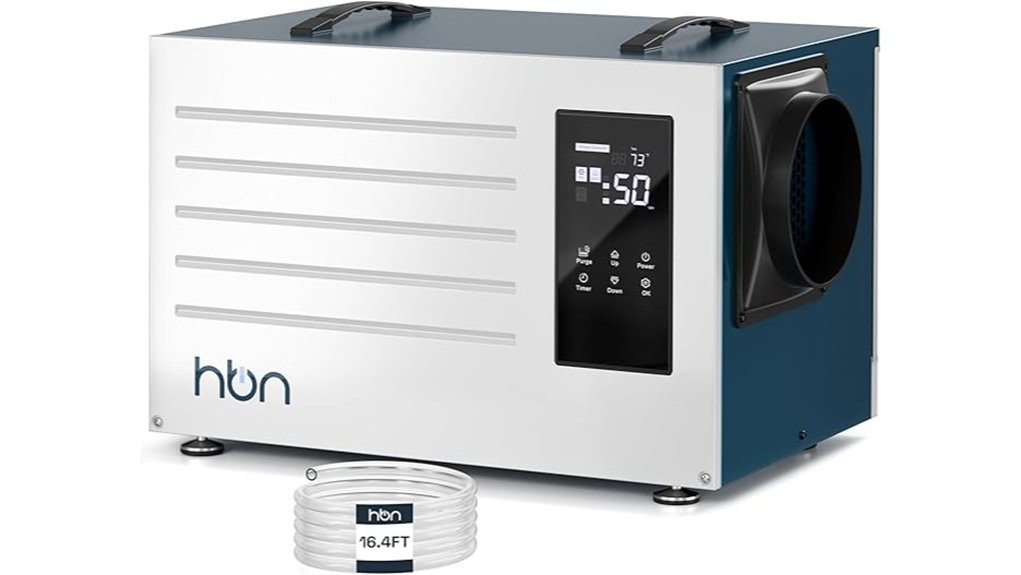
The HBN is advertised as a 125-pint crawl-space and commercial dehumidifier with both gravity drainage and a built-in pump. A current retail listing for a closely related HBN model states 125 pints per day at 95°F and 90% RH, 60 pints per day at AHAM conditions, approximately 300 CFM airflow, a 16.4-foot pump lift, and a 6.6-foot gravity hose.
The controls are advertised to include a touchscreen, humidity sensing, a timer, automatic defrost, and power-outage memory. However, model numbers and coverage claims vary across current retailer listings. Confirm that the Amazon ASIN matches the specifications you need, including model number, AHAM capacity, pump lift, dimensions, operating-temperature range, safety certifications, warranty coverage, and included hoses.
Best For: Crawl spaces, basements, workshops, or storage areas where a low-profile housing and upward pump drainage are useful and the buyer can verify the exact model.
Why You’ll Like It:
- Advertised pump and gravity-drain flexibility.
- Low-profile format is more suitable for crawl spaces than an upright residential unit.
- Digital humidity control and automatic defrost are useful for unattended operation.
Who Should Avoid It:
- Buyers who need a single, clearly documented model specification across every retailer.
- Professional restoration companies that need a clearly published AHAM rating.
- Anyone who cannot confirm warranty service and replacement-part support in their area.
Factors to Consider When Choosing a Commercial Dehumidifier for Mold-Prone Spaces
The largest advertised pint number is not automatically the best choice. Compare capacity test conditions, actual moisture load, airflow, drainage, operating temperature, placement, service support, and electrical requirements before ordering.
Capacity and Test Conditions
First determine whether a product’s headline rating is measured at saturation, at AHAM-style conditions, or under a current DOE or ENERGY STAR test. A unit advertised at 155 or 180 pints under very hot, humid conditions may remove substantially less water in a cool basement.
Use standardized ratings for direct comparison whenever they are available. Maximum figures are still useful for extreme conditions, but only when the temperature and relative humidity are clearly stated.
Coverage Area and Moisture Load
Square-foot coverage is only a starting point. Two buildings of the same size can have very different moisture loads because of ceiling height, air leakage, groundwater, wet materials, ventilation, temperature, and how frequently doors open.
For routine humidity control, consider the room volume, starting RH, target RH, temperature, and sources of moisture. For flood restoration, calculate the amount and type of wet material, water class, air movement, and drying deadline. Professional sizing may be worthwhile for a major loss.
Drainage Options
A gravity drain is simple and dependable, but the hose must slope continuously toward a lower drain. A built-in pump is better when condensate must travel upward to a sink, window, standpipe, or elevated drain.
- Confirm the maximum vertical lift rather than confusing it with total hose length.
- Check whether the pump runs automatically and whether a manual purge control is included.
- Make sure the hose can be routed without kinks, freezing exposure, or trip hazards.
- Choose a model with accessible pump and drain components for cleaning.
Airflow and Air Movement
Airflow, measured in CFM, determines how quickly damp air reaches the evaporator coil. Higher airflow can improve circulation in open rooms, but walls, shelving, closed doors, and stored materials can create dead zones.
Place the unit with the required inlet and outlet clearance. Restoration projects may also need separate air movers to direct dry air across wet floors, walls, framing, and contents.
Operating Temperature and Defrost
Refrigerant dehumidifiers lose capacity as the temperature falls and may develop frost on the coil. For a cool basement or crawl space, check the published operating-temperature range and confirm that automatic defrost is included.
Automatic defrost helps protect performance, but it does not mean every unit will remove moisture efficiently at every low temperature. Compare performance at conditions similar to the intended installation.
Portability and Housing Design
For mobile work, consider total weight, handle placement, wheel size, stair access, stackability, and whether one person can load the unit safely. A compact crawl-space unit may fit between joists but be less convenient to roll across a warehouse. A tall wheeled unit may move easily on a flat floor but be difficult to carry downstairs.
Controls and Sensors
A digital humidistat, automatic restart, timer, continuous mode, run-hour meter, and remote monitoring can reduce supervision. Do not assume the built-in humidity display is a precision instrument. Use a separate calibrated hygrometer when accurate documentation is important.
Restoration professionals may also track temperature, RH, dew point, and grains per pound with separate meters rather than relying only on the machine’s display.
Energy Efficiency
Compare efficiency only when the products use the same rating method. For ENERGY STAR models, review the Integrated Energy Factor and annual energy estimate for the exact model number. A large maximum capacity does not necessarily mean better efficiency in everyday conditions.
Operating cost also depends on temperature, target RH, fan operation, air leakage, filter condition, and how many hours the compressor runs.
Warranty and Support
Read the written warranty instead of relying on a headline such as “five-year coverage.” Some warranties provide full-unit coverage for a shorter period and longer coverage only for the sealed refrigeration system.
Check whether the warranty covers labor, shipping, pumps, sensors, filters, and commercial use. Also verify registration requirements, response channels, repair procedures, replacement-part availability, and whether unauthorized installation or maintenance can affect coverage.
Before You Buy Checklist
For water-damage work, confirm that the building’s electrical system is safe before plugging in a dehumidifier. Follow the unit’s circuit, grounding, clearance, and extension-cord instructions, and keep plugs and connections away from standing water.
- Is the stated pint capacity maximum, AHAM, DOE, or ENERGY STAR rated?
- What temperature and RH were used for the rating?
- Can the drain hose slope downward, or do you need a pump?
- Will the unit physically fit through the access opening?
- Can the electrical circuit support the running and startup load?
- Does the operating-temperature range match the room?
- Are filters, pump parts, and service support available?
- Is the moisture source being repaired rather than merely managed?
Frequently Asked Questions
Will a Dehumidifier Kill or Remove Mold?
No. A dehumidifier reduces airborne moisture and can make conditions less favorable for additional mold growth. Existing mold must still be cleaned or removed appropriately, and the leak, condensation, drainage failure, or other water source must be corrected.
What Humidity Level Helps Discourage Mold?
A practical target for many occupied buildings is approximately 30% to 50% relative humidity. At minimum, try to keep indoor RH below 60%. Avoid excessive drying, and use a separate hygrometer to confirm conditions in different parts of the space.
How Often Should I Clean My Dehumidifier?
Follow the manual for the exact model. During heavy commercial use, inspect the filter, intake, outlet, drain hose, and pump frequently, often at least weekly. Clean the reusable filter when visibly dirty or when airflow drops. Keep the drain line clear and inspect the coil for dust or frost.
Can I Use a Dehumidifier in a Cold Environment?
Yes, but capacity usually falls as temperatures decrease. Select a unit with automatic defrost and an operating range that includes the expected room temperature. In very cold conditions, a desiccant dehumidifier or another drying strategy may be more suitable.
Do Square-Foot Coverage Claims Guarantee Performance?
No. Coverage figures are estimates based on assumptions that may not match your building. Ceiling height, temperature, air leakage, moisture sources, wet materials, room layout, target humidity, and drainage all affect real performance. Use standardized pint-per-day ratings and the actual moisture load as the primary sizing inputs.
How Long Does a Commercial Dehumidifier Last?
There is no universal lifespan. Service life depends on operating hours, dust exposure, temperature, maintenance, drainage reliability, compressor cycling, transport damage, and access to replacement parts. Warranty length should not be treated as a guaranteed lifespan.
How Do I Determine the Right Capacity?
Do not use a one-pint-per-square-foot formula. Start with room volume, temperature, current RH, target RH, moisture source, air leakage, and whether building materials are wet. Compare capacities measured under similar test conditions. For major water damage, use a restoration drying calculation or obtain professional sizing.
Is a Built-In Pump Better Than a Gravity Drain?
Not always. Gravity drainage has fewer moving parts and is often preferable when a lower floor drain is nearby. A pump is necessary when water must travel upward, but it adds a component that requires cleaning and can eventually need service.
Can One Dehumidifier Dry Several Closed Rooms?
Only if air can circulate effectively between them. Closed doors, walls, shelving, and stored materials can create separate humidity zones. You may need ducting, transfer fans, air movers, or more than one dehumidifier.
Final Recommendation
Choose the ALORAIR Storm Pro for restoration-oriented construction, a published 85-pint AHAM rating, pumped drainage, and remote monitoring.
Choose the MOUNTO when compact storage and stackability are more important than app-based controls.
Choose the Yaufey for a large open room where wheels, a pump, and straightforward controls are priorities.
Choose the Airecoler GT-X5 for a low-clearance crawl space with a reliable downhill drain.
Choose the Airzentti when you have confirmed the exact ENERGY STAR-listed model and understand why its maximum, stated AHAM, and DOE Appendix X1 capacities differ.
Consider the HBN for low-profile pumped drainage only after verifying the exact model, standardized capacity, pump lift, warranty, and service support on the product listing.
The right dehumidifier can help maintain safer moisture levels, protect materials, and reduce the conditions that support mold growth. It cannot replace leak repair, contaminated-material removal, airflow planning, or professional remediation when the moisture problem is extensive.