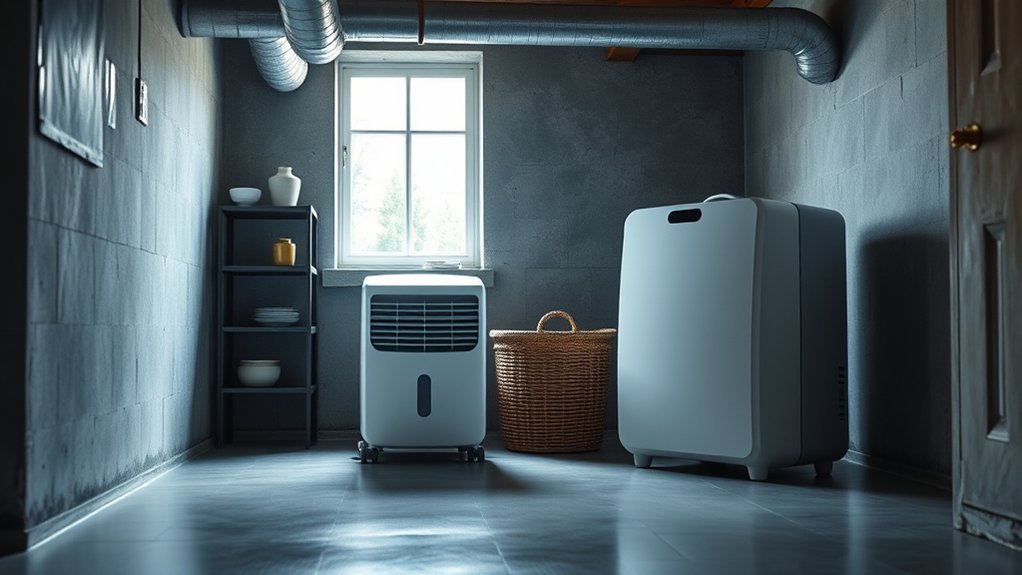
For mold-prone rooms, the best choice is usually a compressor dehumidifier sized for the room and the severity of the dampness. This guide focuses on six Amazon.com models that can remove meaningful amounts of moisture, support controlled humidity settings, and offer either a drain hose or a removable tank. A dehumidifier can help control the moisture that supports mold growth, but it cannot remove existing mold or repair a leak.
Quick Comparison
| Product | Best For | Advertised Capacity | Drainage | Amazon |
|---|---|---|---|---|
| AEOCKY 4500 Sq.Ft Best Overall |
Large damp basements and high-use areas | Up to 80 pints/day under hot, humid conditions | Tank or hose | Check Price |
| Yaufey 5000 Sq. Ft. Best for Very Large Spaces |
Large open basements and very damp rooms | Up to 80 pints/day under high-load conditions | 1.06-gallon tank or hose | Check Price |
| AEOCKY 50 Pint Best Balanced Pick |
Medium-to-large rooms and basements | Up to 50 pints/day | 0.8-gallon tank or hose | Check Price |
| KNKA 2500 Sq.Ft Best Mid-Size Basement Pick |
Damp bedrooms, living rooms, and basements | Up to 34 pints/day | Tank or included hose | Check Price |
| PLUSCENT 32 Pint Best Value |
General home humidity control | Up to 32 pints/day | Tank or hose | Check Price |
| 1500 Sq. Ft 21 Pint Best for Smaller Damp Rooms |
Smaller basements, bedrooms, and laundry areas | Up to 21 pints/day | 2L tank or included hose | Check Price |
How We Compared These Dehumidifiers
We prioritized compressor-based moisture removal, adjustable humidity control, practical drainage, room suitability, maintenance, portability, and transparent limitations. Advertised square-foot coverage is useful only as a starting point. Room temperature, starting humidity, air movement, ceiling height, water intrusion, and the manufacturer’s test conditions can change real-world performance.
AEOCKY 4500 Sq.Ft Smart Compressor Dehumidifier
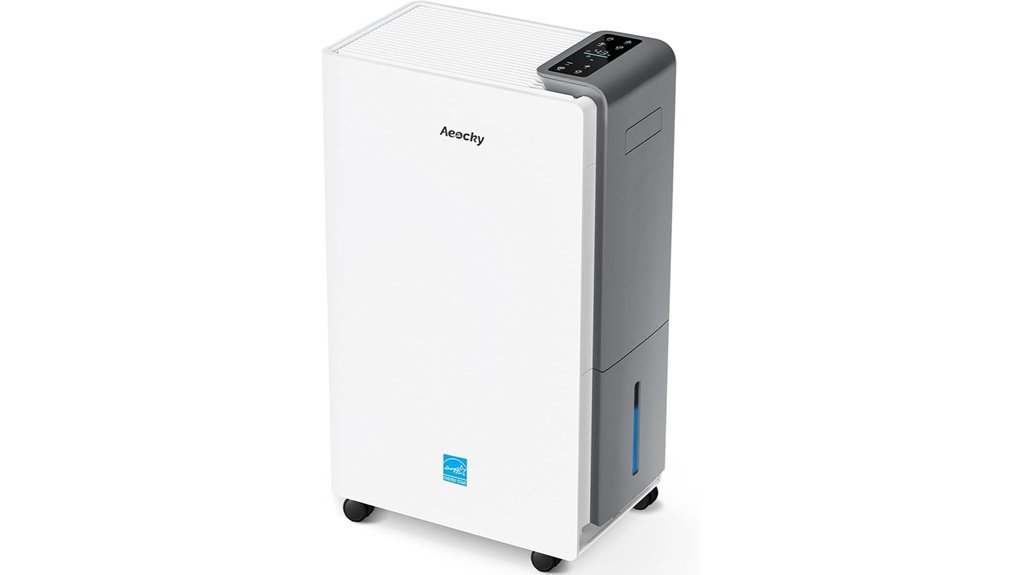
The AEOCKY 4500 Sq.Ft model is the strongest overall option for buyers dealing with a large, persistently damp basement. It combines compressor dehumidification, a humidistat, automatic defrost, a drain-hose option, and movable casters. The listing advertises a maximum of 80 pints per day under hot and extremely humid conditions, so compare the standard-rated capacity and your actual room conditions rather than relying on the largest number alone.
Why You’ll Like It: It is designed for long operating periods in large spaces and gives you both manual tank collection and continuous drainage. Its ENERGY STAR Most Efficient 2025 model family also makes it the most compelling efficiency-focused choice in this group.
Best For: Large basements, open living areas, and homeowners who expect the unit to run frequently.
Who Should Avoid It: Buyers with a small mildly damp room who do not need a larger compressor unit.
Pros:
- High-capacity compressor design for demanding moisture loads.
- Intelligent humidity control, automatic defrost, and hose drainage.
- ENERGY STAR Most Efficient 2025 model family.
Cons:
- The advertised 80-pint figure is based on hotter, wetter conditions than standard basement testing.
- Larger footprint and weight than lower-capacity models.
- U.S.-market electrical compatibility must be checked before use elsewhere.
Yaufey 5000 Sq. Ft. Energy Star Dehumidifier
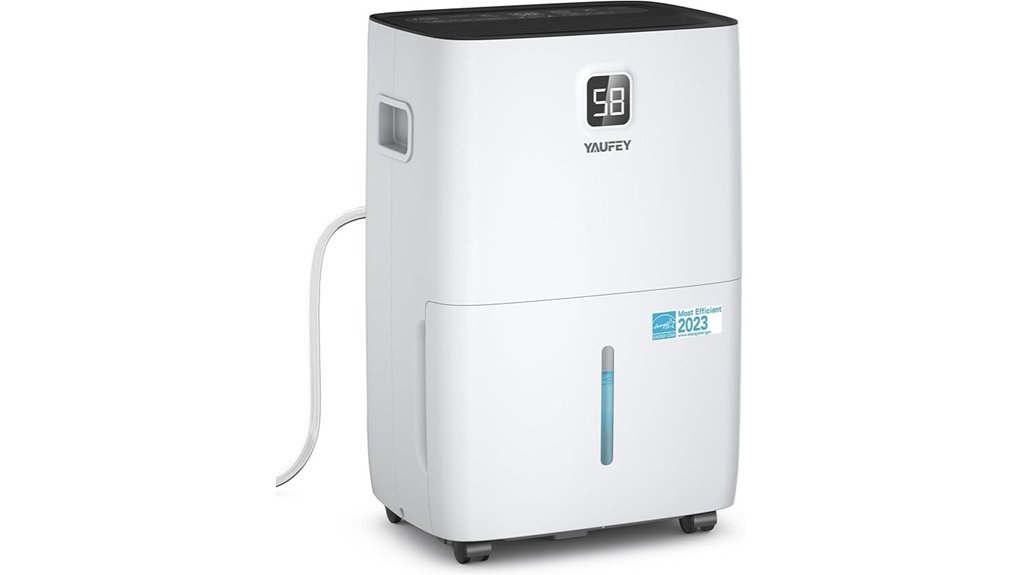
The Yaufey is built for large rooms and heavy humidity loads. Its listing describes coverage up to 5,000 square feet, a 1.06-gallon tank, continuous drainage, automatic shut-off, a timer, and intelligent humidity control. The maximum 80-pint claim applies to high-temperature, high-humidity conditions, so buyers should not compare it directly with a standard-condition pint rating without checking the listing details.
Why You’ll Like It: The larger tank and drain-hose support reduce day-to-day maintenance, while the humidistat lets the unit cycle around a selected target instead of running blindly.
Best For: Very large basements, open-plan spaces, and rooms that regularly remain well above the desired humidity range.
Who Should Avoid It: Buyers who need a compact unit for a single small room.
Pros:
- Large-space design with tank and continuous-drain options.
- Automatic shut-off, timer, and adjustable humidity control.
- Portable layout for moving between larger areas.
Cons:
- Maximum daily removal is stated under extreme test conditions.
- May be more machine than a mildly damp room needs.
- Confirm current brand, warranty, and electrical details on the listing.
AEOCKY 50 Pint Compressor Dehumidifier for Home
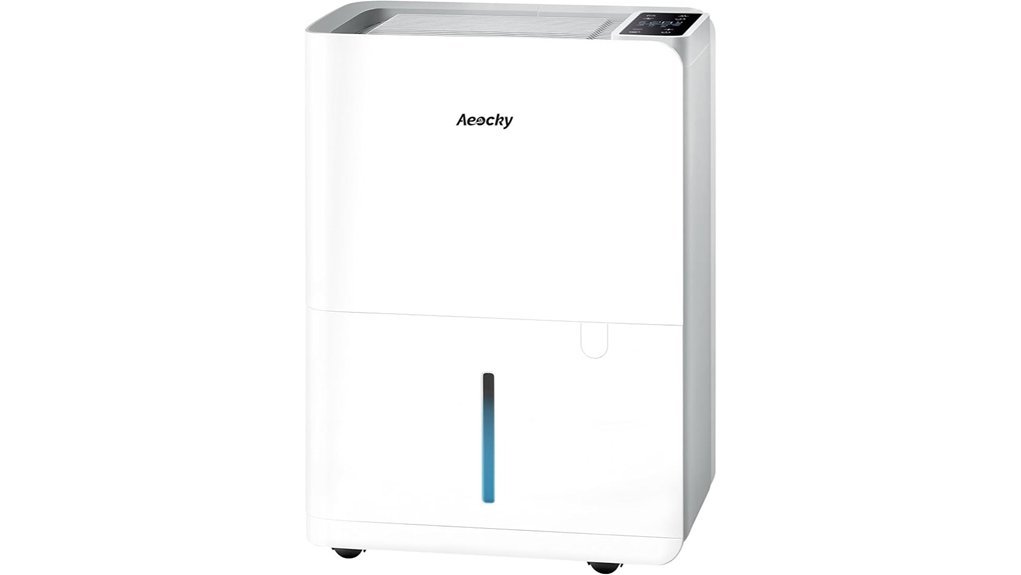
The AEOCKY 50 Pint model offers a more manageable balance of capacity, size, and drainage for a medium-to-large damp room. The listing identifies a 3,500-square-foot coverage claim, a 0.8-gallon tank, an included drain hose, adjustable humidity control, fan-speed control, a timer, and a child lock.
Why You’ll Like It: It gives buyers the controls that matter for routine moisture management without stepping up to the largest model in the roundup.
Best For: Basements, bedrooms, living spaces, and laundry areas with moderate-to-heavy humidity.
Who Should Avoid It: Buyers needing whole-home ducted dehumidification or a very small unit for occasional use.
Pros:
- Useful middle-ground capacity for many residential spaces.
- Drain hose, intelligent humidistat, timer, and child lock.
- 0.8-gallon tank is larger than many lower-capacity competitors.
Cons:
- Coverage claims still depend heavily on room conditions.
- The tank will require emptying if gravity drainage is not available.
- Not a substitute for repairing active water intrusion.
KNKA 2500 Sq.Ft Dehumidifier with Drain Hose
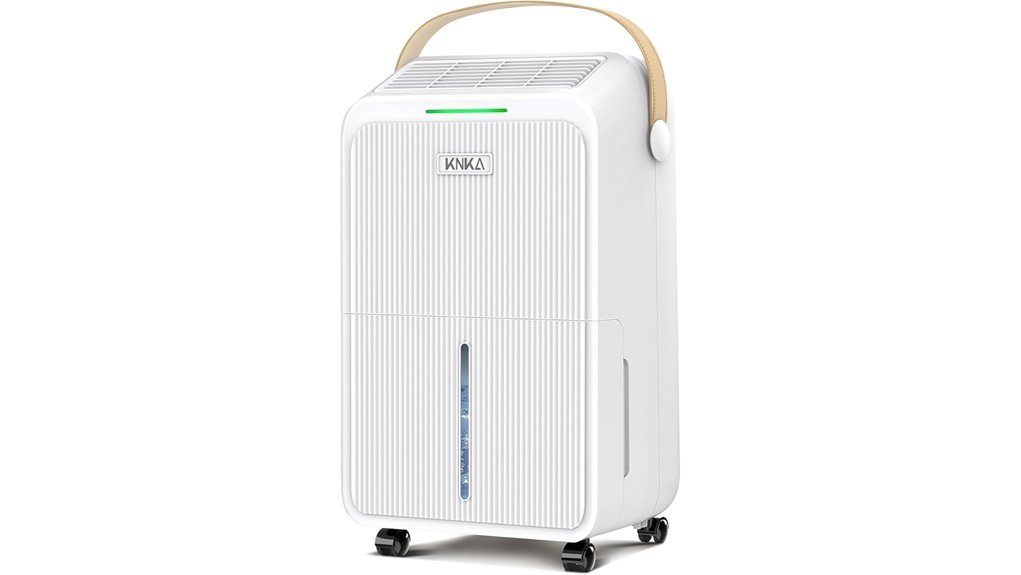
The KNKA is a practical mid-capacity option for buyers who want automatic humidity control and included continuous drainage. The listing advertises up to 34 pints per day, coverage up to 2,500 square feet, three operating modes, clothes-drying support, a 24-hour timer, and a drain hose.
Why You’ll Like It: It offers the main features needed for a damp basement without moving into the size and cost of the largest units.
Best For: Mid-size basements, bedrooms, living rooms, and laundry areas.
Who Should Avoid It: Buyers with a very wet space exceeding its practical capacity or those who need a verified whole-home system.
Pros:
- Three modes for normal dehumidification, continuous operation, and laundry drying.
- Included hose supports lower-maintenance drainage.
- Timer and intelligent humidity controls improve usability.
Cons:
- Square-foot coverage should not be treated as a guarantee.
- Manual tank emptying is still required without a suitable drain.
- Long-term warranty details should be confirmed before purchase.
PLUSCENT 32 Pint Dehumidifier for Home
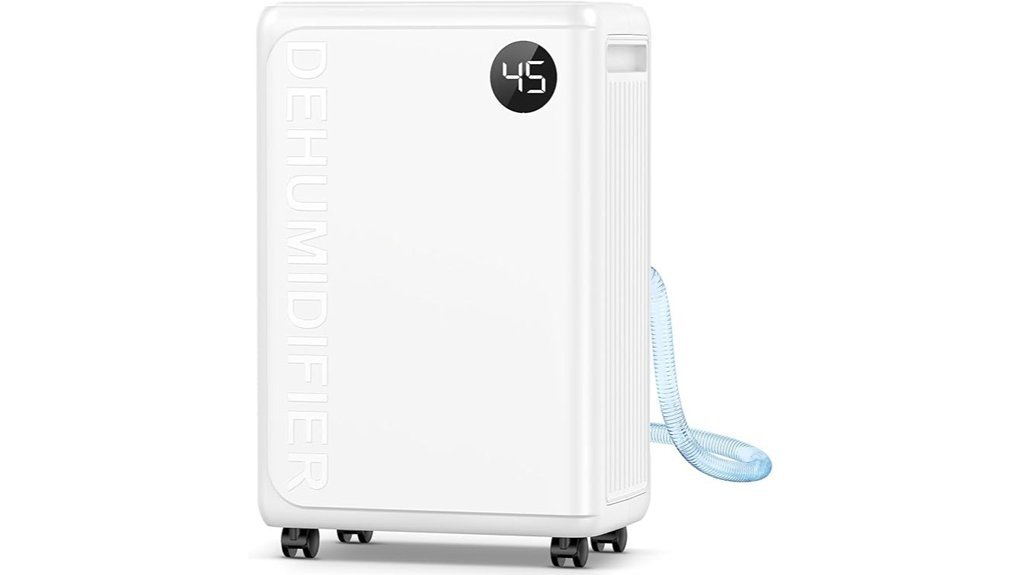
The PLUSCENT 32 Pint Dehumidifier is a straightforward option for general home humidity control. Its listing advertises coverage up to 2,500 square feet, three operating modes, a 24-hour timer, automatic defrost, portable wheels, and a drain-hose option.
Why You’ll Like It: It includes the controls most buyers need while keeping the capacity below the oversized large-basement models.
Best For: Apartments, bedrooms, living areas, and moderately damp basements.
Who Should Avoid It: Buyers dealing with severe seepage, standing water, or a very large open basement.
Pros:
- Three operating modes and a programmable timer.
- Automatic defrost and portable design.
- Continuous drainage option for unattended operation.
Cons:
- A small collection tank may fill quickly in high humidity.
- Brand support and warranty terms should be checked carefully.
- Advertised room coverage may be optimistic in very damp conditions.
1500 Sq. Ft Dehumidifier with Intelligent Humidity Control
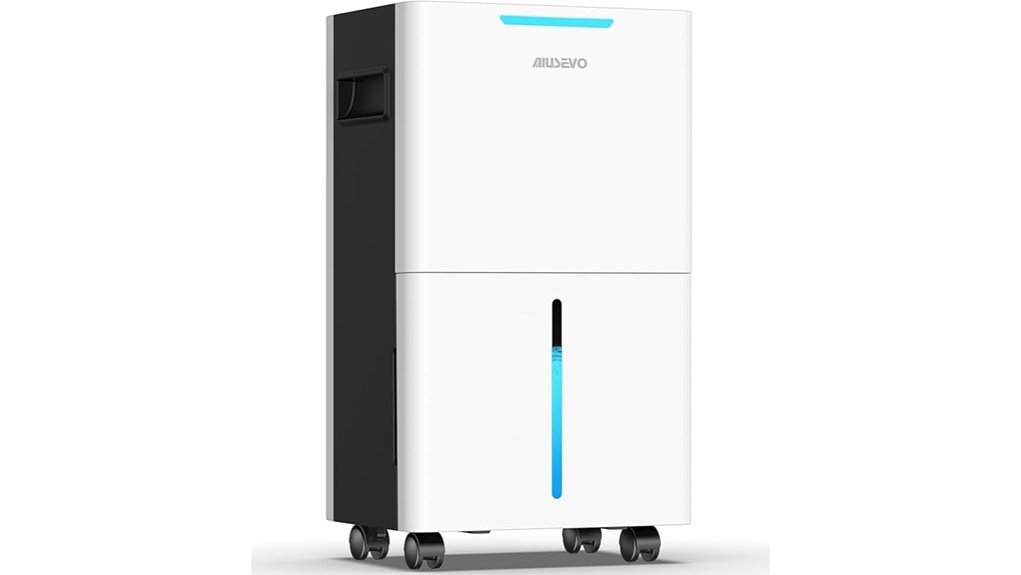
This 21-pint compressor model is better suited to a smaller basement, bedroom, bathroom, or laundry area than the high-capacity units above. The listing identifies a 2-liter tank, an included drain hose, automatic shut-off, automatic defrost, adjustable humidity, three modes, and a 24-hour timer. Its 21-pint claim is stated at 95°F and 90% relative humidity, so output will be lower in cooler conditions.
Why You’ll Like It: It provides compressor performance and continuous drainage in a more compact format.
Best For: Smaller damp rooms where a mini thermoelectric device would be underpowered.
Who Should Avoid It: Buyers with a large, very wet basement that requires a higher standard-rated capacity.
Pros:
- Compressor-based moisture removal in a smaller format.
- Included hose, 2-liter tank, timer, and three operating modes.
- Automatic shut-off and defrost improve everyday usability.
Cons:
- Lower capacity than the other retained models.
- Advertised 21-pint output uses hot, humid test conditions.
- May need to run longer in cool basement conditions.
Factors to Consider When Choosing a Dehumidifier for Mold
Fix the Moisture Source First
A dehumidifier can reduce airborne moisture, but it cannot repair a leaking roof, plumbing leak, foundation seepage, or poor bathroom ventilation. Dry wet materials promptly, clean or remediate existing mold appropriately, and correct the source of the water. Use the dehumidifier as part of the moisture-control plan rather than as the only solution.
Target Humidity Range
Use a separate hygrometer to check the room. A practical target is generally 30% to 50% relative humidity, while keeping the room below 60% is especially important for mold prevention. Avoid setting the unit unnecessarily low, because continuous over-drying can waste energy and make the room uncomfortable. See the EPA mold and moisture guidance for more detail.
Capacity and Test Conditions
Dehumidifier capacity is measured by how much water the unit removes in 24 hours under defined test conditions. Some Amazon listings also promote a larger “maximum” number measured in hotter and more humid air. Compare like with like, and do not assume two products using different test conditions have equal performance. The ENERGY STAR capacity guide explains why current standard ratings may look lower than older or high-temperature claims.
Room Size and Dampness
Choose capacity based on both room size and moisture severity. A moderately damp bedroom needs less capacity than a similarly sized basement with wet walls, seepage, laundry drying, or frequent door openings. When two sizes seem reasonable, a slightly larger compressor unit usually reaches the target faster and cycles off more often than an undersized unit that runs continuously.
Compressor vs. Mini Thermoelectric Models
For recurring mold risk, a compressor model is generally the more suitable category because it can remove moisture in pints per day and maintain a selected humidity level. Small thermoelectric units can help in a closet, RV cabinet, or tiny bathroom, but they should not be presented as substitutes for a properly sized basement dehumidifier.
Drainage Options
A removable tank is convenient when the unit is used occasionally. For a basement or any space requiring daily operation, look for a hose connection and confirm that gravity can carry the water to a floor drain. If the drain is higher than the dehumidifier, you may need a model with a built-in pump or a separate condensate pump.
Energy Efficiency
Compare ENERGY STAR certification and the unit’s Integrated Energy Factor when available. Energy efficiency matters most when the dehumidifier will run for many hours per day. Avoid unsupported annual savings claims because actual cost depends on local electricity rates, humidity, room conditions, settings, and runtime.
Cold-Room Performance
Basements can be cool enough for frost to form on a compressor coil. Automatic defrost helps, but performance still drops as the air gets cooler. Check the manufacturer’s minimum operating temperature when the unit will run in an unheated basement, garage, or crawlspace.
Noise and Placement
Place the dehumidifier on a level surface with enough clearance around the air intake and outlet. Avoid relying only on advertised decibel numbers, because fan speed, room echo, floor vibration, and distance affect perceived noise. A lower fan setting may be more comfortable in a bedroom, while a basement can usually tolerate a louder high-output mode.
Maintenance and Filtration
Clean the washable filter on the manufacturer’s schedule, inspect the tank and hose for buildup, keep the intake unobstructed, and confirm that the drain line slopes correctly. A dirty filter or kinked hose can reduce performance and lead to unwanted shutdowns or leaks.
Electrical and Market Compatibility
Do not assume that a plug adapter makes a U.S.-market dehumidifier safe in another country. Verify the input voltage and frequency on the rating label, the plug and fuse requirements, warranty coverage, and whether the manufacturer authorizes use in your location. Compressor appliances can draw substantial startup power, so an undersized converter is not an appropriate workaround.
Frequently Asked Questions
Can a Dehumidifier Remove Existing Mold?
No. A dehumidifier can make the environment less favorable for new mold growth by reducing humidity, but existing mold still needs proper cleaning or remediation. The water source must also be repaired.
What Is the Ideal Humidity Level for Mold Prevention?
Aim for roughly 30% to 50% relative humidity. Keeping the room below 60% is especially important. Use a hygrometer rather than relying only on how the air feels.
How Large a Dehumidifier Do I Need?
Match the unit to the room size and the severity of the dampness. A small damp room may be served by a 20-to-30-pint class unit, while a very damp or wet basement often benefits from a larger compressor model. Treat advertised square-foot coverage as an estimate, not a guarantee.
How Often Should I Empty the Water Tank?
Empty it whenever the full-tank indicator appears. In very humid conditions, that may be daily or even more often. Continuous drainage is more convenient when the unit runs for long periods.
Why Do Pint-Capacity Claims Differ Between Listings?
Capacity changes with the test temperature and relative humidity. Hotter, wetter air allows a unit to collect more water, so a “maximum” rating at extreme conditions may be much higher than the standardized capacity used for efficiency comparisons.
Should I Run the Dehumidifier Continuously?
Continuous mode can help during initial drying or after a moisture event. For normal use, set a target humidity and let the humidistat cycle the compressor. This usually provides better comfort and avoids unnecessary runtime.
Can I Use a U.S. Dehumidifier in the UK?
Only when the appliance rating label explicitly supports the local voltage and frequency and the connection meets local electrical requirements. A simple travel adapter changes the plug shape but does not convert voltage or frequency.
Conclusion
For a large, persistently damp basement, the AEOCKY 4500 Sq.Ft Smart Compressor Dehumidifier offers the best combination of capacity, humidity control, drainage, and efficiency positioning. The AEOCKY 50 Pint is the more balanced choice for many medium-to-large rooms, while the 21-pint 1500 Sq. Ft model makes more sense for a smaller damp space. Whichever model you choose, verify the standard capacity, operating temperature, drainage setup, electrical compatibility, and warranty before buying. Most importantly, pair the dehumidifier with leak repair, ventilation, and proper mold cleanup for a healthier long-term result.