
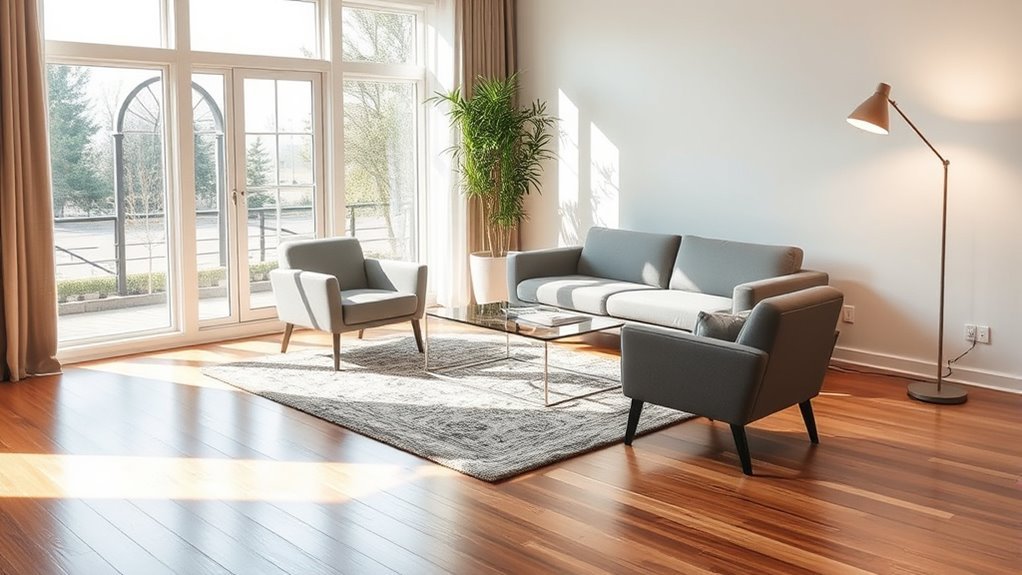
Learning how to arrange furniture without pushing it against the wall transforms a flat, awkward room into an inviting space built around how people actually sit, talk, walk, and relax. Instead of lining the perimeter like a waiting room, pull only the seating pieces that improve conversation, visual balance, or traffic flow inward while protecting clear walkways around them. Even in a compact living room, shifting a sofa or armchair just a few inches off the drywall creates shadow, depth, and a deliberate layout without sacrificing usable floor area.
Quick Answer
To arrange furniture without pushing it against the wall, orient your main sofa toward a single focal point, pull seating inward 3 to 36 inches depending on room size, anchor the group on a properly sized rug, set the coffee table 14 to 18 inches from seats, and keep main walkways 30 to 36 inches wide.
At a Glance
| Time Required | 1 to 3 hours to measure, tape the floor, move seating, and test walkways |
| Difficulty | Beginner-friendly |
| Tools Needed | Tape measure, painter’s tape, notepad, furniture sliders, rug pad, and wall-anchor hardware for tall storage |
| Cost | $0 to rearrange existing pieces; optional expenses for sliders, cord covers, or anti-tip brackets |
Which Furniture Should You Float?
You should float the seating pieces that bring people into comfortable conversation distance—4 to 8 feet apart—while leaving heavy storage and media units near the walls. Instead of moving every item at once, reposition your primary sofa or a pair of accent chairs first, then build the rest of the room around that anchor.
| Room condition | Best first move | What can stay near a wall |
| Small living room (under 12×12 ft) | Pull the sofa forward 3–5 inches for breathing room and float one low-profile accent chair at an angle | Media console, bookcases, and main sofa back as long as vents, curtains, and door swings stay clear |
| Medium living room (12×15 to 14×18 ft) | Float the sofa 10–14 inches out to fit a narrow console table behind it, or 30–36 inches out for a rear walkway | Anchored tall storage, credenzas, and wall-mounted TV units supporting the seating group |
| Large or open-plan room (16×20 ft+) | Position the sofa or sectional in the center as a room divider and group chairs around an 8×10 or 9×12 ft rug | Bookcases, sideboards, bar cabinets, and perimeter display pieces |
| Pass-through room | Float the main sofa so foot traffic flows behind its back rather than cutting between seats and the TV | Shallow consoles (12 inches deep or less) and wall-mounted lighting that never pinch the path |
Recommended Products

Premium Comfort & Support -- Individually wrapped pocket coils and high-density foam keep the seat supportive instead of saggy, so this comfy accent chair stays cozy for reading, napping, or watching TV in the living room.

Mid-Century Charm - This lounge chair has a mid-century charm with its extra pillows, widened arms, and flared legs. The green color of the fabric complements the walnut color of the frame, which will fit in with any of your home decor styles.

【Comfortable & Relaxing Chair】 This accent chair boasts a spacious 26.8 inch wide seat, allowing you to sit cross-legged while using your phone or curl up for a nap. The 6.3 inch thick cushion and ergonomic design ensure ample support and lasting comfort, making it ideal for long periods of reading, gaming, watching TV, or working from home. Note: Cushion is vacuum-compressed; fluffs to 80% in 1-2 hours, full in 24h.
Understanding the Importance of Furniture Placement
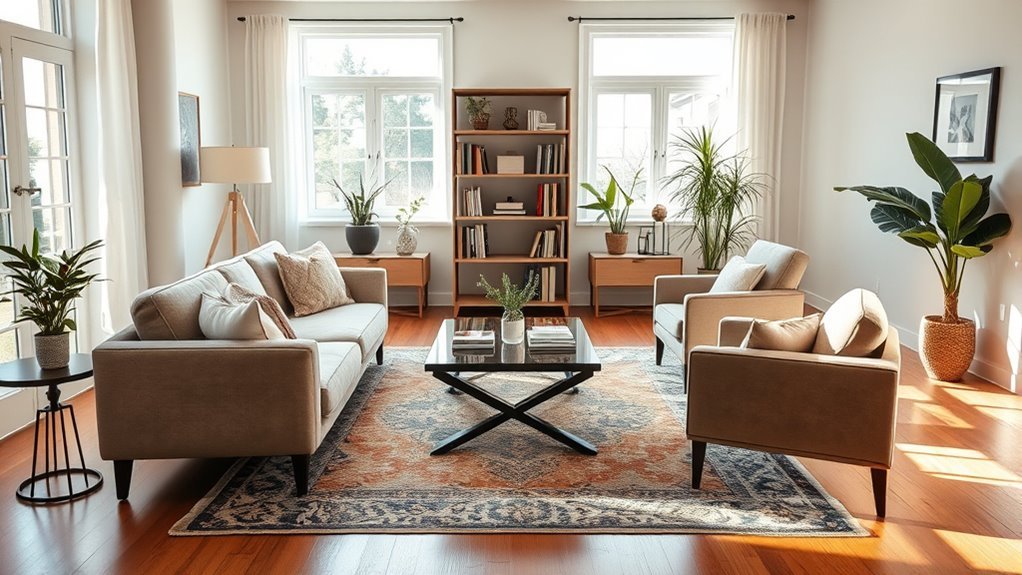
Intentional furniture placement shapes how effortless a room feels every day by balancing visual depth, conversation distance, and clear circulation. When every piece hugs the perimeter, the center of the room turns into an empty “dance floor” where guests have to raise their voices across a 12-foot gap just to talk.
Pulling seating inward solves this acoustic and visual disconnect. Keeping opposing sofas and armchairs within 4 to 8 feet of each other lets people converse comfortably without leaning forward, while exposing a strip of floor and wall behind the seating creates architectural depth.
Before lifting a single piece, answer four planning questions:
- Primary activity: Do you use this room mostly for conversation, watching TV, reading, hosting, or working from home?
- Traffic lines: Which doorways and hallways connect through the space, and where do people naturally walk?
- Strongest focal point: Should the seating face a fireplace, picture window, media wall, built-in bookcase, or central conversation table?
- Scale bottlenecks: Which existing pieces block sightlines, pinch walkways under 30 inches, or sit too far from a table?
Note: “Away from the wall” does not always mean centered in the room. In a compact space, pulling a sofa forward just 3 to 5 inches prevents upholstery from crushing curtains or baseboards and casts a soft shadow that makes the room look larger.
Should Furniture Touch the Walls?
Furniture should rarely sit pressed flush against every wall, because lining the perimeter flattens the room’s proportions and isolates each seat. While bookcases, dressers, and media consoles belong against walls for stability and cable access, floating at least one or two seating pieces turns leftover floor area into functional living space.
Should Living Room Furniture Be Against the Wall?
Living room seating works best when at least part of the group is pulled off the walls to form an inward-facing U-shape, L-shape, or parallel conversation zone. Pushing every sofa and armchair to the edges creates a stiff waiting-room layout where nobody makes natural eye contact.
Use these practical upgrades to break up a perimeter-bound layout:
- Add a behind-sofa console: Pull the couch out 10 to 14 inches and slide a narrow console table (28 to 32 inches tall, flush with or 1 to 2 inches below the sofa back frame) behind it for lamps and drinks.
- Angle two armchairs inward: Float a pair of chairs opposite the sofa at a 15- to 30-degree angle so guests can face both the sofa and the focal point.
- Ground the island with textiles: Place an area rug underneath the group so the floating seats read as a unified zone rather than drifting pieces.
- Mix wall-anchored and floating items: Leave tall bookcases or your media console against the wall while pulling the seating cluster 2 to 4 feet inward.
Ignoring Traffic Flow
A floating layout fails immediately if it forces people to turn sideways, dodge sharp table corners, or walk directly in front of the television. Protecting clear circulation routes keeps the room feeling open even when furniture sits near the center.
Follow these clearance standards when mapping your floor plan:
- Main walkways: Keep primary circulation paths 30 to 36 inches wide from doorway to doorway.
- Accessible routes: When designing for wheelchair access or mobility aids, maintain at least 36 inches of continuous clear width (which may narrow to 32 inches for obstructions under 24 inches long), following the U.S. Access Board guidance for accessible walking surfaces.
- Minor pass-throughs: Secondary gaps between two armchairs or beside an occasional table need at least 18 to 24 inches for a single person to step through.
- Mechanical clearances: Account for full door swings (typically 30 to 36 inches), cabinet doors, and recliner footrests, which extend total chair depth to 64–72 inches when open.
Warning: Never run lamp or extension cords under rugs or beneath floating furniture; according to CPSC extension cord fire-safety guidance, trapped heat and crushed insulation can ignite fires. Also secure dressers, bookcases, and cabinets to wall studs with anti-tip brackets as recommended by the CPSC’s Anchor It campaign.
How to Arrange Furniture Without Pushing It Against the Wall: Step by Step
To arrange furniture without pushing it against the wall, measure your room and largest pieces first, tape out walkways on the floor, orient your main sofa toward one focal point, and layer in rugs, tables, and lighting. Testing the footprint with tape takes 15 minutes and saves you from lifting heavy upholstery twice.
1. Measure the Room First
Measure the total length and width of the room, then record the exact positions of doorways, window sills, electrical outlets, floor vents, radiators, and fireplace hearths. Next, measure the length, depth, and height of your sofa, chairs, coffee table, and area rug.
Use blue painter’s tape to mark the outlines of your floating layout directly on the floor. Walk through the room, open every door, and check that you have at least 30 to 36 inches of open floor along the primary traffic lane before moving any furniture.
2. Choose One Main Focal Point
Select a single dominant feature—such as a fireplace, picture window, media wall, or large canvas—before placing your sofa, because the primary seat should face or frame that anchor. When a room has no architectural focal point, create one by centering a large piece of artwork over a sideboard or grouping seating face-to-face around a statement coffee table.
If you are positioning your floating sofa to face a 4K television, set the seating distance at 1.2 to 1.6 times the screen’s diagonal measurement. That equals roughly 5.5 to 7.5 feet away for a 65-inch TV or 6.5 to 8.5 feet away for a 75-inch screen, with the center of the screen positioned near seated eye level (about 40 to 42 inches off the floor).
3. Float the Main Seating Piece
Move your largest sofa into position first and test which of the three floating distances fits your room’s depth:
- Micro-float (3 to 5 inches off the wall): Ideal for small or narrow rooms where you need maximum walkway space in front of the sofa while still creating shadow, depth, and clearance for drapes.
- Console zone (10 to 14 inches off the wall): Leaves just enough depth to tuck a slim sofa table or floor lamp base behind the frame; never treat a gap under 24 inches as a walking path.
- Full island float (30 to 36+ inches off the wall): Pulls the sofa into the center of a medium, large, or open-plan room so foot traffic can pass comfortably behind the backrest.
Once the sofa is set, arrange accent chairs within 4 to 8 feet of the couch so guests can talk without straining. Place furniture sliders under heavy legs while fine-tuning angles, then swap to rubber grippers once the layout is locked in.
4. Anchor the Seating Area With a Rug
Slide an area rug beneath the seating group so the floating furniture looks grounded rather than adrift on bare flooring. Extend the rug at least 6 to 12 inches past both ends of the sofa, and rest at least the front two legs of the sofa and every armchair on the rug surface.
5. Add Tables, Lighting, and Storage
Position the coffee table 14 to 18 inches from the front edge of the sofa cushions and place side tables within easy reach of seats not served by the center table. To light a floating seating island without running dangerous cords across walkways, plug lamps into a floor outlet underneath the sofa, tuck a low-profile floor cord cover along the room’s perimeter, or use rechargeable cordless LED table lamps on your console and end tables.
When selecting bulbs for your lamps, shop by lumen output rather than wattage. ENERGY STAR explains that light output is measured in lumens, and the FTC Lighting Facts label guide notes that an 800-lumen LED bulb delivers the same brightness as a traditional 60-watt incandescent while using only about 9 watts.
Choosing a Focal Point for Your Living Room
A clear focal point gives a floating layout instant visual order by establishing where the main sofa and chairs should point. Without a primary anchor, furniture placed away from the walls looks random and cluttered.
Prioritize focal points in this order:
- Architectural features: Fireplaces, bay or picture windows, exposed beams, built-in bookcases, or an outdoor view.
- Functional hubs: A media console with a television, a central conversation grouping, or a dedicated music or game zone.
- Created decor anchors: An oversized piece of wall art (spanning roughly two-thirds the width of the console below it), a gallery wall, or an arched mirror.
Avoid giving two walls equal visual weight on opposite sides of the room, which forces guests to crane their necks between two competing zones.
When Should You Keep Furniture Near a Wall?
You should keep your largest sofa near a wall when floating it into the center would narrow the main walkway below 30 inches, block a door swing, or leave an unusable 18-inch dead zone behind the frame. Floating furniture is a design strategy for improving flow, not a rigid rule that every room must follow.
In rooms narrower than 10 to 11 feet, keep the main sofa 3 to 5 inches off the longest wall and float a single open-frame accent chair or round ottoman opposite it. If your layout includes a reclining sofa or chair, check its mechanism before pushing it near a wall: standard manual or rocker recliners need 6 to 14 inches of rear wall clearance to recline fully, whereas wall-hugger models slide forward on their tracks and require only 1 to 4 inches behind the backrest.
The Benefits of Floating Your Couch for Space
Floating your couch makes a living room feel more welcoming and functional by turning dead center space into an intimate seating zone and routing foot traffic around—rather than through—conversations. It also frees up perimeter walls for bookcases, radiators, baseboard heaters, and full-length curtains.
Enhanced Room Flow
Pulling a sofa away from the wall lets the backrest act as a soft architectural divider that channels people along a clear hallway path behind the seating area. In open-concept homes, this prevents family members walking from the kitchen to the hallway from cutting directly in front of the TV screen.
Keep circulation natural with three layout habits:
- Align the sofa back with the traffic lane: Position the couch parallel to the main walking route so the path is immediately obvious from the doorway.
- Keep sightlines low: Choose a sofa with a back height of 30 to 34 inches so natural light from windows still reaches the rest of the room.
- Leave vents and baseboards uncovered: Keeping upholstery at least 3 to 6 inches away from supply vents and baseboard registers improves heating and cooling efficiency.
Improved Seating Arrangement
A floating sofa brings armchairs and loveseats closer together so everyone sits within a comfortable 4- to 8-foot conversation circle. Instead of sitting shoulder-to-shoulder in a single straight row against the drywall, guests can face one another across a shared coffee table.
When the back of a floating sofa faces an entryway or dining table, give it a finished look by backing it with a console table that is 10 to 14 inches deep, 28 to 32 inches tall, and two-thirds to the full length of the sofa. Style the console with a pair of table lamps or tuck two Upholstered stools underneath for pull-out guest seating.
Pro Tip: Run a 60-second layout test before calling the room finished: stand in the main doorway and snap a phone photo (cameras reveal lopsided spacing faster than the naked eye), walk the primary route at normal speed without sidestepping, and sit in every seat to verify you can set down a mug without leaning forward more than 18 inches.
How to Ensure Smooth Traffic Flow in Your Living Room
Smooth traffic flow requires predictable walkways of 30 to 36 inches for main routes and 18 to 24 inches for secondary pass-throughs, paired with rounded furniture edges in tight corners. When clearance numbers are right, people move from doorway to seat without thinking about where to step.
A good living room layout feels easy before it looks impressive: clear paths, reachable tables, comfortable seating, and no awkward squeeze points.
Use this reference chart to verify every measurement in your floating layout:
| Main walkway width | 30 to 36 inches for comfortable daily circulation; 18 to 24 inches for minor gaps between chairs |
| Accessible-route clear width | 36 inches minimum continuous width (32 inches allowed at brief pinch points up to 24 inches long) per U.S. Access Board standards |
| Conversation distance | 4 to 8 feet (9 feet maximum) between facing sofa and chair cushions |
| Sofa to coffee table | 14 to 18 inches (close enough to reach a drink, wide enough for legroom) |
| TV viewing distance (4K) | 1.2 to 1.6 times the diagonal screen size (5.5–7.5 ft for 65-inch; 6.5–8.5 ft for 75-inch), centered ~40–42 inches high |
| Behind floating sofa | 3 to 5 inches for visual breathing room; 10 to 14 inches for a slim console; 30 to 36+ inches for a walkway |
How Should a Rug Sit Under Floating Furniture?
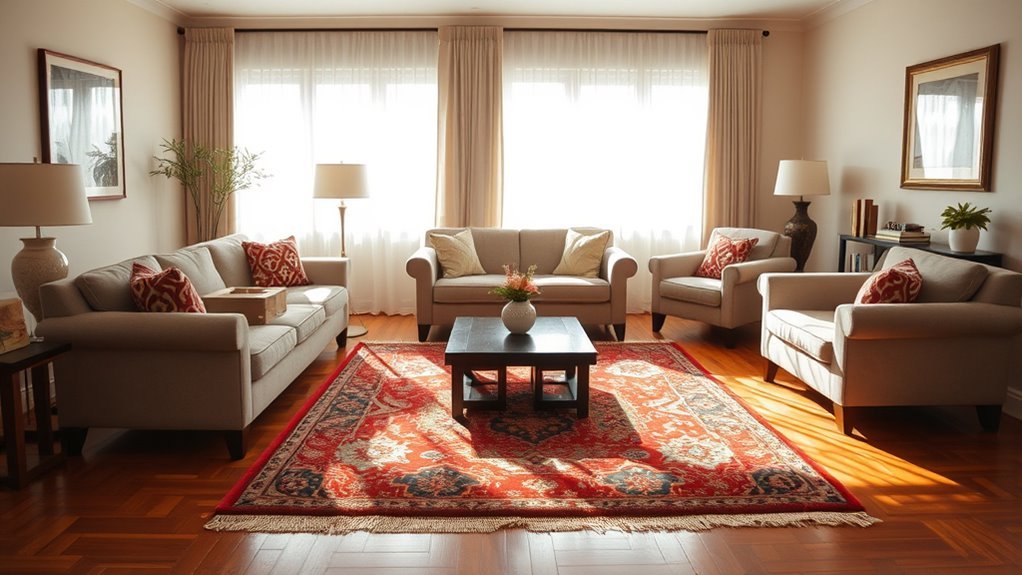
A rug under floating furniture should be large enough that at least the front two legs of the sofa and every main chair sit 6 to 12 inches onto the rug, or all four legs rest completely on it in larger rooms. A “postage-stamp” rug that holds only the coffee table makes floating seating look disconnected and shrinks the perceived size of the room.
Match your rug dimensions to your room size and floating configuration:
- Small living rooms (around 10×12 ft): Use a 6×9 ft or 8×10 ft rug with the front legs of the sofa and accent chair resting on the edges, leaving 6 to 12 inches of bare floor along the walls.
- Medium living rooms (12×15 to 14×17 ft): Choose an 8×10 ft or 9×12 ft rug so all front legs—and ideally the full footprint of floating armchairs—sit on the pile, framed by 12 to 18 inches of exposed flooring.
- Large or open-plan spaces (16×20 ft+): Step up to a 9×12 ft or 10×14 ft rug so all four legs of the floating sofa, chairs, and behind-sofa console sit completely on the rug with an 18- to 24-inch perimeter border where walls are nearby.
Always place a non-slip felt-and-rubber rug pad (cut 1 to 2 inches smaller than the rug in each direction) underneath so floating chairs do not ruck the edges or slide on hardwood floors.
How Far Should Tables Be From Floating Seating?
Place your coffee table 14 to 18 inches from floating sofas and chairs, and position side tables within effortless arm’s reach—typically 2 to 6 inches from the outer armrest. Because floating seats have no walls nearby, accessible table surfaces are essential so every seat has a spot for a drink, book, or remote.
Coffee Table Size Matters
A coffee table looks balanced and serves every seat when its length measures roughly one-half to two-thirds the length of the sofa—for example, a 42- to 56-inch table in front of an 84-inch sofa. If your sofa has a chaise return, measure only the open horizontal seating section so the table does not pinch the corner walkway.
Verify three measurements before buying or placing a center table:
- Clearance (14 to 18 inches): Closer than 14 inches bumps knees; farther than 18 inches forces people to lean out of their seats.
- Height (equal to or 1 to 2 inches below seat height): Most sofa cushions sit 17 to 19 inches high, making a 15- to 18-inch coffee table comfortable to reach.
- Shape for traffic flow: Choose a round or oval coffee table (30 to 40 inches in diameter) in tight rooms or sectional layouts so people can walk past without bruising their shins on sharp corners.
Side Table Accessibility Tips
Side tables make floating armchairs and sofa ends functional when their tops sit nearly level with the seat arm and stay clear of foot traffic. Use the guide below to position accent tables accurately:
| Tip | Details | Purpose |
| Protect walkway clearance | Keep side table footprints inside the line of the sofa arm or share one round drum table (14–18 inches wide) between two angled chairs | Preserves the 30–36 inch main path |
| Corral loose items on trays | Group remotes, coasters, and candles on one small tray covering no more than half the tabletop | Leaves open space for glasses and books |
| Match the arm height | Select a side table within 2 inches of the sofa or chair arm height (typically 22 to 26 inches tall) | Prevents awkward reaching or knocked-over drinks |
Multi-Functional Table Options
Compact, movable tables give floating seating flexible surfaces without cluttering the floor plan:
- Lift-top or storage coffee tables: Conceal throw blankets, board games, and controllers inside the base while keeping the visual center tidy.
- Nesting tables: Separate the smaller tables beside floating chairs when hosting guests, then slide them back under the main frame afterward.
- Upholstered ottomans with rigid trays: Function as a soft footrest, extra party seat, and drink table all in one piece.
- C-tables: Slide the cantilevered base directly under a floating sofa or armchair cushion when there is no room for a traditional end table.
Layering Lighting for Better Furniture Arrangement
Layered lighting anchors a floating furniture layout at night by combining overhead ambient light, seat-level task lamps, and perimeter accent fixtures totaling roughly 1,500 to 3,000 lumens across an average living room. Relying on a single ceiling fixture casts harsh downward shadows and makes the center seating island feel cold.
Build a balanced lighting plan across three levels:
- Ambient lighting (general illumination): Ceiling fixtures, recessed cans on dimmers, or torchiere lamps bouncing light off the ceiling.
- Task lighting (450 to 800 lumens per lamp): Floor lamps arched behind a floating armchair or table lamps placed on a behind-sofa console for reading and games.
- Accent lighting (150 to 450 lumens per fixture): Picture lights, wall sconces, or LED uplights highlighting artwork, bookshelves, and plants around the perimeter.
According to U.S. Department of Energy bulb purchasing guidance, bulbs with a warm Correlated Color Temperature (CCT) of 2,700 K to 3,000 K and a Color Rendering Index (CRI) of 80 or higher flatter wood finishes, upholstery fabrics, and skin tones in residential living spaces. Keep all fixtures in the room within the same Kelvin range so your lighting looks cohesive.
Layout Solutions for Tricky Rooms
Awkward floor plans—including small apartments, bowling-alley rooms, open-concept layouts, and dual-focal-point spaces—respond best when you adapt how far you float each piece to the room’s specific bottlenecks.
Recommended Products

Glow Up Your Space-- Transparent acrylic legs and a built-in RGB LED strip make this chaise appear to float while casting customizable color across the floor — an eye-catching centerpiece for living rooms, bedrooms, gaming setups, and reading nooks

Your Space, Your Way: Reshape your space effortlessly with our cloud sectional couch; Like a chameleon, it seamlessly shifts from a sleek sofa to a cozy bed, ideal for any room-whether it's your living room, apartment, guest room
How Do You Float Furniture in a Small Living Room?
In a small living room under 12×12 feet, pull the main sofa 3 to 5 inches off the wall for visual depth and float one slender, open-legged accent chair opposite it at a 30-degree angle. Pair the seating with a 30-inch round coffee table or C-table and choose sofas and chairs raised 4 to 6 inches off the floor on exposed legs so continuous flooring remains visible underneath.
Narrow Living Rooms
In a long, narrow room (such as a 10×18 ft space), avoid lining furniture along both long walls like a train car. Instead, set the sofa 3 to 5 inches off one long wall, float one or two swivel chairs perpendicular to the sofa to divide the room into two shorter zones, and keep a single 30- to 36-inch walkway running cleanly along the opposite wall.
Open-Concept Living Rooms
In an open-concept floor plan, float the sofa in the center of the space so its back creates a visual boundary between the living room and the kitchen or dining area. Leave at least 36 inches between the back of the sofa (or behind-sofa console) and the edge of dining chairs when pulled out, and anchor the living zone on an 8×10 or 9×12 ft rug.
Sectionals
Free an L-shaped sectional from the corner by floating it on a 9×12 ft rug with the main sofa section facing your focal point and the chaise acting as a soft room divider. In tighter rooms where one arm must sit near a wall, pull the frame 4 inches clear of the baseboards and float a round swivel chair opposite the open end to complete the conversation circle.
What If the TV and Fireplace Compete?
When the television and fireplace sit on adjacent walls, arrange your floating sofa facing the feature you use most and place two swivel chairs (allowing a 36- to 42-inch turning diameter for each) opposite the couch. That L-shaped or U-shaped arrangement lets everyone enjoy both the hearth and the screen without mounting the TV uncomfortably high above the mantel.
Finish the Layout Without Crowding It
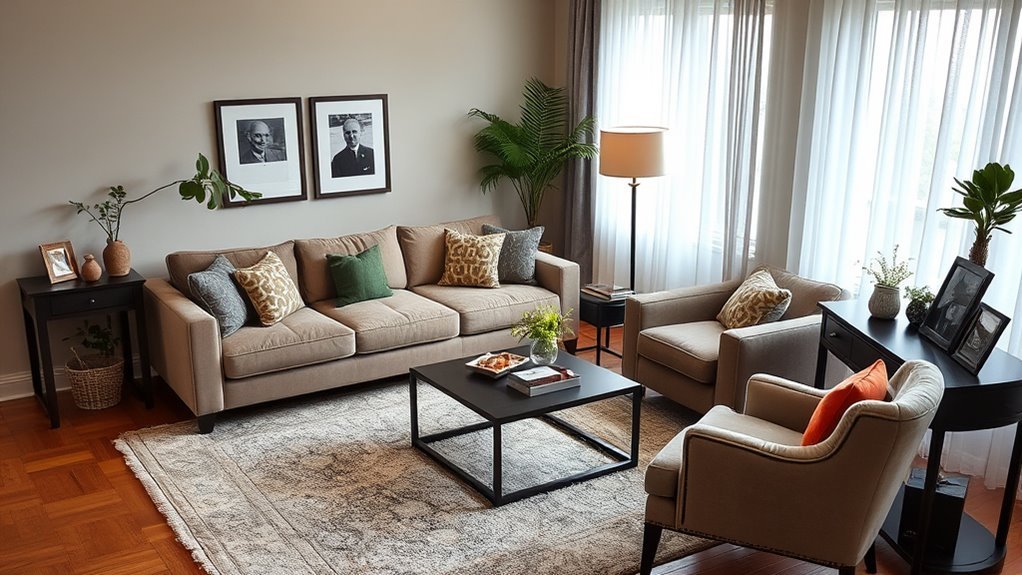
Once your floating furniture footprint passes the walkway and reach tests, layer in textiles, plants, and personal objects that unify the room without encroaching on circulation paths. Keep at least half of every coffee table and console surface open for daily use.
- Style in odd-numbered groupings: Arrange 3 or 5 objects of varying heights—such as a low book stack, a ceramic bowl, and a small vase—on a coffee table tray so sightlines across the room stay clear.
- Soften exposed corners: Place a tall floor plant or woven storage basket beside the exposed end of a floating sofa to smooth the transition into the walkway.
- Repeat 3 core colors and textures: Echo the tones of your area rug in throw pillows, curtains, and wall art so the floating island connects visually with the perimeter walls.
- Audit clutter seasonally: Remove extra footstools, oversized floor cushions, or decorative tables whenever they narrow a main path below 30 inches.
Creating Defined Zones to Enhance Functionality
Dividing a room into distinct functional zones—such as a central conversation island plus a corner reading nook or compact desk—lets one living space handle multiple daily activities without feeling chaotic. Floating furniture naturally marks where one zone ends and the next begins.
Use these five techniques to establish clear zones:
- Separate areas with rugs: Anchor the main sofa group on an 8×10 or 9×12 ft rug and ground a secondary reading chair with a small 3×5 ft accent rug or sheepskin.
- Orient backs as boundaries: Turn the back of a floating sofa or pair of chairs toward a secondary workspace or dining table to create mental separation.
- Assign dedicated task lighting: Give each zone its own switchable lamp so you can light just the reading corner or desk at night.
- Bridge zones with low storage: Use a 30-inch-high open bookcase or console table behind the sofa as a shared divider.
- Coordinate materials across zones: Repeat wood tones, metal finishes, and bulb color temperatures (2,700 K–3,000 K) so separate zones still belong to the same room.
Troubleshooting Common Layout Problems
If your room still feels cramped, awkward, or unbalanced after floating your furniture, adjust one clearance variable at a time using these targeted fixes:
- The room feels cramped: Slide the sofa back to a 3- to 5-inch micro-float, swap a rectangular coffee table for a 32-inch round table, or remove one side table to restore a 30- to 36-inch walkway.
- The floating sofa looks bare from behind: Add a 10- to 14-inch-deep console table flush with the sofa back frame, drape a textured throw over the backrest, and anchor the front legs on a rug.
- Conversation feels distant: Pull accent chairs inward until opposing seats sit 4 to 8 feet apart and tighten the coffee table gap to 14 to 18 inches.
- The rug looks like a floating island: Slide the rug forward so the front legs of the sofa and chairs sit 6 to 12 inches onto the pile, or size up from a 5×8 ft to an 8×10 ft rug.
- Lamp cords cross the floor: Switch to rechargeable cordless LED table lamps on floating tables, or route cords back to the wall inside a paintable low-profile floor cord cover—never under the rug.
- Chairs scrape or slide on hardwood: Add a felt-and-rubber rug pad beneath the area rug and stick heavy-duty rubber furniture grippers under exposed rear sofa legs.
Recommended Products

Rustic and Modern Design: Elevate your home with the timeless appeal of this swivel barrel chair. Featuring a natural rattan frame paired with luxurious brown leather, this rattan accent chair strikes the perfect balance between rustic charm and modern sophistication, offering an organic yet polished look for any space

【Plush Comfort & Ergonomic Support】Sink into cloud-like comfort with high-density foam cushioning in the seat and backrest—breathable and perfect for all-day relaxation. The shelter-style arms and body-hugging contour provide gentle support, whether you're working, reading, or simply unwinding.

1、Smooth 360-Degree Swivel: A concealed black metal base lets the seat turn in any direction while keeping the profile low and clean for flexible conversation, reading, or relaxing.
Related Guides
Key Takeaways
- Match your float distance to the room: 3 to 5 inches adds depth in small rooms, 10 to 14 inches fits a slim console, and 30 to 36+ inches creates a comfortable rear walkway.
- Keep opposing seats 4 to 8 feet apart for effortless conversation and set 4K TV seating at 1.2 to 1.6 times the screen diagonal.
- Choose an area rug large enough (typically 8×10 ft or 9×12 ft) for at least the front legs of all seating pieces to rest 6 to 12 inches on the pile.
- Power floating lamps safely with floor outlets, perimeter cord covers, or rechargeable LED lamps—never run cords beneath rugs or furniture legs.
- Anchor bookcases, dressers, and storage units to wall studs with anti-tip brackets even when your seating floats in the center.
Frequently Asked Questions
What is the 2/3 rule for a coffee table?
The 2/3 rule is a proportion guideline stating that a coffee table looks most balanced when its length is roughly two-thirds (or between one-half and two-thirds) the length of your sofa. For a standard 84-inch sofa, aim for a coffee table around 42 to 56 inches long, and leave 14 to 18 inches of legroom between the table edge and seat cushions.
How do you keep furniture from moving when it is not against a wall?
Keep floating furniture from sliding by placing non-slip rubber grippers or caster cups under sofa and chair legs and laying a dual-surface felt-and-rubber pad under your area rug. Anchoring the front legs of your sofa on the rug also uses the furniture’s own weight to lock the grouping in place. Always secure tall perimeter storage with drawers, doors, or shelves to wall studs using anti-tip brackets.
What is the 3-5-7 rule of decorating?
The 3-5-7 rule is an interior styling principle that groups objects in odd numbers—three, five, or seven—because asymmetrical arrangements look more natural and dynamic to the human eye than even pairs. Apply it by clustering three items of varied heights on a coffee table tray or five throw pillows across a sectional, while leaving at least half of your table surfaces clear for daily use.
How far should a sofa be from the wall?
A sofa should sit 3 to 5 inches from the wall for visual depth when no one walks behind it, 10 to 14 inches out if you are adding a narrow console table, or at least 30 to 36 inches away if the space behind it serves as a walkway. When following U.S. Access Board accessible-route guidelines, maintain at least 36 inches of clear passage width behind the sofa.
Is it okay to put a sofa against the wall in a small living room?
Yes, keeping a sofa near the wall is often the smartest choice in a small or narrow living room where floating it would block the main 30-inch walkway. Avoid the “waiting room” effect by pulling the sofa forward just 3 to 5 inches, floating one accent chair opposite it at an angle, and connecting both pieces on a 6×9 or 8×10 ft area rug.
How far should a couch be from the coffee table?
Position your coffee table 14 to 18 inches from the front edge of the couch cushions, with 16 to 18 inches serving as the ideal middle ground for most rooms. That gap is close enough to set down a drink without leaning out of your seat, yet wide enough to stretch your legs comfortably. In tight spaces, use a round table or ottoman to keep corners out of the path.
How do you hide lamp cords on floating furniture?
The safest ways to power lamps on floating furniture are plugging into a recessed floor outlet under the sofa, using rechargeable cordless LED table lamps on your console, or routing cords along the room’s perimeter inside a low-profile floor cord cover. Never run electrical or extension cords underneath area rugs or furniture legs, as trapped heat and pinched insulation create a fire hazard.
Conclusion
Arranging furniture without pushing everything against the wall builds a living room that works from the inside out: comfortable 4- to 8-foot conversation seating, reachable tables set 14 to 18 inches away, and unobstructed 30- to 36-inch walkways. Start today by marking one new sofa or chair position with painter’s tape, walking your normal route through the room, and sitting in every seat to test the view and reach before making the change permanent.
Sources
- U.S. Access Board — ADA Chapter 4: Accessible Routes: Supports the 36-inch minimum continuous clear-width guidance (and 32-inch short-segment exception) for accessible walking surfaces.
- U.S. Consumer Product Safety Commission — Anchor It: Supports anchoring furniture with drawers, doors, and shelves to wall studs to prevent tip-over injuries.
- U.S. Consumer Product Safety Commission — Household Extension Cords Can Cause Fires (Pub. 5032): Supports the safety warning never to run electrical or extension cords under rugs, carpets, or furniture.
- ENERGY STAR — Learn About Brightness: Supports selecting light bulbs by lumen output rather than watts.
- Federal Trade Commission — Shopping for Light Bulbs: Supports the Lighting Facts label guidance and the 800-lumen (~9W LED) replacement benchmark for 60-watt incandescent bulbs.
- U.S. Department of Energy — Purchasing Energy-Efficient Light Bulbs: Supports choosing 2,700 K–3,000 K warm color temperatures and a CRI of 80+ for residential living areas.
- Better Homes & Gardens — How to Arrange Furniture: Supports practical furniture-clearance, conversation-layout, and painter’s-tape planning guidance.
- Southern Living — How to Choose the Right Coffee Table Size and Shape: Supports the one-half to two-thirds coffee table proportion guideline and seating-to-table spacing.
- Good Housekeeping — Why Designers Recommend Floating Key Furniture: Supports floating furniture for visual depth and conversation while recognizing small-room exceptions.
- Emily Henderson — Living Room Layout Rules: Supports leaving a 3- to 5-inch breathing gap behind a sofa and practical seating-to-table spacing.
- Livingetc — 3-5-7 Rule in Decorating: Supports the odd-number styling guideline used in the decor section and FAQ.

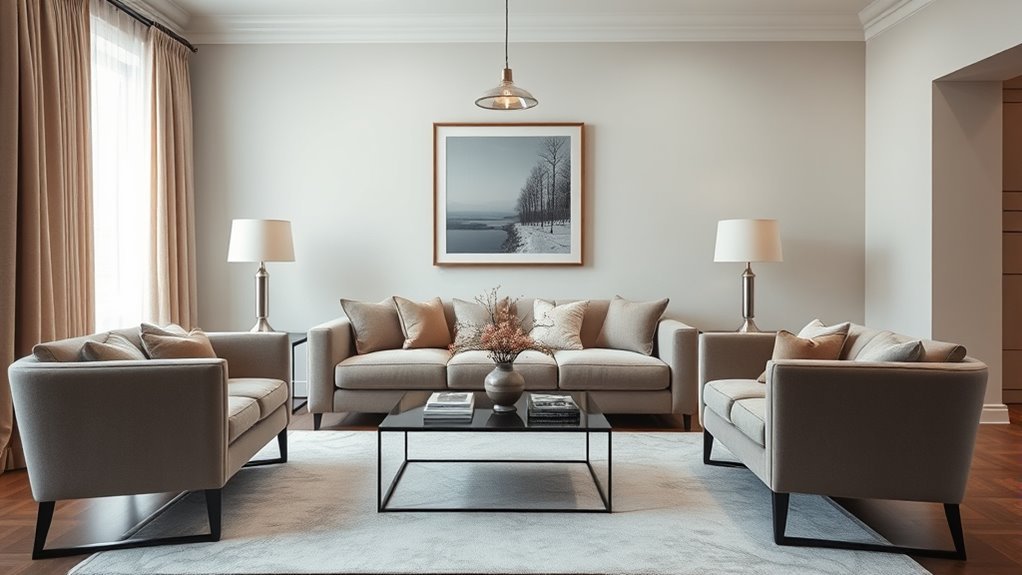

[…] How to Arrange Furniture Without Pushing Everything Against the Wall: Step-By-Step Guide […]