Last updated: August 2026
If you want a window air conditioner with dehumidifier mode, start with the cooling capacity your room needs, then compare dry-mode performance, noise, controls, electrical requirements, and window fit. The models below cover manufacturer-suggested room sizes from about 250 to 700 square feet. A correctly sized unit generally cools more evenly and can manage humidity better than an oversized unit that reaches the set temperature too quickly.
Key Takeaways:
- Start with room size: the listed 6,000 BTU models target smaller rooms, the 8,000 BTU models target medium rooms, and the 14,000 BTU Hisense is intended for a much larger space.
- Dry or dehumidifier mode can improve comfort during humid weather, but it does not automatically replace a dedicated dehumidifier for severe or continuous moisture problems.
- Check the exact model number, window-opening requirements, voltage, weight, and current manufacturer instructions before buying.
Quick Comparison
| Model | Cooling | Suggested Room Size | Dehumidifying | Controls | Best Use |
|---|---|---|---|---|---|
| TCL Smart | 8,000 BTU | Up to 350 sq. ft. | Dry/dehumidifier mode | App, Alexa, Google Assistant, remote | Connected bedrooms and living rooms |
| Keystone | 6,000 BTU | Up to 250 sq. ft. | Up to 1.5 pints/hour listed | Follow Me remote, panel | Small rooms and targeted temperature sensing |
| Midea EasyCool | 6,000 BTU | Up to 250 sq. ft. | Dehumidifier mode | Remote, panel | Straightforward small-room value |
| LG Smart | 8,000 BTU | Up to 350 sq. ft. | Dry/dehumidifier mode | ThinQ app, Alexa, Google Assistant, remote | Established smart-home platform |
| ROVSUN | 8,000 BTU | Up to 350 sq. ft. | Dehumidifier mode | Remote, panel | Basic 3-in-1 medium-room use |
| Hisense Smart | 14,000 BTU | Up to 700 sq. ft. | Dry/dehumidifier mode | App, Alexa, Google Assistant, remote, panel | Large-room smart control |
How We Compared These Window ACs
We compared each remaining model by its listed cooling capacity, suggested coverage, dehumidifier or dry mode, control options, published sound information where available, installation style, filter access, timer functions, electrical needs, and likely use case. We also checked the linked model information against currently accessible product details. Marketplace listings, sellers, specifications, and variants can change, so treat room coverage and sound figures as manufacturer guidance rather than guaranteed results in every home.
TCL 8000 BTU Smart Window Air Conditioner
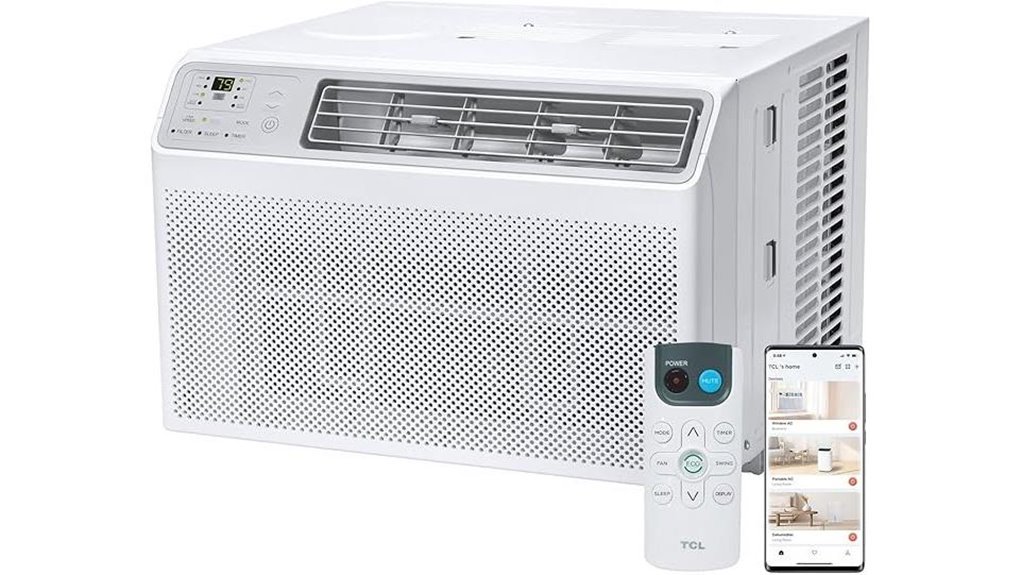
TCL’s H8W35W 8,000 BTU window AC is suited to manufacturer-suggested spaces up to about 350 square feet. It combines cooling, fan, and dehumidifier functions with TCL Home app control, an included remote, and voice support through Alexa and Google Assistant. Eco mode, Sleep mode, a 24-hour timer, auto restart, adjustable airflow, and a reusable filter make it a balanced connected option.
Best For: Buyers who want app and voice control for a medium-size bedroom, office, or living room.
Why You’ll Like It: It combines useful smart controls with a dedicated dehumidifying function in a common 8,000 BTU room-size class.
Who Should Avoid It: Buyers who do not want app setup, specifically want an inverter-style window design, or have a room much smaller or larger than its intended range.
Pros:
- App, remote, Alexa, and Google Assistant control
- Cooling, fan, and dehumidifying functions for changing weather
- Eco mode, Sleep mode, timer, auto restart, and washable filter
Cons:
- Traditional window installation requires careful measuring and sealing
- Buyers seeking an inverter-style design should compare TCL’s current inverter models separately
- Actual coverage may be lower in sunny, poorly insulated, or high-ceiling rooms
Keystone 6000 BTU Window Air Conditioner & Dehumidifier
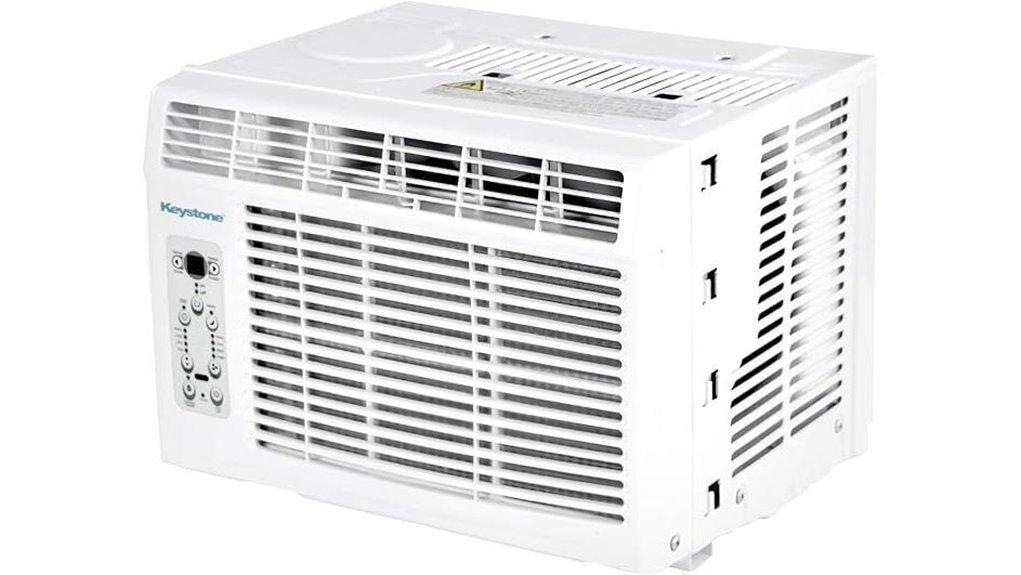
The linked Keystone KSTAW06CE 6,000 BTU unit is intended for rooms up to about 250 square feet and lists dehumidification of up to 1.5 pints per hour. Its Follow Me remote senses temperature near the remote instead of relying only on the sensor at the front panel. Three cooling settings, three fan speeds, four-way louvers, Sleep mode, Energy Saver mode, a timer, and a filter alert complete the main feature set.
Best For: Small rooms where the temperature near the bed, desk, or sofa differs from the area around the window.
Why You’ll Like It: Its published moisture-removal rate and temperature-sensing remote make it easier to compare with other small-room models.
Who Should Avoid It: Buyers who need Wi-Fi control, a larger-room capacity, or specifically want a variable-speed inverter compressor.
Pros:
- Up to 1.5 pints-per-hour listed moisture removal
- Follow Me remote and four-way airflow control
- Energy Saver mode, Sleep mode, timer, and washable filter
Cons:
- Limited to small-room cooling
- Compressor and fan cycling may still be noticeable at night
- Window-opening dimensions must be checked before purchase
Midea 6000 BTU 3-in-1 Window Air Conditioner
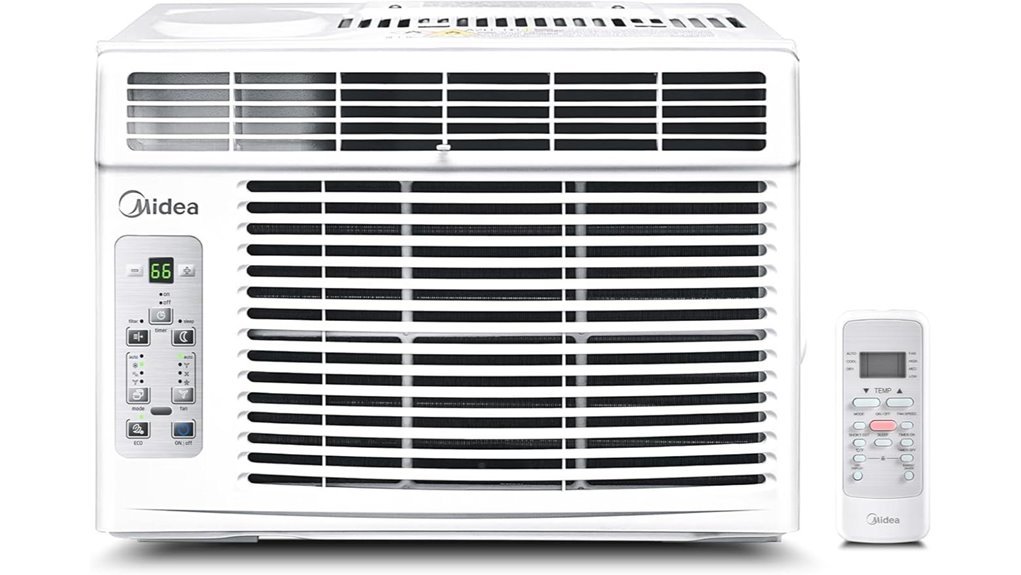
Midea’s MAW06R1CWT 6,000 BTU EasyCool model is a straightforward 3-in-1 unit for manufacturer-suggested spaces up to about 250 square feet. It provides cooling, fan circulation, and dehumidifying modes, along with three fan speeds, a remote, an LED display, Eco mode, a timer, and a reusable filter. Its listed sound level is about 52 dB, so it is better described as reasonably quiet than silent.
Best For: Small bedrooms, studies, and offices that need simple controls rather than Wi-Fi features.
Why You’ll Like It: It covers the core cooling and dehumidifying functions in an uncomplicated design without requiring smart-home setup.
Who Should Avoid It: Buyers who need smart-home control, stronger large-room capacity, or exceptionally quiet overnight operation.
Pros:
- Simple 3-in-1 cooling, fan, and dehumidifier operation
- Remote, Eco mode, timer, and reusable filter
- Compact-room coverage with three fan speeds
Cons:
- No app or voice control
- Not powerful enough for large or connected spaces
- Sound may still be noticeable to very light sleepers
LG 8000 BTU Smart Window Air Conditioner
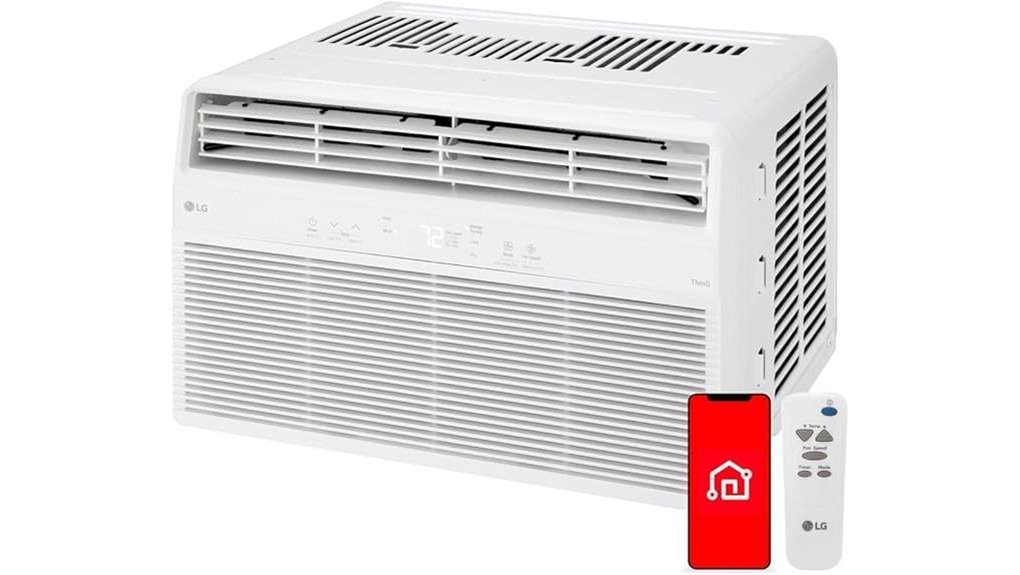
LG’s LW8024RSM 8,000 BTU smart window AC is intended for manufacturer-suggested spaces up to about 350 square feet. It combines cooling, fan, and dehumidifying functions with LG ThinQ app control, an included remote, and Alexa and Google Assistant compatibility. Three fan speeds, four-way air direction, a 24-hour timer, auto restart, and a washable filter make it a strong fit for buyers who value connected controls.
Best For: Medium-size bedrooms and living rooms where app control and scheduling are priorities.
Why You’ll Like It: ThinQ adds remote adjustments and smart-home control while the dehumidifying function helps during damp weather.
Who Should Avoid It: Buyers who specifically want a U-shaped cabinet, an inverter compressor, or the lowest possible bedroom noise.
Pros:
- ThinQ app, remote, Alexa, and Google Assistant control
- Cooling, fan, and dehumidifying functions with four-way airflow
- Timer, auto restart, and washable filter
Cons:
- Traditional window cabinet blocks more of the view than U-shaped designs
- Not an inverter-style window AC
- Installation may be cumbersome at roughly 44 pounds
ROVSUN 8000 BTU 3-in-1 Window Air Conditioner
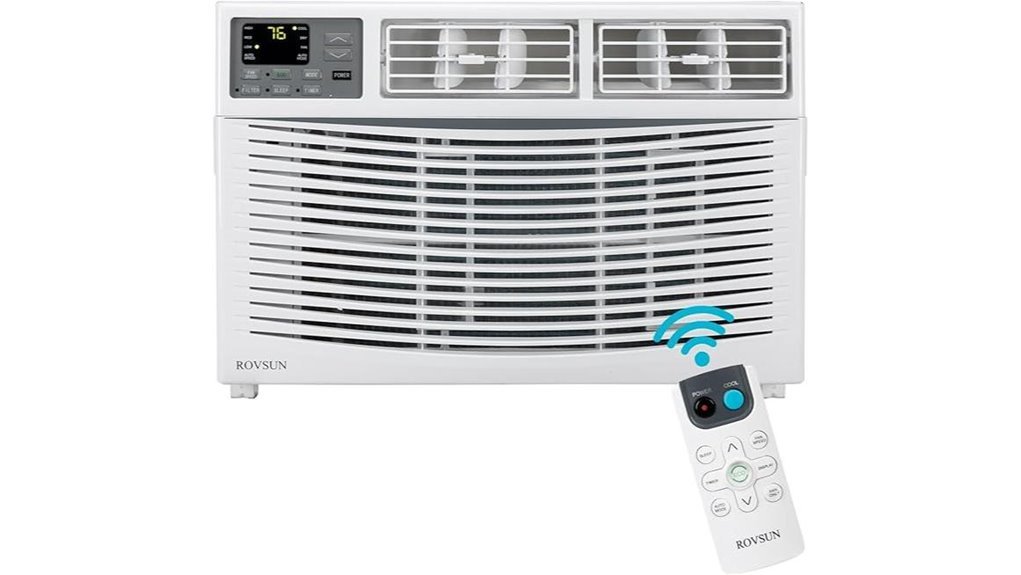
The linked ROVSUN G46000668 8,000 BTU window AC is listed for rooms up to about 350 square feet and provides cooling, dehumidifier, and fan functions. The control panel and remote let you adjust everyday operating settings, and the unit includes a timer, washable filter, and window installation kit.
Best For: Buyers who want medium-room capacity and familiar remote controls without making Wi-Fi a priority.
Why You’ll Like It: It combines cooling, dehumidifying, and fan functions in a conventional window-AC layout that is easy to understand.
Who Should Avoid It: Buyers who prioritize Wi-Fi control, an inverter-style design, or a more open window view.
Pros:
- 3-in-1 operation for rooms up to about 350 sq. ft.
- Remote control and timer for everyday convenience
- Washable filter and installation kit included
Cons:
- Current warranty, seller support, and replacement-parts access should be checked before purchase
- Traditional cabinet blocks part of the window
- Compressor and fan sound may be noticeable at night
Hisense 14000 BTU Smart Window Air Conditioner
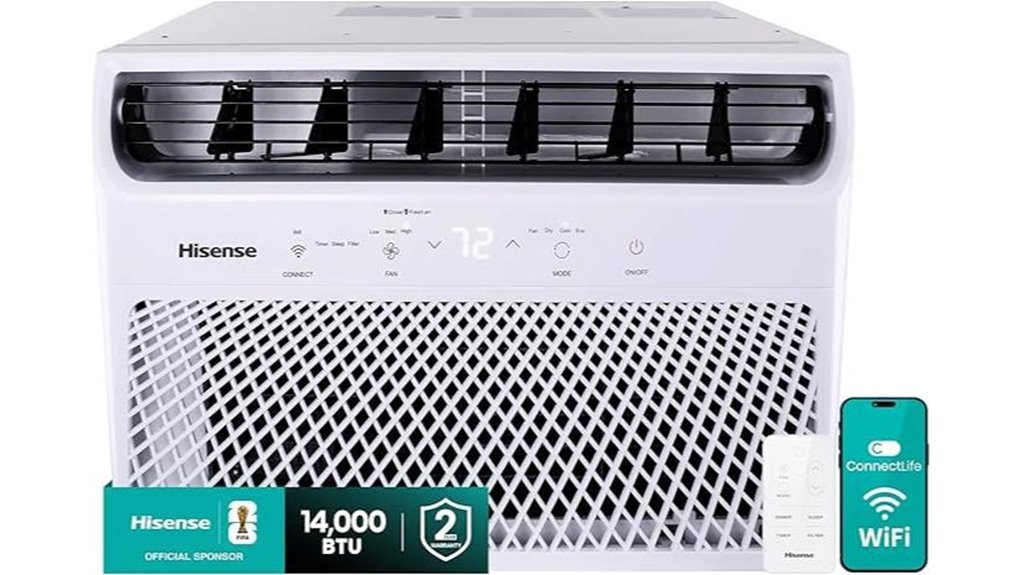
The Hisense WC14W25A 14,000 BTU model targets manufacturer-suggested spaces up to about 700 square feet. It includes cooling, fan, and dry modes, plus ConnectLife app control, remote and panel controls, and Alexa and Google Assistant support. A 24-hour timer, washable filter, filter reminder, and included window kit support everyday convenience. Its listed sound level is around 56 dB, so it suits buyers who prioritize capacity over near-silent operation.
Best For: Large bedrooms, living areas, and open rooms that genuinely need higher-capacity 115-volt window cooling with smart control.
Why You’ll Like It: It combines high cooling capacity, dry mode, app control, and voice control in a traditional window unit.
Who Should Avoid It: Buyers with a small room, a narrow window, lifting limitations, or an electrical setup that does not match the product requirements.
Pros:
- 14,000 BTU capacity for substantially larger spaces
- Cooling, fan, and dry modes with app, voice, remote, and panel controls
- Timer, washable filter, filter reminder, and installation kit
Cons:
- Large and heavy compared with 6,000 or 8,000 BTU models
- May be oversized for smaller rooms, which can reduce humidity control
- Window dimensions, outlet condition, and installation support must be checked carefully
Factors to Consider When Choosing Window Air Conditioners With Dehumidifier Mode

Start with room size and installation fit, then compare moisture-removal ratings, sound, controls, efficiency, drainage behavior, and maintenance. Dry mode is useful for comfort, but a window AC is not always a complete replacement for a dedicated dehumidifier in a persistently damp basement or a whole-home humidity problem.
Cooling Capacity
Match BTU output to the room rather than automatically choosing the largest model. Within the products reviewed here, 6,000 BTU models are listed for rooms up to about 250 sq. ft., 8,000 BTU models for about 350 sq. ft., and the 14,000 BTU Hisense for roughly 700 sq. ft. Strong sun, poor insulation, high ceilings, kitchens, and extra occupants can increase the required capacity. An oversized unit may cool too quickly, cycle off, and remove less humidity.
Room Size and Layout
Measure the room’s length and width, then multiply them to estimate square footage. Open doorways, connected rooms, vaulted ceilings, heat-producing equipment, and direct afternoon sun can raise the actual cooling load. Manufacturer coverage is guidance, not a guarantee.
Dehumidifying Power
When a listing provides a pints-per-hour figure, it is easier to compare moisture removal across models. Keystone is the clearest example in this group because its linked model publishes a moisture-removal rate. Dry mode still relies on a cold indoor coil, so some room cooling is normal. Performance can fall when the compressor cycles off or airflow is restricted by a dirty filter. For severe moisture problems, compare the AC with a dedicated dehumidifier rated for the space.
Energy Efficiency
For window room air conditioners, compare the current EnergyGuide label, ENERGY STAR status, and CEER or EER where available. Do not rely on a generic SEER claim copied from an unrelated product type. Inverter or variable-speed compressors can run more steadily, while Eco or Energy Saver modes can reduce unnecessary operation depending on the model.
Noise Levels
Check whether a published sound figure applies to low, medium, or high operation. Conventional units in the low-50 dB range can still be noticeable in a quiet bedroom. Installation quality, window vibration, loose panels, and gaps around the cabinet also affect perceived noise.
Smart Controls
Wi-Fi control is useful for schedules, pre-cooling, and adjusting settings from another room. Confirm the supported app and voice platforms on the current product page. A remote with a temperature sensor can be more useful than Wi-Fi when the main problem is uneven temperature across the room.
Installation Fit
Measure the window opening, sill depth, and available exterior clearance before buying. Check the product’s minimum and maximum window dimensions, cabinet weight, power-cord location, voltage, amperage, and outlet requirements. Heavy units may need two people or an approved support bracket. Follow the manufacturer’s instructions for sealing, support, and drainage rather than improvising the installation angle.
Warranty and Support
Check the written warranty, seller return terms, replacement-parts access, and service options before purchase. A longer feature list is less valuable if the exact model is difficult to service or the listing does not clearly identify the manufacturer and warranty provider.
Before You Buy:
- Measure room square footage and window dimensions.
- Confirm the exact model number, BTU rating, and installation style shown on the product page.
- Confirm outlet voltage and avoid extension cords unless the manual expressly allows one.
- Compare CEER/EER, sound level, and pints-per-hour dehumidification where listed.
- Check current manufacturer and CPSC safety notices for the exact model number.
- Confirm that your window and landlord or building rules allow the required installation.
- Plan for two-person lifting or an approved support bracket if the unit is heavy.
Frequently Asked Questions
Can Dehumidifier Mode Run Without Cooling?
Dry or dehumidifier mode may reduce sensible cooling compared with normal Cool mode, but the compressor generally still has to cool the indoor coil so moisture can condense. Some temperature drop is therefore normal. Operation varies by model, so check the manual for the exact control logic.
Do Window ACs Need a Drain Hose or Bucket?
Most window air conditioners do not use an indoor collection bucket. Condensate usually moves to the outdoor side, where it may drain or be splashed over the condenser to improve efficiency. Follow the installation instructions and do not drill a drain hole unless the manufacturer specifically directs you to do so.
How Noisy Is Dehumidifier Mode Compared to Cooling?
Dry mode may use a lower fan setting on some models, but the compressor and fan can still cycle, so it is not silent. Actual sound depends on the model, fan speed, compressor design, window condition, and how securely the unit is installed.
Does Dry Mode Use Less Electricity Than Cool Mode?
Not always. Dry mode may use less fan power or cycle differently, but energy use depends on humidity, temperature, runtime, and the model’s control logic. Compare the EnergyGuide information and use a timer or schedule rather than assuming one mode is always cheaper.
Can I Use Dehumidifier Mode During Rainy Weather?
Yes. Dry mode can be useful when indoor air feels damp during rainy weather. Keep doors and windows closed while the unit runs, clean the filter, and avoid oversizing the AC if humidity control is a priority.
Is a Window AC a Replacement for a Dedicated Dehumidifier?
It can help with seasonal room humidity while cooling, but it may not maintain a precise humidity level or remove enough moisture in a very damp space. A dedicated dehumidifier is usually better for basements, continuous moisture loads, or humidity control when cooling is not wanted.
How Do I Confirm the Linked Model Is the One Reviewed?
Compare the product-page brand, model number, BTU rating, room-size claim, control type, voltage, and cabinet design with the review section before ordering. Do not rely only on the product image or the first words of a marketplace title, because sellers may merge or redirect listing variants.
Conclusion
The best window air conditioner with dehumidifier mode is the one correctly sized for your room, outlet, and window. TCL and LG are the strongest connected choices here for common medium-size rooms. Keystone and Midea cover smaller spaces, while ROVSUN offers a conventional 8,000 BTU alternative. Hisense is the high-capacity large-room option in this list. Confirm the exact listing, installation fit, electrical requirements, safety notices, and warranty terms before ordering, then use Dry mode as a comfort feature rather than treating every window AC as a full dedicated dehumidifier.
“`