Last updated: August 19, 2026
Choosing the best dehumidifier for a second floor depends on more than advertised square footage. Upstairs airflow, actual relative humidity, bedroom noise, drainage access, bucket size, and whether interior doors stay open can matter just as much. The Midea Cube 20 Pint is the strongest all-around choice here for smart control and its large 3.2-gallon bucket. The Yaufey JD025Q-80 is a better fit for a larger open upstairs zone with a heavier moisture load, while the PLUSCENT PD10 stands out for its stated 39–42 dB operating range. The Midea MAD22C1AWS 22 Pint is a traditional upright alternative that also supports Wi-Fi smart control.
Quick Verdict
Best overall: Midea Cube 20 Pint for app control, an included drain hose, and a 3.2-gallon bucket. Best for a larger open upstairs area: Yaufey JD025Q-80, which has a current ENERGY STAR water-removal rating of about 24.93 pints per day. Best quieter bedroom-oriented option: PLUSCENT PD10, based on its stated 39–42 dB range. Best traditional upright smart option: Midea MAD22C1AWS 22 Pint. Manufacturer square-foot claims are only a guide because real performance depends on humidity, temperature, airflow, and closed doors.
Affiliate note: Amazon product links below are affiliate links. Qualifying purchases may earn a commission.
Quick Comparison
| Dehumidifier | Best For | Capacity Note | Standout Feature | Amazon |
|---|---|---|---|---|
| PLUSCENT PD10 | Bedrooms and open upstairs zones where lower noise is a priority | Up to 32 pints per day at about 95°F/90% RH; not a directly comparable current DOE rating | Stated 39–42 dB range and three modes | Check Amazon Details |
| Yaufey JD025Q-80 | Larger open upstairs layouts with steady moisture | 24.93 pints per day in the current ENERGY STAR product data | ENERGY STAR certification, three fan speeds, and included drain hose | Check Amazon Details |
| Midea Cube 20 Pint | Best overall for smart control and less frequent bucket emptying | 20 pints per day; marketed for spaces up to 1,500 sq. ft. | SmartHome app, 3.2-gallon bucket, and lift-and-twist design | Check Amazon Details |
| Midea MAD22C1AWS 22 Pint | Traditional upright design with smart control and room-to-room mobility | About 22 pints per day; marketed for spaces up to 1,500 sq. ft. | Wi-Fi control, voice-assistant support, timer, and wheels | Check Amazon Details |
Important: Advertised coverage is a general guide, not a guarantee. A dehumidifier may serve an open upstairs landing and nearby rooms more effectively than several bedrooms with closed doors.
How These Picks Were Evaluated
The comparison focuses on moisture-removal capacity, current ENERGY STAR data where available, drainage method, bucket size, noise information, portability, smart controls, and how well each design fits a typical second-floor layout. No product is treated as a substitute for fixing roof, plumbing, window, or HVAC moisture problems.
PLUSCENT 32 Pint Dehumidifier for Home
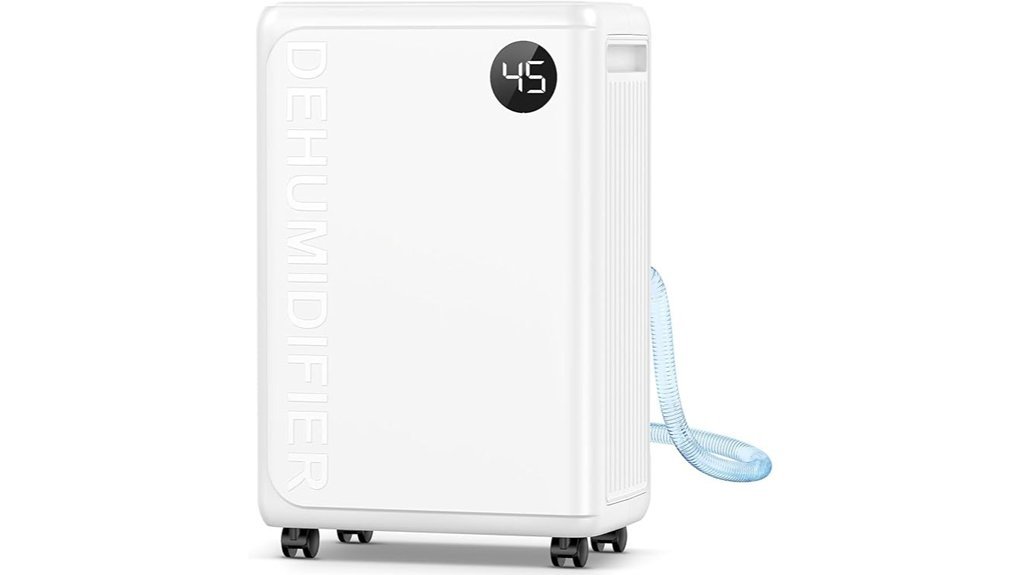
Best Quieter Bedroom-Oriented Pick
The PLUSCENT PD10 is a compressor dehumidifier for buyers who need more moisture removal than a small thermoelectric unit can provide. Its Amazon listing markets it for spaces up to 2,500 sq. ft. and states up to 32 pints per day at approximately 95°F and 90% relative humidity. Because that capacity is quoted under hot, very humid conditions, do not compare the 32-pint marketing figure directly with current standardized DOE or ENERGY STAR pint ratings.
Its three operating modes include standard dehumidification, continuous operation, and a laundry-drying mode. Adjustable humidity control, automatic defrost, a 24-hour timer, a child lock, and a washable filter make it suitable for regular household use. The listing also states an operating range of approximately 39–42 dB, which may be useful in bedrooms or home offices.
The included hose supports gravity drainage. This means the hose must slope downward toward a suitable drain. The unit does not pump water upward to a sink or drain located above it.
Best For: Upstairs bedrooms, open landings, home offices, or living areas where the stated lower-noise range matters more than app control.
Why You’ll Like It:
- Three operating modes provide more control over everyday humidity and laundry moisture.
- The stated 39–42 dB operating range is relatively bedroom-friendly for a compressor model.
- A timer, child lock, automatic defrost, and continuous-drain connection support convenient operation.
Consider Before Buying:
- The 32-pint figure comes from hot, very humid test conditions and should not be treated as a guaranteed household collection rate.
- The 2-liter tank may need frequent emptying when continuous drainage is unavailable.
- Gravity drainage requires a lower drain and a continuously downward-sloping hose.
Yaufey JD025Q-80 ENERGY STAR Dehumidifier
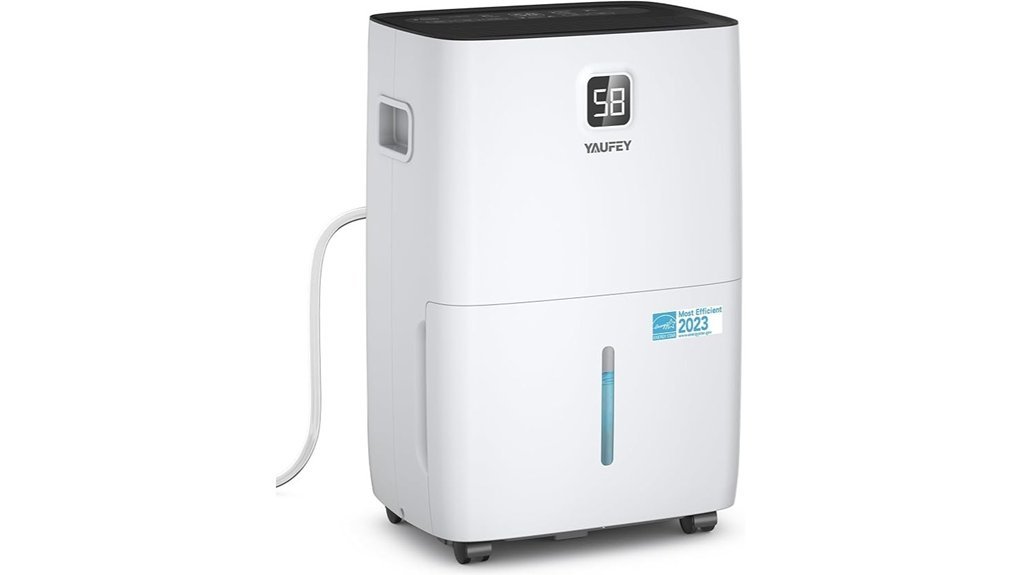
Best for Larger Open Upstairs Areas
The Yaufey JD025Q-80 is an ENERGY STAR-certified portable dehumidifier with adjustable humidity control, four operating modes, three fan speeds, automatic shutoff, a washable filter, and an included 3.28-foot gravity drain hose.
Its capacity requires careful explanation. The Amazon listing markets it as an “80-pint” model based on performance at approximately 95°F and 90% relative humidity. In the current ENERGY STAR product data, model JD025Q-80 is rated at 24.93 pints per day with an Integrated Energy Factor of 1.7 L/kWh. The standardized rating is the better figure for comparing it with other current portable dehumidifiers.
The manufacturer advertises coverage up to 5,000 sq. ft., but buyers should not choose it by square footage alone. An open, moderately damp second floor is easier to manage than the same-sized area divided into closed bedrooms or affected by an active roof, plumbing, or bathroom leak.
Best For: Open upstairs layouts, persistent seasonal humidity, and households that can use continuous gravity drainage.
Why You’ll Like It:
- ENERGY STAR certification provides a standardized measure of energy-efficient operation.
- Adjustable humidity settings and multiple modes make it adaptable to bedrooms, hallways, and living areas.
- The included hose allows hands-off drainage when a suitable lower drain is available.
Consider Before Buying:
- The “80-pint” marketing number should not be compared directly with current DOE or ENERGY STAR pint ratings.
- The 1.06-gallon bucket can still fill quickly during very humid weather.
- Its drainage system relies on gravity and does not lift water to a higher drain.
Midea Cube 20 Pint Dehumidifier with Smart Control
Best Overall Smart Pick
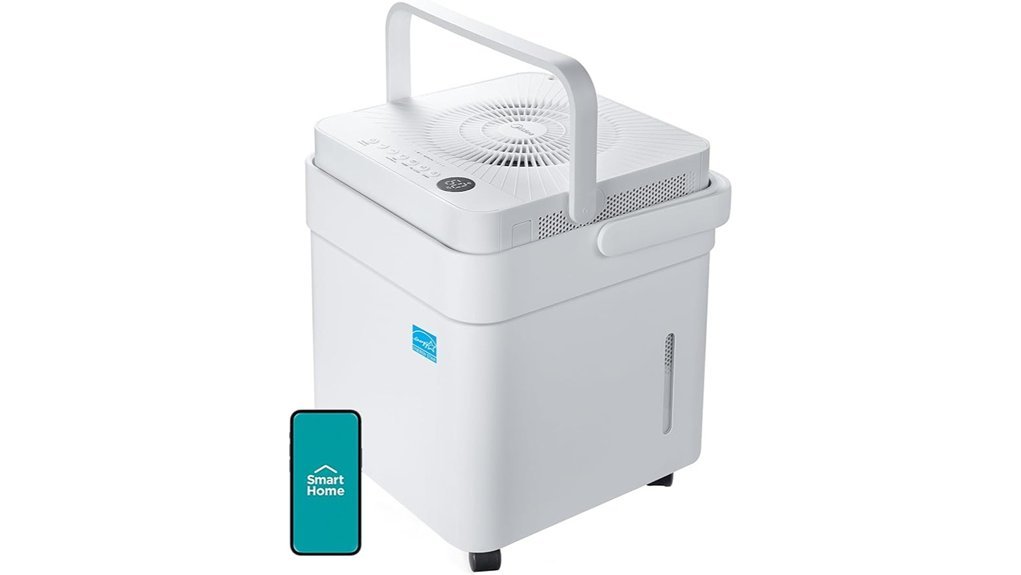
The Midea Cube MAD20S1QWT is a 20-pint dehumidifier marketed for spaces up to 1,500 sq. ft. It is the strongest all-around choice in this group when you want remote control, a large bucket, and flexible continuous-drain setup for an upstairs bedroom, landing, or open living area.
The SmartHome app and compatible voice-assistant controls support remote adjustments. Its lift-and-twist design allows the compressor section to nest inside the bucket for storage or extend upward during use. The 3.2-gallon removable bucket also reduces how often it must be emptied compared with many conventional 20-pint models.
You can connect the included hose for continuous drainage or position the unit so water can flow safely to a lower drain. This 20-pint Cube does not use a built-in pump, so the drainage route still needs gravity. Automatic restart, automatic defrost, adjustable humidity control, wheels, and a washable filter add everyday convenience.
Best For: Smart-home users, open upstairs areas within the model’s practical capacity, and buyers who want fewer manual bucket-emptying trips.
Why You’ll Like It:
- App and voice-assistant controls allow remote humidity adjustments.
- The large removable bucket can extend the time between emptying trips.
- The nesting design makes the unit shorter and easier to store when not in use.
Consider Before Buying:
- At approximately 33 pounds, it is not as light as its compact appearance may suggest.
- The large bucket can become heavy and awkward when filled near capacity.
- Wi-Fi setup adds complexity for buyers who only want basic manual controls.
Midea MAD22C1AWS 22 Pint EasyDry Dehumidifier
Best Traditional Upright Smart Pick
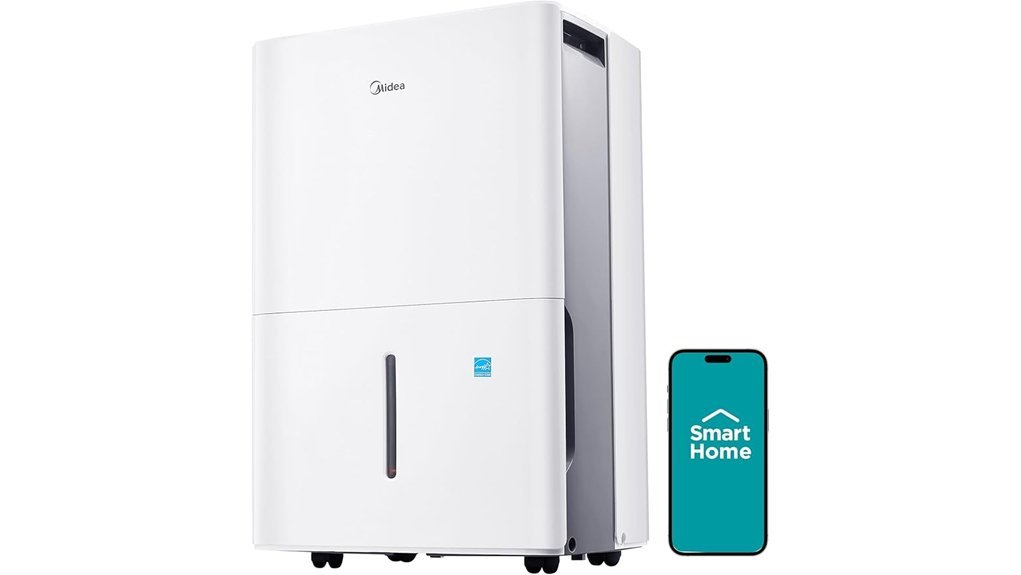
The linked Midea MAD22C1AWS is a 22-pint portable dehumidifier marketed for spaces up to 1,500 sq. ft. The current Amazon listing identifies this 1,500-sq.-ft. variant as Wi-Fi enabled, so the older “simple controls only” description should not be used for this ASIN.
It supports SmartHome app control plus Alexa and Google Assistant voice control. The traditional upright cabinet also includes a digital control panel, a timer, automatic restart, automatic defrost, a reusable filter, handles, and four rotating wheels for moving the unit between rooms on the same floor.
The bucket is listed at 0.8 gallon, which is much smaller than the Midea Cube’s 3.2-gallon bucket. A continuous-drain connection is available, but the standard hose is not included with this listing, so confirm the required hose size and drainage route before relying on unattended operation.
Best For: Buyers who want a conventional upright dehumidifier with smart control, easy same-floor mobility, and a familiar digital control panel.
Why You’ll Like It:
- Wi-Fi app control and Alexa/Google Assistant support add remote convenience.
- Four wheels and built-in handles make same-floor repositioning easier.
- The timer, auto restart, automatic defrost, and reusable filter support routine household use.
Consider Before Buying:
- The 0.8-gallon bucket is relatively small and may require frequent emptying in damp conditions.
- A drain hose is not included with the standard listing, so continuous drainage may require a separate hose.
- Wheels help on one level, but the roughly 30-plus-pound appliance should still be carried carefully on stairs.
Factors to Consider When Choosing a Dehumidifier for a Second Floor
An upstairs dehumidifier needs to match the moisture problem, not just the total floor area. Measure the relative humidity with a separate hygrometer, consider how air moves between rooms, and decide how the collected water will be removed before choosing a model.
Measure the Humidity First
Place a hygrometer in the affected upstairs area and observe it over several days. Indoor relative humidity should generally remain below 60%, with approximately 30–50% being a practical target for many homes. A reading that rises after showers, cooking, laundry drying, or rainy weather can help identify when and where the moisture load is highest.
A dehumidifier’s built-in sensor may not exactly match a separate hygrometer because the sensor is located close to the unit’s intake and warm exhaust. Small differences are normal, but a large persistent difference should be investigated.
Floor Layout and Advertised Coverage
Advertised square-foot coverage assumes reasonably good airflow. One dehumidifier placed near a central landing may help an open second floor, but it cannot pull air efficiently through several closed bedroom doors.
For the best whole-floor performance, place the unit in an open central location and keep interior doors open when practical. If privacy or air-conditioning needs require closed doors, individual high-humidity rooms may need separate moisture control or improved HVAC airflow.
Moisture-Removal Capacity
Current portable-dehumidifier capacity is measured in pints removed during 24 hours under standardized conditions. Larger and wetter spaces need greater capacity, but pint ratings from different test conditions should not be compared directly.
ENERGY STAR generally recommends approximately 20–30 pints per day for a slightly or moderately damp space below 2,000 sq. ft. A very damp or wet area may need 25–50 pints or more, depending on its size and moisture load.
Do not use a dehumidifier as a substitute for repairing roof leaks, plumbing leaks, overflowing drain pans, or water entering around windows.
Noise Level Considerations
Noise matters when the dehumidifier will operate near a bedroom, nursery, office, or television. Compressor models produce both fan noise and a low mechanical hum. Published decibel figures are useful for comparison, but the sound may change with fan speed, floor vibration, and room acoustics.
Place the unit on a firm, level surface and avoid allowing it to touch furniture or walls that could amplify vibration. A lower fan setting may be more comfortable overnight, although moisture removal can take longer.
Portability and Design
Wheels are useful for moving a dehumidifier between rooms on the same floor, but they do not make a roughly 30-pound or heavier appliance easy to carry upstairs. Check the unit’s listed weight, handles, dimensions, and bucket design before buying.
If the dehumidifier will remain upstairs permanently, move it into place before regular operation and avoid carrying it while the bucket contains water. Empty and dry the bucket before relocating the unit.
Tank, Gravity Drain, or Pump
A collection bucket is the simplest option, but it must be emptied regularly. Automatic shutoff prevents normal overflow when the bucket is installed correctly, although it also stops moisture removal until the bucket is emptied.
A gravity drain hose must run continuously downward to a floor drain, shower drain, or another suitable location. Avoid loops, upward sections, pinched hose, or routing that could leak onto the lower floor. None of the four linked models reviewed here uses a built-in condensate pump for lifting water upward.
Energy Efficiency Ratings
Look for ENERGY STAR certification and compare the Integrated Energy Factor when standardized data is available. This measurement is expressed in liters of water removed per kilowatt-hour. A higher value indicates more moisture removal for the electricity consumed under test conditions.
Correct sizing can also improve practical efficiency. An undersized unit may run continuously without reaching the selected humidity, while an excessively large unit may cost more and occupy unnecessary space.
Maintenance and Airflow
Clean the reusable filter according to the manufacturer’s instructions and keep the air intake and exhaust unobstructed. Dust buildup can reduce airflow, increase noise, and make the appliance work harder.
Check the bucket, hose connection, and drain path regularly. A blocked or poorly sloped hose can stop drainage even when the dehumidifier itself is working correctly.
Before You Buy
- Measure the upstairs humidity with a separate hygrometer.
- Estimate the area that has open airflow rather than counting every closed room.
- Confirm that you can safely empty the bucket or route a downward drain hose.
- Check the product weight if it must be carried upstairs.
- Choose quieter operation for bedrooms and home offices.
- Repair leaks and active water intrusion before relying on a dehumidifier.
Frequently Asked Questions
How Do I Maintain My Dehumidifier Effectively?
Empty and rinse the bucket regularly, clean the reusable filter as directed, and remove dust from the intake and exhaust. Inspect the drain hose for bends, blockage, or algae buildup. Always unplug the unit before cleaning it.
What’s the Ideal Humidity Level for a Second Floor?
A practical indoor target is usually between 30% and 50% relative humidity. Try to keep it below 60%, since persistently higher humidity can support condensation, musty odors, dust mites, and mold growth.
Can One Dehumidifier Handle an Entire Second Floor?
It may work in an open layout with good airflow and interior doors left open. One portable unit is less likely to control several bedrooms that remain closed. Use hygrometers in distant rooms to confirm whether humidity is actually decreasing throughout the floor.
Can Dehumidifiers Help With Mold Prevention?
A dehumidifier can reduce the excess airborne moisture that supports mold growth. It cannot remove established mold or correct roof leaks, plumbing leaks, wet insulation, or other water sources. Existing mold and water damage should be addressed separately.
Should I Use Continuous Drainage Upstairs?
Continuous drainage can reduce maintenance, but only when the hose can run safely downward to an approved drain. Secure the hose and inspect the route for leaks. Do not allow water to drain onto a roof, exterior walkway, or location where it could damage the lower floor.
Are There Energy-Efficient Options Available?
Yes. Look for current ENERGY STAR certification and, when available, compare each model’s Integrated Energy Factor. Actual electricity use will still depend on humidity, temperature, fan speed, selected setting, and operating time.
How Noisy Are These Dehumidifiers During Operation?
Compressor models normally create a steady fan sound and a mild mechanical hum. A quieter setting may be suitable for sleeping, but no compressor dehumidifier is completely silent. Floor vibration and nearby walls can also make a unit sound louder than its published rating.
Why Is My Upstairs Humid Even With Air Conditioning?
Possible causes include short air-conditioner cycles, restricted HVAC airflow, bathroom moisture, an unvented dryer, roof or window leaks, and outdoor air entering through gaps. A dehumidifier may help manage the symptoms, but persistent or localized dampness should be investigated.
Conclusion
The best second-floor dehumidifier is the one that matches your actual moisture load, layout, noise tolerance, and drainage options. The Midea Cube 20 Pint is the best overall choice here for smart control, an included drain hose, and a large 3.2-gallon bucket. The Yaufey JD025Q-80 is the stronger choice for a larger open upstairs area where its higher standardized moisture-removal capacity is useful. The PLUSCENT PD10 is appealing when its stated 39–42 dB operating range is a priority, while the Midea MAD22C1AWS 22 Pint offers a traditional upright design with Wi-Fi and voice-assistant control.
Use a hygrometer to confirm results after installation, keep indoor humidity below 60% and ideally near 30–50%, and remember that a portable dehumidifier cannot replace repairs for leaks, wet materials, or existing mold.