
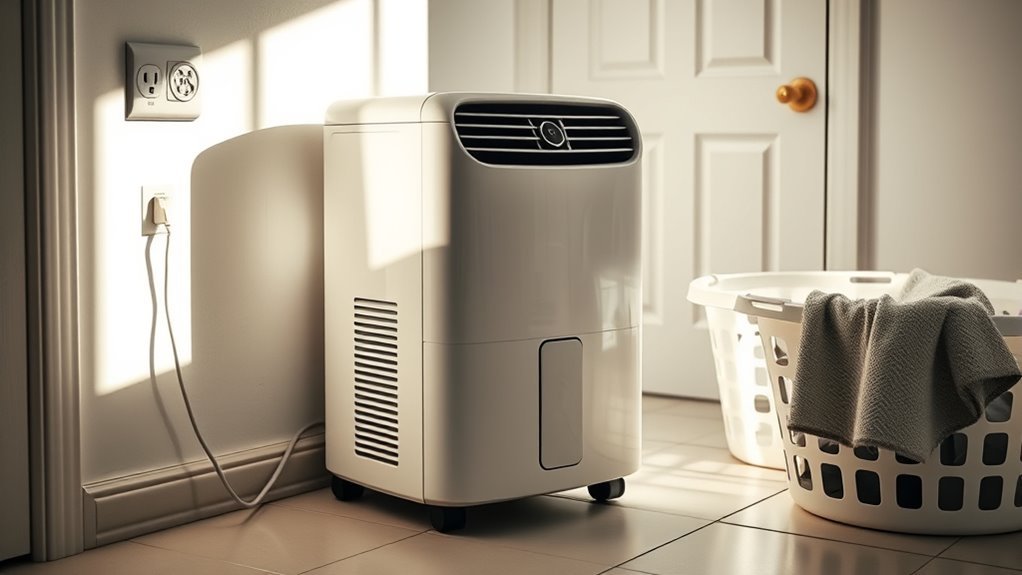
Figuring out how much electricity does a dehumidifier use comes down to three numbers: the appliance’s wattage, how many hours its compressor actively runs, and your local utility rate. While a portable unit draws a few hundred watts when pulling moisture from the air, its humidistat cycles the compressor off once your room reaches the target humidity. Knowing your unit’s real kilowatt-hour (kWh) consumption helps you control dampness without a surprise on your monthly electric bill.
Quick Answer
Most portable household dehumidifiers use 240 to 700 watts, consuming 0.24 to 0.70 kWh per active hour. At the July 2026 U.S. average residential electricity rate of 18.31 cents per kWh, running a 500-watt dehumidifier for 8 active hours a day uses 4 kWh ($0.73 daily, or about $21.97 per month).
Last checked: October 16, 2026. Dates and figures were verified against official sources.
At a Glance
| Time Required | 2–5 minutes to calculate; 24–72 hours to measure real-world cycling |
| Difficulty | Easy |
| Tools Needed | Dehumidifier nameplate label, utility bill, calculator, and an optional plug-in watt meter |
| Cost | Free to calculate by formula; $12–$30 for an optional plug-in electricity monitor |
How Much Electricity Does a Dehumidifier Use?
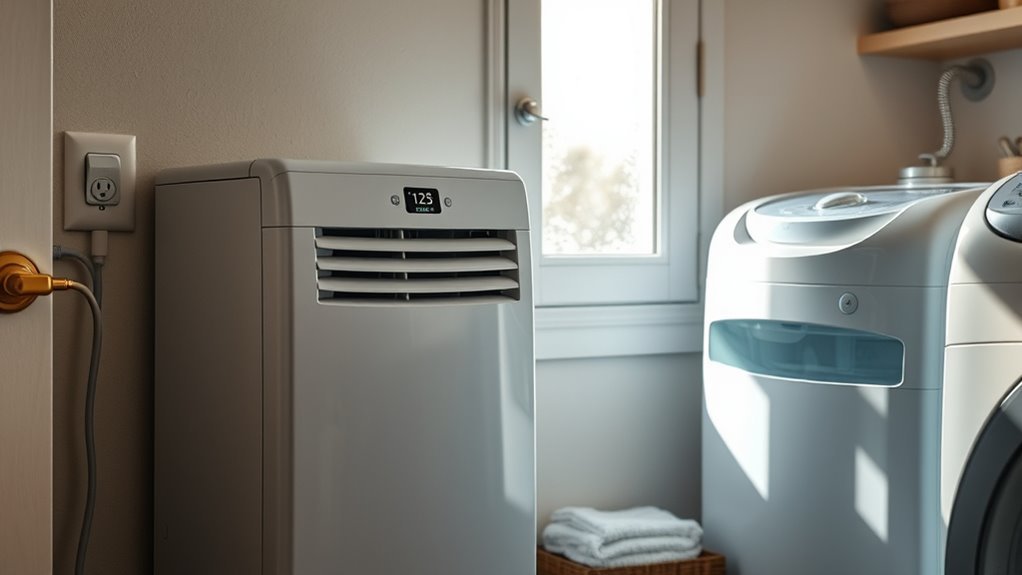
A standard portable compressor dehumidifier draws between 240 and 700 watts while its fan and refrigeration compressor are actively running. Mini thermoelectric (Peltier) units for closets draw just 20 to 65 watts, whereas ducted whole-home dehumidifiers typically draw 500 to 1,200 watts. Check the appliance nameplate, manual, or specification sheet for your exact model’s rated input wattage.
To read your appliance label and utility bill accurately, keep the difference between watts and kilowatt-hours in mind:
- Watts (W) or kilowatts (kW) measure the instantaneous electrical power the dehumidifier draws at a given moment (1,000 watts = 1 kilowatt).
- Kilowatt-hours (kWh) measure the total electrical energy consumed over time and are the unit your electric company bills you for.
- Operating modes change power draw: Full rated wattage applies only when the compressor and fan run together. In fan-only mode, most portable units use 40 to 100 watts, and in standby (waiting for humidity to rise or with a full bucket), they draw about 1 to 5 watts.
| Dehumidifier Type & DOE Capacity | Typical Active Wattage | Energy Used per Active Hour | Typical Space |
|---|---|---|---|
| Mini thermoelectric (under 2 pints/day) | 20–65 W | 0.02–0.07 kWh | Closets, small bathrooms, RVs |
| Small portable (20–25 pints/day) | 240–350 W | 0.24–0.35 kWh | Bedrooms, damp rooms up to 1,500 sq. ft. |
| Medium portable (30–35 pints/day) | 350–500 W | 0.35–0.50 kWh | Basements, medium-to-large rooms |
| Large portable (45–55 pints/day) | 500–700 W | 0.50–0.70 kWh | Wet basements, large open areas over 2,000 sq. ft. |
| Whole-home ducted (70–170 pints/day) | 500–1,200 W | 0.50–1.20 kWh | Entire house via HVAC ductwork |
These hourly figures apply while the compressor runs continuously. Once the built-in humidistat reaches your target relative humidity, the compressor cycles off and average hourly electricity consumption drops.
ENERGY STAR reports that dehumidifiers certified under its Version 6.0 specification (effective October 1, 2025) are 20% more efficient than non-certified models, saving enough electricity annually to power an ENERGY STAR refrigerator for nearly two months.
What Affects Dehumidifier Power Use?
The wattage on your appliance label tells you how much power the unit draws when active, but your room conditions determine how many hours per day the compressor stays on. Two identical 500-watt dehumidifiers can have vastly different monthly kWh totals depending on the environment.
- Starting humidity level: A wet basement at 75%–90% relative humidity requires far more compressor runtime than a bedroom sitting at 55% relative humidity.
- Room size and ongoing moisture load: Foundation seepage, wet concrete, shower steam, unvented clothes drying, and crawl-space vapor continuously replenish moisture in the air.
- Pint capacity match: An undersized unit runs non-stop without reaching the set point. Choosing a model that meets or slightly exceeds the room’s moisture load lets the compressor cycle off sooner.
- Room temperature: Standard refrigerant coils lose efficiency when air temperatures drop below 65°F (18°C). Frost can form on the coils, forcing the unit into repeated defrost cycles that consume power without removing water.
- Humidistat target setting: Setting the humidistat to 35% instead of 50% can double or triple daily compressor hours.
- Open doors and windows: Unsealed windows, exterior doors, or open basement stairwells let humid outdoor air pour in continuously.
- Airflow and maintenance: A dust-clogged air filter, blocked intake grille, or dirty evaporator coil restricts airflow and forces longer runtimes per pint of water removed.
- Drainage method: A full water bucket triggers an automatic float switch that stops the unit. Attaching a continuous drain hose or condensate pump prevents shutoffs, which increases convenience but allows 24/7 power draw if the moisture source is never fixed.
Note: Dehumidifier pint ratings changed in 2020 when the U.S. Department of Energy lowered its test room temperature from 80°F to 65°F to reflect real basement conditions. According to ENERGY STAR’s capacity testing guide, an older 30-pint unit equals a current 20-pint model, an older 50-pint unit equals a current 30-pint model, and an older 70-pint unit equals a current 45- to 50-pint model.
How Do You Calculate Dehumidifier kWh?
You can calculate your dehumidifier’s daily and monthly electricity consumption in under five minutes by converting its rated wattage into kilowatts and multiplying by active runtime. Use this standard energy formula:
Daily kWh = (Watts ÷ 1,000) × Active Operating Hours per Day
- Locate the input wattage (W) on the silver or white UL/ETL nameplate sticker on the back of the dehumidifier. (If only amps and volts are listed, multiply Amps × Volts to get rough wattage.)
- Divide the wattage by 1,000 to convert watts into kilowatts (kW).
- Multiply the kilowatts by the number of hours the compressor actively runs each day.
- Multiply your daily kWh by 30 to find monthly energy consumption.
- Multiply total monthly kWh by the per-kWh price on your electric bill.
For example, if a 300-watt dehumidifier actively runs for 6 hours per day:
(300 W ÷ 1,000) × 6 hours = 1.8 kWh per day
Over a 30-day month, that equals 54 kWh. At the July 2026 U.S. average residential rate of $0.1831 per kWh, running that unit costs about $0.33 per day or $9.89 per month.
| Wattage & Daily Runtime | Daily Energy Use | 30-Day Energy Use | Daily Cost ($0.1831/kWh) | 30-Day Cost ($0.1831/kWh) |
|---|---|---|---|---|
| 300 W for 6 hours | 1.8 kWh | 54 kWh | $0.33 | $9.89 |
| 500 W for 8 hours | 4.0 kWh | 120 kWh | $0.73 | $21.97 |
| 700 W for 5 hours | 3.5 kWh | 105 kWh | $0.64 | $19.23 |
| 700 W for 12 hours | 8.4 kWh | 252 kWh | $1.54 | $46.14 |
The cost column uses the U.S. residential average of 18.31 cents per kWh for July 2026 reported by the U.S. Energy Information Administration (released September 24, 2026). Because average residential rates range from roughly 9.09 cents per kWh in North Dakota to over 41 cents per kWh in Hawaii, always check your own utility bill for your exact supply and delivery rate.
How Much Does It Cost to Run a Dehumidifier?
Running a portable dehumidifier typically costs between $10 and $46 per month under normal cycling conditions (5 to 12 active hours per day), or $39.55 to $92.28 per month if the compressor runs nonstop 24/7. Your actual cost depends on your unit’s wattage, daily compressor duty cycle, and whether your utility uses flat or time-of-use pricing.
Use this cost formula with the all-in per-kWh rate from your electric bill:
Operating Cost = Total kWh × Electricity Rate per kWh
Cost to Run a Dehumidifier 24 Hours a Day
The table below shows the maximum cost if a dehumidifier’s compressor runs continuously at full wattage for 24 hours a day. In a sealed room with a working humidistat, once the target humidity is reached, the compressor typically cycles on for 50% to 70% of the day, making real-world costs 30% to 50% lower than these 24/7 maximums.
| Active Power Draw | 24-Hour Energy Use | 30-Day Energy Use | 24/7 Daily Cost ($0.1831/kWh) | 24/7 Monthly Cost ($0.1831/kWh) |
|---|---|---|---|---|
| 300 watts (small, ~20-pint) | 7.2 kWh | 216 kWh | $1.32 | $39.55 |
| 500 watts (medium, ~30–35-pint) | 12.0 kWh | 360 kWh | $2.20 | $65.92 |
| 700 watts (large, ~50-pint) | 16.8 kWh | 504 kWh | $3.08 | $92.28 |
If your unit truly runs at full power 24 hours a day, it usually points to active water intrusion, an undersized appliance, open crawl-space vents or windows, or room temperatures below 65°F. Address bulk water leaks and foundation drainage first rather than relying on a dehumidifier to keep up with standing water.
How to Measure Actual Dehumidifier Energy Use
A plug-in electricity monitor (such as a Kill A Watt meter or smart energy-monitoring plug rated for 15 amps) gives you exact kWh numbers instead of rough runtime estimates. It automatically tracks high-wattage compressor cycles, low-wattage fan cycles, and standby periods.
- Verify that your plug-in electricity monitor is rated for at least 120V and 15A (1,800W), exceeding your dehumidifier’s maximum amp and watt draw.
- Plug the monitor directly into a properly grounded three-prong wall outlet.
- Plug the dehumidifier’s power cord into the monitor.
- Reset the monitor’s cumulative kWh counter and timer to zero.
- Run the dehumidifier at your normal humidity setting for 48 to 72 hours so the reading captures both daytime and overnight humidity swings.
- Divide the cumulative kWh reading by the total elapsed hours, then multiply by 24 to get your true average daily kWh.
- Multiply your average daily kWh by 30 and by your utility’s per-kWh rate to find your exact monthly operating cost.
Pro Tip: Note the starting indoor relative humidity, target set point, room temperature, and outdoor weather during your 72-hour test. A dehumidifier often uses twice as much electricity during the first 24 hours of drying out damp basement air and concrete as it does once the room stabilizes at 50% humidity.
Always inspect the outlet and cord temperature after the first hour of testing to ensure a tight, safe connection.
Warning: Follow all appliance manual and electrical ratings. Plug the dehumidifier directly into a grounded wall receptacle, keep cords and meters elevated away from puddles or drain hoses, and never use a light-duty extension cord or an underrated smart plug, which can overheat under continuous compressor loads.
Recommended Products
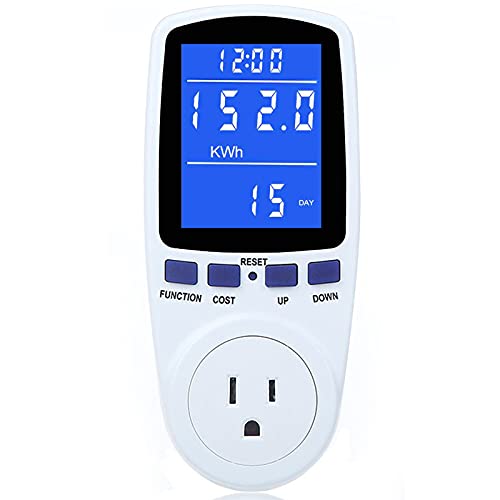
Various Monitoring Parameters: The power meter plug can monitor the power (W), energy (kWh), volts, amps, hertz, power factor, cost, minimum and maximum power (W), cumulative days and time of your appliances. By switching 7 display modes, you can easily know the various parameters while the appliance is working. The home energy monitor can also calculate and display how much power your appliance uses and how much electricity bill it cost in cumulative time

Multi-function power monitor: Our electric usage monitor can monitor the power (W), electricity(kWh), voltage(V), frequency(Hz), current(A), power factor(PF), unit price($/kWh), total cost($) of your appliances. By switching 8 display modes, you can easily know the various parameters while the appliance is working. The “electricity” mode can calculate and display how much power your appliance uses. And the “total cost” mode will show how much electricity bill it cost in cumulative time

✓ Backlit LCD Display: The watt meter features an upgraded backlit LCD display with a 160° wide viewing angle, providing clear and distinct data readings from any angle, day or night. (Note: To conserve energy, the backlight will automatically turn off after 15 seconds of continuous use.)
Which Dehumidifier Uses the Least Energy?
An ENERGY STAR-certified dehumidifier matched to your room’s temperature and moisture load uses the least electricity per pint of water removed. Rather than looking at wattage alone, compare models using the official Integrated Energy Factor (IEF), which measures how many liters of water a unit removes for each kilowatt-hour of electricity it consumes (L/kWh).
A higher IEF means lower electricity bills for the same amount of drying. Under the ENERGY STAR Version 6.0 efficiency criteria (effective October 1, 2025), certified dehumidifiers must meet strict minimum IEF thresholds tested at 65°F:
- Portable units up to 25 pints/day: IEF of at least 1.70 L/kWh (compared to the federal baseline minimum of 1.30 L/kWh).
- Portable units from 25.01 to 50 pints/day: IEF of at least 2.01 L/kWh.
- Large portable units over 50 pints/day: IEF of at least 3.30 L/kWh.
- Whole-home dehumidifiers: IEF of at least 2.22 L/kWh for compact cases (up to 8.0 cu. ft.) and 3.81 L/kWh for larger cases (over 8.0 cu. ft.).
Because a higher-capacity unit often has a higher IEF, a 35- or 50-pint model that extracts moisture quickly and shuts off can use less total daily electricity than a 20-pint unit that runs nonstop.
Recommended Products
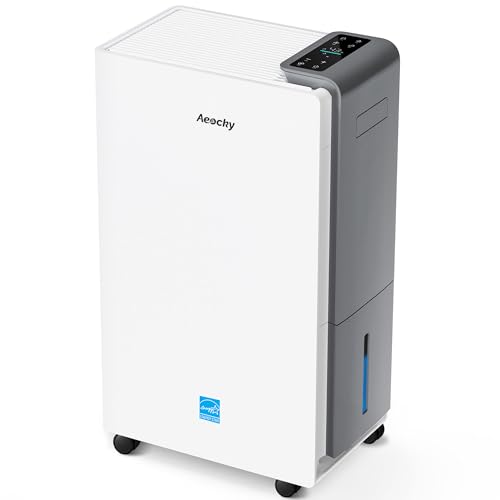
【ENERGY STAR 25 ≠ ENERGY STAR Most Efficient 2025】Don't fall for competitors' word games. With only 2.6% of ENERGY STAR models earning "Most Efficient 2025" title, these options are exceptionally rare on the market. RHEA-001 is one of the few to truly hold this top-tier certification. Many brands use misleading phrases like "Energy Star Efficient 25" or "Energy Star 25" to imply a standard they haven't met. Choosing them is a risk.With AEOCKY, you get verified performance and the peace of mind of authentic, top-tier efficiency.

2500 Sq. Ft High-Efficiency Dehumidifier – The KNKA basement dehumidifier features a quiet, high-performance compressor that removes up to 34 pints of moisture per day (at 95°F, 90% RH). Ideal for basements, offices, bathrooms, bedrooms, kitchens, stockrooms, living rooms, laundry rooms, garages, crawlspaces, or RVs. It helps maintain optimal humidity between 50%–70% for healthier, more comfortable living

Semiconductor dehumidifiers use thermoelectric cooling to remove moisture from the air. They create a drier, more comfortable environment by reducing humidity and improving air quality.
Desiccant Versus Refrigerant Dehumidifiers
Standard refrigerant (compressor) dehumidifiers pull air over cold evaporator coils to condense moisture, making them the most energy-efficient choice in rooms above 65°F (18°C). Desiccant dehumidifiers pass air through a moisture-absorbing rotor wheel (typically silica gel) and use an internal electric heater to regenerate that material, drawing roughly 300 to 700 watts.
In warm basements or living areas, compressor models remove significantly more water per kWh than desiccant units. However, in unheated garages, crawl spaces, or winter storage rooms below 60°F—where compressor coils freeze up and waste power defrosting—a desiccant dehumidifier maintains steady water removal without frost delays. You can review how both systems handle moisture in Carrier’s dehumidifier technology guide.
How Can You Lower Dehumidifier Electricity Costs?
You can cut your dehumidifier’s electricity bill by 20% to 50% by avoiding overly aggressive humidity settings and stopping outdoor or plumbing moisture from entering the room. Focus on reducing compressor runtime first:
- Set the humidistat near 50% relative humidity. The U.S. Environmental Protection Agency recommends keeping indoor relative humidity between 30% and 50% (and always below 60%) to prevent mold. Setting a dehumidifier to 35% or 40% forces the compressor to run hours longer each day with little added benefit.
- Keep windows and exterior doors closed. Running a dehumidifier with a basement window cracked open pulls an endless supply of humid outdoor air into the room.
- Stop bulk moisture at the source. Extend gutter downspouts away from the foundation, seal crawl-space dirt floors with a vapor barrier, fix weeping pipes, and vent clothes dryers outdoors.
- Run bathroom and kitchen exhaust fans. Vent shower steam and cooking moisture directly outside so your dehumidifier does not have to condense it later.
- Clean the intake air filter every 2 to 4 weeks. Rinse reusable mesh filters in warm water and vacuum dust from the grilles so air flows freely across the cold coils.
- Leave 6 to 12 inches of clearance around the cabinet. Unless your unit is designed for flush wall placement, restricted airflow causes the sensor to misread room humidity and reduces water extraction per watt.
- Use auto-humidistat mode instead of “Continuous.” Continuous mode overrides the humidity target and keeps the appliance running even after the air is dry.
- Run heavy drying cycles during off-peak utility hours. If your electric utility uses time-of-use (TOU) rates, schedule the dehumidifier to do its heaviest work overnight or outside peak afternoon pricing windows.
Why Does a Dehumidifier Run Constantly?
A dehumidifier that never cycles off is usually fighting an ongoing moisture source, an unrealistic set point, or low room temperatures rather than a broken compressor. Check these common culprits before replacing the unit:
- Target set below 45% RH: Many portable units struggle to pull a damp basement below 40%–45% relative humidity and will run indefinitely trying to reach 35%.
- Undersized capacity: A 20-pint unit placed in a wet, 2,000-square-foot basement cannot remove moisture faster than the slab and walls release it.
- Air leaks and open spaces: Unsealed rim joists, open crawl-space vents, or open doors to the rest of the house continually feed humid air to the unit.
- Room temperature below 65°F: Ice buildup on the evaporator coils insulates the metal, preventing moisture condensation while the fan and compressor keep running.
- Clogged filter or frosted coils: Restricted airflow keeps humid room air from reaching the cold coil surface.
- Drifted built-in humidity sensor: Onboard sensors sit inches from the warm compressor and can read 5% to 10% off.
Place an independent digital hygrometer a few feet away from the dehumidifier to verify the room’s true relative humidity. If the room is already at 48% RH while the dehumidifier reads 60% RH and keeps running, simply raise the set point on the machine until the compressor cycles off at your desired room reading.
How Does a Dehumidifier Compare to AC?
A portable dehumidifier uses far less electricity per hour than a central air conditioner (typically 300–700 watts versus 3,000–4,500 watts for central AC), but they serve different purposes. An air conditioner cools the air and removes moisture as a byproduct, while a standalone dehumidifier removes moisture in a closed loop and slightly warms the room.
Recommended Products

🍃Advanced Small Dehumidifier for Home: Designed for lasting home use, our bathroom dehumidifier works gently and steadily to maintain a balanced humidity level. The large 44 OZ (1.3L) water tank minimizes emptying frequency. Suitable for dorm room, camper, apartment, room, office and living room. No more dampness-just fresh, comfortable air everywhere

High Efficient Dehumidifiers for Home: This compact 44oz dehumidifier efficiently removes excess moisture in rooms with 86°F and 80% RH, collecting up to 11.8oz (349ml) of water in 24 hours. It maintains an ideal humidity level of 45%-55% while operating at ultra-low energy consumption (24W/hour, 576W/day). Perfect for bedrooms, bathrooms, and small spaces.

【Efficient Dehumidification】With 360° dual cooling semiconductor technology, the dehumidification area reaches up to 650sq ft. The Levoair safe dehumidifier with 2000ml(68oz)water tank could absorb up to 35oz (1000ml) of moisture per day in a humid environment (Temperature: 86°F, Humidity: 80%RH) and keep moisture below 45%. Say goodbye to humidity!
Energy Use Comparison
| Appliance | Typical Wattage | Effect on Room Air | Best Scenario |
|---|---|---|---|
| Portable dehumidifier | 240–700 W | Dries air; raises room temperature by 1–3°F | Cool or mild damp spaces (basements, spring/fall rainy days) |
| Window or portable AC | 500–1,500 W | Cools and dehumidifies one room, venting heat outdoors | Single rooms that are both hot and humid |
| Whole-home dehumidifier | 500–1,200 W | Dries ducted house air independently of cooling | Humid climates when outdoor temps don’t require heavy AC runtime |
| Central air conditioner | 3,000–4,500 W | Cools and removes moisture across the entire home | Hot summer weather across the whole house |
Cooling Versus Drying
Run your air conditioner when the house is both hot and humid. Run a dehumidifier when the temperature is comfortable—such as in a naturally cool 68°F basement or during mild, rainy spring and autumn weeks—when turning on the AC just to dry the air would leave the room clammy and overcooled.
Keep in mind that a portable dehumidifier vents its condenser heat and latent heat of condensation right back into the room. If you run a portable dehumidifier inside an air-conditioned living room during a summer heatwave, your AC has to work slightly harder to remove the heat the dehumidifier adds.
Cost Savings Potential
A dehumidifier saves money when it keeps you from cranking the central AC thermostat down to 68°F just to stop sticky indoor air. Lowering indoor humidity to 50% makes 75°F or 76°F feel noticeably cooler on the skin. Whether combining the two lowers your total monthly utility bill depends on:
- Location of the dehumidifier: Running it in an unconditioned or semi-conditioned basement prevents moisture from migrating upstairs without adding heat to your main living zones.
- Shoulder-season weather: On humid 70°F days, a 400-watt dehumidifier dries the air for a fraction of the power of a 3,500-watt central AC compressor.
- HVAC sizing: Homes with oversized single-stage AC systems often cool the house too quickly to dehumidify properly; a dedicated dehumidifier solves that humidity gap efficiently.
Key Takeaways
- Simple kWh formula: Divide your unit’s input wattage by 1,000 and multiply by active compressor hours to get daily kWh.
- Cycling lowers real cost: Rated wattage reflects active compressor draw (240–700 W); fan-only mode uses 40–100 W and standby uses 1–5 W.
- 2026 U.S. cost benchmark: At the July 2026 EIA residential average of $0.1831/kWh, a 500-watt dehumidifier running 8 hours daily costs $21.97 per 30-day month ($65.92 if run 24/7).
- Look for high IEF & ENERGY STAR: ENERGY STAR Version 6.0 dehumidifiers are 20% more efficient than conventional models, requiring an IEF of 1.70 to 3.30+ L/kWh depending on pint capacity.
- Best money-saving set point: Keep your humidistat near 50% RH, seal windows and doors, and clean the intake filter monthly to avoid wasted compressor hours.
Frequently Asked Questions
How many kWh does a dehumidifier use per hour?
A portable dehumidifier uses 0.24 to 0.70 kWh per full active hour. Divide your model’s wattage by 1,000: a 300-watt dehumidifier uses 0.3 kWh per hour, a 500-watt unit uses 0.5 kWh, and a 700-watt unit uses 0.7 kWh. Average hourly use drops once the humidistat cycles the compressor off.
How much does it cost to run a dehumidifier 24/7 for a month?
At the July 2026 U.S. average rate of $0.1831 per kWh, continuous 24/7 full-power operation for 30 days costs about $39.55 for a 300-watt unit (216 kWh), $65.92 for a 500-watt unit (360 kWh), or $92.28 for a 700-watt unit (504 kWh). If the compressor cycles off for half the day, your cost is roughly half those amounts.
Do dehumidifiers raise the electric bill?
Yes, a typical portable dehumidifier adds $10 to $46 per month to your electric bill during humid months depending on wattage, runtime, and local utility rates. You can minimize the increase by setting the humidistat to 50%, closing windows, fixing water leaks, and cleaning the air filter regularly.
What humidity setting saves electricity?
Setting your dehumidifier to 50% relative humidity offers the best balance of mold prevention and low electricity use. The U.S. EPA recommends maintaining indoor humidity between 30% and 50% (and below 60%). Setting the target to 35% or 40% forces the compressor to run much longer without extra health benefits.
Do dehumidifiers use electricity when the bucket is full or in standby?
When the water bucket is full or the room has reached its target humidity, the compressor shuts off and the dehumidifier enters standby, drawing only 1 to 5 watts (less than $0.70 per month). However, if the fan is set to run continuously between compressor cycles, the fan alone draws 40 to 100 watts.
Does a dehumidifier use more electricity than a fan or air conditioner?
A portable dehumidifier (240–700 watts) uses roughly 5 to 10 times more electricity than a ceiling or box fan (30–75 watts), because it runs a refrigeration compressor. However, it uses far less electricity than a central air conditioner (3,000–4,500 watts) or a large window AC unit (900–1,500 watts).
Should you use a dehumidifier if you have COPD?
A dehumidifier can help reduce flare-up triggers when indoor humidity exceeds 50% and promotes mold or dust mites, though it is not a medical treatment for COPD. Both high humidity and overly dry air can irritate airways. Monitor room humidity, clean the water bucket regularly, and consult your physician, as the American Lung Association advises creating a personalized trigger plan with your care team.
Conclusion
To find out exactly how much electricity your dehumidifier uses, divide its rated wattage by 1,000, multiply by its active daily runtime hours, and multiply that kWh figure by the electricity rate on your utility bill. Because built-in humidistats cycle the compressor on and off, testing your appliance for 48 to 72 hours with a plug-in watt meter will give you the truest monthly cost.
Check your dehumidifier’s nameplate wattage and current humidistat setting today—setting your target near 50% relative humidity, rinsing the intake filter, and closing basement windows are the fastest ways to trim your next electric bill while keeping indoor moisture under control.
Sources
- ENERGY STAR: Dehumidifiers: Version 6.0 efficiency savings (20% more efficient), room sizing, operating temperatures below 65°F, and drainage guidance.
- ENERGY STAR: Dehumidifier Testing and Capacity: U.S. DOE 65°F test conditions and old-versus-new pint capacity equivalents.
- ENERGY STAR: Dehumidifiers Key Efficiency Criteria: Version 6.0 Integrated Energy Factor (IEF) minimums (1.70 to 3.81 L/kWh) effective October 1, 2025.
- U.S. Energy Information Administration: Electric Power Monthly: July 2026 U.S. residential electricity price benchmark (18.31 cents per kWh).
- U.S. Environmental Protection Agency: Care for Your Air: Recommended 30%–50% indoor relative humidity range.
- American Lung Association: Prevent a COPD Flare-Up: High humidity and weather changes as COPD symptom triggers.
- Carrier: How Dehumidifiers Work: Refrigerant versus desiccant dehumidifier operation and heat release.



[…] deeper explanations of the two measurements, see how many kWh a dehumidifier uses and how many watts a dehumidifier […]