A good classroom dehumidifier should control excess moisture without creating unnecessary noise, drainage problems, or extra maintenance for teachers and facilities staff. Start with the room’s measured relative humidity and the source of the moisture, then compare extraction capacity, test conditions, humidistat controls, noise, automatic shutoff, continuous drainage, filter access, cord placement, and school approval requirements. For a normal classroom with recurring humidity, a compressor dehumidifier is generally the more practical choice than a small desktop-style unit.
Quick Verdict
- Best balanced pick for mild-to-moderate recurring humidity: Waykar 34 Pints Energy Star Dehumidifier for its adjustable humidistat, automatic controls, portability, and tank-or-hose drainage.
- Best for a larger room or heavier moisture load: AEOCKY 4500 Sq.Ft Energy Star Dehumidifier for its stronger seller-stated extraction, child lock, humidity controls, and continuous-drain support.
- Best classroom control package: PLUSCENT 32 Pint Dehumidifier for its child lock, timer, washable filter, humidistat, automatic functions, and included gravity hose.
Selection note: These products were compared for classroom relevance, capacity context, controls, drainage, maintenance, noise information, and honest limitations. Seller coverage claims and headline pint ratings are not always directly comparable. Temperature, starting humidity, ceiling height, outdoor-air load, open doors, HVAC operation, and the test method can materially change real-world moisture removal.
Quick Comparison of Classroom Dehumidifiers
| Product | Best For | Capacity Context | Classroom-Friendly Controls | Drainage | Amazon |
|---|---|---|---|---|---|
| Waykar 34 Pints Energy Star Dehumidifier Best Balanced Pick |
Smaller classrooms, offices, and mild-to-moderate recurring humidity | Amazon advertises up to 34 pints/day at 95°F and 90% RH. ENERGY STAR lists a closely identified PD160B-A record at 9.81 pints/day, so verify the exact certification identifier. | 30%–80% humidity control, automatic defrost, automatic functions, washable filter | 0.66-gallon tank or included gravity hose | Check Product Details |
| AEOCKY 4500 Sq.Ft Energy Star Dehumidifier Best for Heavy Humidity |
Larger classrooms, multi-use rooms, or more persistent moisture loads | Amazon advertises up to 80 pints/day. RHEA variants have different standardized ENERGY STAR capacities, so verify the exact model number before comparing certified ratings. | Adjustable humidity control, child lock, timer, fan control, automatic modes | 1.45-gallon tank, drain hose, and garden-hose adapter | Check Product Details |
| PLUSCENT 32 Pint Dehumidifier Best Classroom Controls |
Moderate humidity where child lock and straightforward drainage are priorities | Seller states up to 32 pints/day at 95°F and 90% RH; do not treat that figure as directly equivalent to a standardized capacity rating. | Child lock, timer, humidistat, washable filter, auto defrost, auto restart | 2 L tank or included 39.4-inch gravity hose | Check Product Details |
Important: Do not rank dehumidifiers only by the largest square-foot number or headline pint claim. A maximum measured in unusually hot and humid conditions can be much higher than a standardized capacity measured under cooler conditions.
Waykar 34 Pints Energy Star Dehumidifier Best Balanced Pick
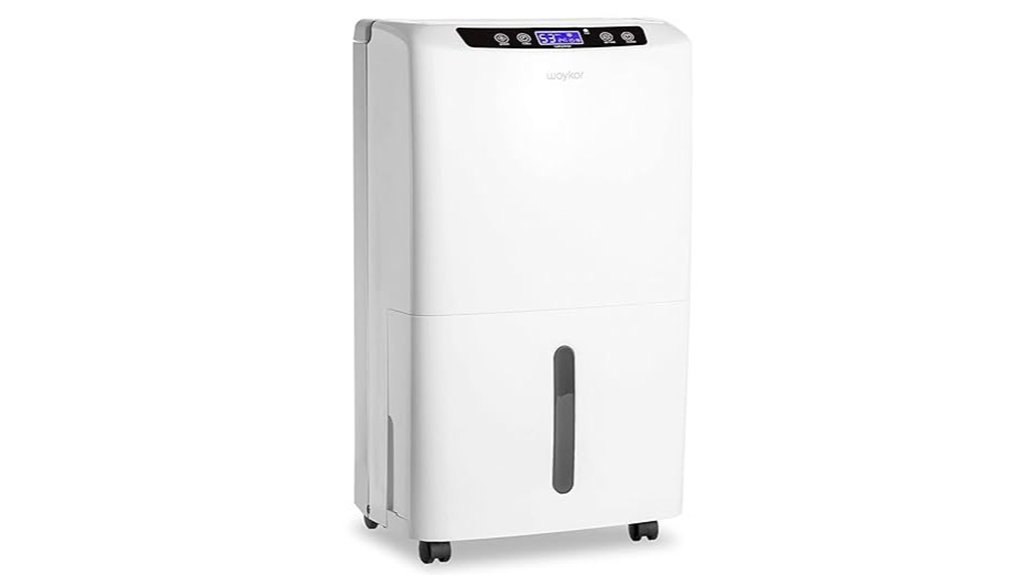
The Waykar PD160B is a practical option when a smaller classroom, office, library zone, or staff space has mild-to-moderate recurring humidity. Amazon advertises up to 34 pints per day at 95°F and 90% relative humidity, but that number should not be treated as a standardized capacity. ENERGY STAR currently lists a closely identified PD160B-A record at 9.81 pints per day under its certified test method, so confirm the exact model and certification identifier before ordering. The Amazon listing also identifies a 30%–80% humidity-control range, automatic defrost, a washable filter, a 0.66-gallon tank, and an included drain hose.
Why You’ll Like It: It combines automatic humidity control, a movable design, and two drainage methods without the footprint of a much larger high-capacity unit.
Who Should Buy This: Schools dealing with moderate seasonal humidity in a smaller classroom, office, staff room, library zone, or similar space where a compact compressor unit can keep pace with the moisture load.
Who Should Avoid This: Large rooms with severe humidity, active water intrusion, or spaces where a low standardized extraction capacity would require the machine to run continuously without reaching the target.
Pros:
- Adjustable 30%–80% humidity control with automatic operation.
- Automatic defrost, washable filter, portable design, and included drain hose.
- Tank collection or gravity drainage gives facilities staff two maintenance options.
Cons:
- The 34-pint headline is measured under very hot and humid conditions and should not be compared directly with standardized capacities.
- The 0.66-gallon tank can require frequent emptying when humidity is high and continuous drainage is not used.
- The Amazon model identifier and ENERGY STAR certification identifier should be checked carefully before relying on a certified rating.
AEOCKY 4500 Sq.Ft Energy Star Dehumidifier Best for Heavy Humidity
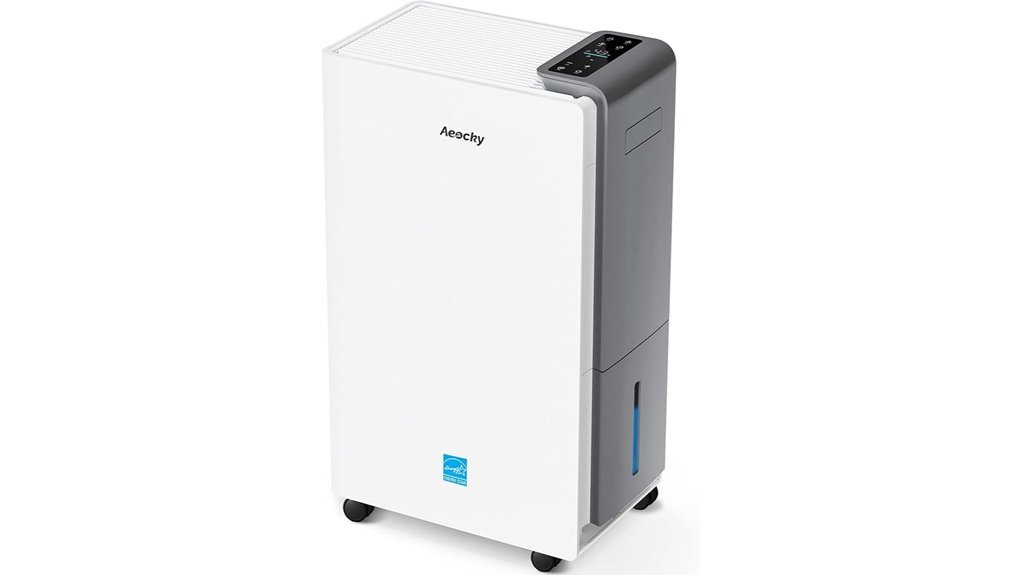
The AEOCKY RHEA-series option is the strongest fit in this group when a classroom, multi-use room, or similar school space has a higher moisture load. The Amazon listing for this ASIN advertises up to 80 pints per day and lists adjustable humidity control, child lock, timer, fan-speed control, a 1.45-gallon tank, drain hose, and garden-hose adapter. Treat the 80-pint and square-foot figures as seller listing information rather than directly comparable standardized capacity figures. ENERGY STAR records contain multiple RHEA variants with different capacities, so match the exact model number on the product to the certification record before relying on a specific standardized rating.
Why You’ll Like It: Its higher reserve capacity and larger tank make it a stronger candidate when a smaller unit struggles to reduce humidity, while the child lock can help prevent accidental setting changes in an accessible classroom location.
Who Should Buy This: Schools dealing with a larger room, frequent door opening, recurring condensation, high seasonal humidity, or a moisture load that exceeds what a smaller compressor model can comfortably manage.
Who Should Avoid This: Small rooms with only mild seasonal humidity, areas with limited floor space, or classrooms without an approved location for the power cord and drainage route.
Pros:
- Higher seller-stated extraction than the other remaining picks.
- Adjustable humidity control, child lock, timer, and automatic operating modes.
- Large tank plus drain hose and garden-hose adapter for flexible drainage.
Cons:
- The headline capacity should not be compared directly with standardized ratings from different test conditions.
- RHEA variants have different ENERGY STAR records, making exact model-number verification important.
- The larger design requires more floor space and more careful cord and hose placement.
PLUSCENT 32 Pint Dehumidifier Best Classroom Controls
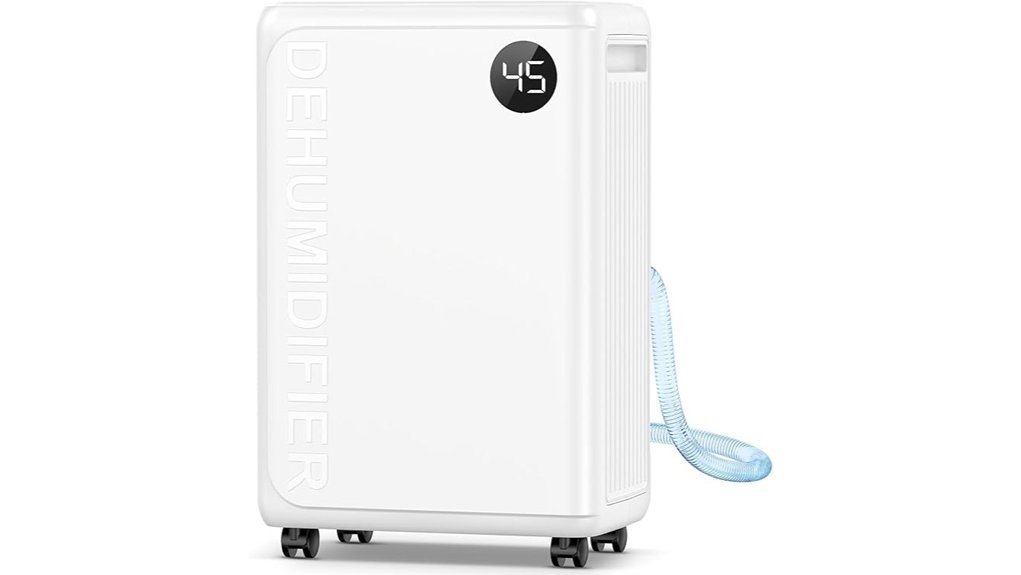
The PLUSCENT PD10 is a useful option when classroom controls and maintenance features matter as much as headline extraction. The current seller listing states up to 32 pints per day at 95°F and 90% relative humidity. It also lists a 2-liter tank, included 39.4-inch gravity drain hose, child lock, automatic shutoff, automatic defrost, auto restart, washable filter, adjustable humidity control, timer, and seller-stated operating noise of about 39–42 dB. Because the 32-pint figure uses hot, humid conditions, it should not be compared directly with a standardized rating measured under different conditions.
Why You’ll Like It: The child lock, washable filter, timer, automatic functions, and included hose address several practical concerns that matter when equipment is operating around students.
Who Should Buy This: Schools that want a compressor-style unit for moderate recurring humidity and prioritize a child lock, timer, automatic functions, and straightforward gravity drainage.
Who Should Avoid This: Buyers who require a clearly matched ENERGY STAR certification record or rooms where the actual moisture load calls for substantially more standardized extraction capacity.
Pros:
- Child lock helps reduce accidental changes to classroom settings.
- 2-liter tank plus included 39.4-inch gravity hose provides two drainage options.
- Washable filter, automatic defrost, auto restart, timer, and humidity controls simplify routine use.
- Seller states approximately 39–42 dB operation.
Cons:
- The 32-pint figure is based on 95°F and 90% RH conditions and is not directly comparable with standardized capacities.
- The 2-liter tank can fill quickly in a damp room when continuous drainage is not used.
- No ENERGY STAR certification should be assumed for this exact model unless the model number is independently matched in the official database.
Factors to Consider When Choosing a Dehumidifier for a Classroom
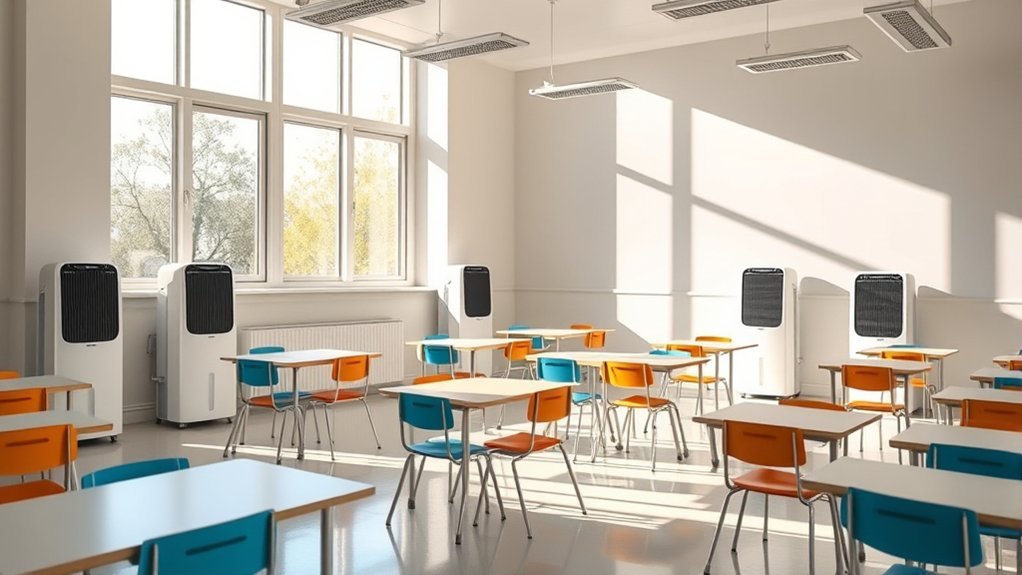
Choose a classroom dehumidifier by starting with the actual moisture problem rather than the biggest advertised square-foot number. Measure relative humidity with a hygrometer, note how long the room stays humid, and identify possible water sources. Also consider room dimensions, ceiling height, outdoor-air exposure, HVAC runtime, door opening, occupancy, noise, drainage, stable placement, electrical access, and who will maintain the unit.
Classroom Size and Moisture Load
Square footage matters, but it is only one part of sizing. A warm classroom with high outdoor humidity, frequent door opening, water intrusion, or limited HVAC dehumidification can place much more demand on a unit than a similarly sized room with mild seasonal dampness. Measure the actual room, note ceiling height and airflow between adjoining spaces, and use the moisture-removal rating together with the room conditions rather than relying only on a seller coverage claim.
Compare Capacity Under Similar Test Conditions
A dehumidifier advertised at 32, 34, or 80 pints per day may have been measured under unusually hot and humid conditions. Standardized capacities can be substantially lower because testing uses different temperature and humidity conditions. Before comparing products, check whether each figure is a seller maximum or a standardized certified capacity and verify the exact model number.
Recommended Classroom Humidity
The U.S. Environmental Protection Agency recommends keeping school relative humidity below 60%, ideally around 30%–50%. The correct operating target can also depend on season, comfort, building policy, HVAC operation, and condensation risk. Review the EPA’s school moisture-control guidance and follow the school’s facilities procedures.
Noise Level Matters
Noise can be especially noticeable during reading, testing, presentations, or small-group instruction. Lower fan settings may reduce distraction but can also reduce airflow and moisture removal. Seller-stated decibel figures may use different test methods, so use them as a general comparison rather than a guarantee of how loud the unit will sound in a classroom. Hard floors, bare walls, and placement near students can make the same appliance seem louder.
Drainage and Maintenance
A continuous gravity drain can reduce staff workload when the hose has a safe, approved path and slopes continuously toward the drain. A hose should not cross a doorway or walkway. If gravity drainage is not practical, choose a tank that is easy to remove and has automatic full-tank shutoff. Check the tank frequently during the first days of use, clean washable filters according to the manual, and inspect the drain hose for kinks or leaks.
Energy Efficiency
If a compressor unit may operate for many hours, ENERGY STAR certification can provide useful standardized efficiency information. Check the exact model number in the ENERGY STAR Product Finder. Similar product names or RHEA/PD model families can contain variants with different certified capacities or efficiency status.
Safety and Classroom Controls
Place the unit on a stable, level surface with the airflow clearance required by the manufacturer. Keep the power cord and drain hose away from students, chairs, doors, rolling carts, and other traffic. Connect the appliance to an appropriate grounded outlet and follow the manufacturer’s electrical instructions and school policy. A child lock is useful when students can reach the controls, but it does not replace appropriate placement, supervision, or facilities approval.
Before You Buy Checklist
- Measure the classroom and note ceiling height, connected spaces, doors, windows, occupancy, and HVAC schedule.
- Measure relative humidity with a hygrometer before deciding what capacity you need.
- Identify leaks, wet materials, condensation, or HVAC drainage problems first.
- Compare moisture-removal figures only after checking the temperature and humidity test conditions.
- Verify the exact model number before relying on an ENERGY STAR certification or standardized capacity.
- Confirm who will empty the tank, clean the filter, inspect the hose, and monitor humidity.
- Plan an approved drainage route that does not cross a walkway.
- Verify an appropriate grounded outlet and safe cord route.
- Choose a child lock when the control panel will be accessible to students.
- Check the current Amazon listing, dimensions, included hose, warranty terms, certification details, and return information before ordering.
Frequently Asked Questions
What Humidity Level Should a Classroom Maintain?
EPA school moisture guidance recommends keeping relative humidity below 60%, ideally around 30%–50%. Use a hygrometer to monitor the room and follow the school’s facilities or HVAC policy when choosing the final setting.
How Do I Size a Dehumidifier for a Classroom?
Start with the classroom dimensions and measured relative humidity, then consider ceiling height, open doors, outdoor-air load, HVAC runtime, occupancy, and whether there is an active moisture source. Compare standardized extraction capacities whenever possible rather than choosing only by an advertised square-foot number.
Can I Compare 32-, 34-, and 80-Pint Ratings Directly?
Not always. A headline rating measured at very high temperature and humidity can be much larger than a standardized rating measured under cooler conditions. Check the test conditions beside each number before deciding which unit actually has more comparable capacity.
How Quiet Should a Classroom Dehumidifier Be?
Lower noise is preferable in teaching spaces, but do not evaluate a unit by a decibel claim alone. Fan speed, compressor cycling, room acoustics, placement, and the seller’s measurement method all affect perceived noise. Place the unit away from the main teaching position and quiet reading areas whenever possible.
Is a Child Lock Important for a Classroom Dehumidifier?
A child lock can help prevent students from accidentally changing the humidity setting or operating mode. It is especially useful when the control panel is within reach, but safe placement and adult supervision still matter.
Should a Classroom Use Continuous Drainage?
Continuous drainage can reduce maintenance when there is an approved drain nearby and the hose can slope downward without creating a trip hazard. If that is not possible, use the collection tank and check it regularly until staff know how quickly it fills.
What Maintenance Do Classroom Dehumidifiers Require?
Empty and rinse the tank as needed, clean the filter according to the manual, keep the air inlet and outlet clear, inspect the drain hose, and check the cord and plug for damage. Assign responsibility to a staff or facilities role so maintenance does not depend on whoever notices the machine first.
Can a Dehumidifier Help With Classroom Allergens?
Controlling excess humidity can reduce conditions that favor mold growth and dust mites, but a dehumidifier is not a medical treatment and does not remove an established mold problem. Moisture-source repair, ventilation, cleaning, and removal of damaged materials may still be necessary.
Can a Dehumidifier Fix a Leak or Visible Mold?
No. A dehumidifier can lower airborne moisture, but the water source and affected building materials still need inspection and correction. Report leaks, water damage, musty odors, and visible mold through the school’s facilities process.
Are Small Desktop Dehumidifiers Enough for a Full Classroom?
Usually not when a full-size classroom has persistent humidity. Small thermoelectric or desktop-style units can be useful in closets, storage zones, offices, or localized damp areas, but their moisture-removal rates are generally much lower than compressor dehumidifiers. Compare actual daily extraction instead of assuming a large advertised coverage number means high capacity.
Conclusion
For mild-to-moderate recurring humidity in a smaller classroom or school office, the Waykar PD160B provides useful humidistat control, automatic operation, portability, and hose drainage, but its 34-pint marketing figure needs to be read in the context of its hot, humid test condition. The AEOCKY RHEA-series unit is the stronger choice when the moisture load is higher and features such as a child lock, larger tank, and continuous drainage matter, but verify the exact RHEA model against the ENERGY STAR record. The PLUSCENT PD10 is a practical control-focused alternative with a child lock, washable filter, timer, automatic functions, and included gravity hose.